
Salaried employee rights in Oregon are often misunderstood. Many workers assume that being paid a salary automatically means they’re not entitled to overtime, meal protections, or wage claim remedies. That’s not always true. In Oregon, whether a worker is truly exempt depends on more than the pay method. The employee’s actual duties, salary basis, and classification all matter. Oregon employees dealing with unpaid overtime or misclassification have options through Oregon wage claims.
If you’ve been told you’re “salaried” and therefore ineligible for overtime, it’s worth taking a closer look. Oregon and federal law both impose specific rules for executive, administrative, and professional exemptions, and the standard most beneficial to the employee generally applies when state and federal requirements differ.
Also Read
- Do You Need a Whistleblower Lawyer? How an Oregon Attorney Protects You When You Report Illegal Activity
- Unemployment Representation: What a Lawyer Actually Does From Denial to Hearing
- How to Prove a Constructive Discharge Lawsuit in Oregon
- Misclassification Lawsuits: Independent Contractor Wrongful Termination
- Executive Severance: Lawyer Negotiation Strategies
TL;DR
Being paid a salary does not automatically eliminate overtime rights in Oregon. To lawfully classify a worker as exempt, an employer generally must satisfy both a duties test and a salary basis test. Oregon’s BOLI explains that “white collar” exemptions apply only when those legal standards are met, and the U.S. Department of Labor confirms that most employees are otherwise entitled to overtime for hours worked over 40 in a workweek. Misclassification can leave workers shorted on overtime, final pay, and other wage protections.
5 Key Takeaways
- A salary alone does not make an employee exempt from overtime.
- Oregon exemption rules focus heavily on what the employee actually does at work.
- The federal salary threshold currently referenced by BOLI and the U.S. Department of Labor is $684 per week / $35,568 annually, after the 2024 rule was vacated.
- Improper deductions from salary can undermine exempt status.
- If wages are unpaid, Oregon workers may have wage claim and penalty wage remedies.
What does “salaried” actually mean in Oregon?
Many employees use the words “salaried” and “exempt” as if they mean the same thing. Legally, they do not.
Under Oregon’s BOLI guidance, “white collar” exemptions apply only to certain executive, administrative, and professional employees who satisfy the legal requirements. That means the employer must usually prove more than the fact that the worker receives a set paycheck.
A salary is only one part of the test
Being paid on a salary basis generally means the employee receives a predetermined amount each pay period that is not reduced because of the quality or quantity of work performed. The employee usually must receive the full salary for any week in which any work is performed, subject to limited exceptions.
Duties matter more than job titles
BOLI states that salaried exempt employees in the private sector must meet one of the recognized duties tests. Titles like “manager,” “administrator,” or “professional” are not enough by themselves. The real question is what the employee’s primary duty actually is.
In Oregon, a worker is not exempt just because the employer says so. The pay structure and the actual work performed both matter.
 Are salaried employees entitled to overtime in Oregon?
Yes, many are.
The FLSA requires that most employees receive overtime pay at one and one-half times the regular rate for hours worked over 40 in a workweek. Oregon follows similar principles, and Meyer Employment Law’s own overtime guide explains the standard overtime calculation used in Oregon.
When a salaried employee may still get overtime
A salaried employee may still be non-exempt if:
- The duties test is not met: The employee does not truly perform executive, administrative, or professional work as defined by law.
- The salary basis test is not met: The employer makes deductions that are inconsistent with exempt treatment.
- The salary level is too low: BOLI explains that the federal minimum salary level currently in effect is $684 per week or $35,568 annually, following the vacatur of the 2024 rule.
Oregon workers should look at reality, not labels
A worker may be called a supervisor but spend most of the day doing the same production work as everyone else. Another may be paid a salary but have pay docked whenever business is slow. Those facts can matter more than a handbook label. Meyer’s exempt vs. non-exempt guide also emphasizes that qualifying as exempt requires strict criteria under federal and Oregon law.
Salaried workers in Oregon may still be legally owed overtime if the exemption rules are not actually satisfied.
How Oregon misclassification happens
Misclassification often happens when an employer treats a worker as exempt to avoid overtime obligations or other wage-and-hour responsibilities.
Meyer Employment Law identifies misclassification as a common wage issue, including misclassification as exempt or as an independent contractor. The firm’s separate misclassification article explains that workers can lose overtime and other protections when labeled incorrectly.
Common red flags
- You regularly work more than 40 hours but get no overtime
- Your job title sounds managerial, but you don’t supervise two or more full-time employees
- You follow detailed instructions instead of exercising true independent judgment
- Your salary is reduced when business is slow or when you miss partial days
- You were switched to “salary” without a real change in duties
Those warning signs line up with the legal tests BOLI and the U.S. Department of Labor describe for executive, administrative, and professional exemptions.
Why misclassification matters
Misclassification can affect more than overtime. It may also influence final pay, wage claim remedies, and the employee’s leverage in a dispute. Oregon’s BOLI notes that workers can file wage claims, and Oregon’s paycheck guidance explains that unpaid final wages can trigger penalty wages in some situations.
Misclassification is not a harmless paperwork issue. It can directly reduce an employee’s pay and legal protections.
What are the duties tests for exempt salaried employees?
This is where many wage disputes are won or lost.
BOLI explains that private-sector salaried exempt employees generally must meet one of three duties tests: executive, administrative, or professional. Federal guidance mirrors that structure.
Executive exemption
To qualify under the executive exemption, the employee’s primary duty must involve managing the enterprise or a recognized department, and the employee must customarily direct the work of at least two full-time employees or the equivalent.
Administrative exemption
Administrative employees generally must perform office or non-manual work directly related to management or general business operations, and their primary duty must include discretion and independent judgment on matters of significance.
Professional exemption
Professional employees generally perform work requiring advanced knowledge or predominantly intellectual work involving consistent discretion and judgment.
Why this matters for real workers
Employers sometimes apply these labels too broadly. A person who mainly follows scripts, handles routine clerical tasks, or spends most of the day doing frontline operational work may not meet the test, even if they receive a salary. That is why fact-specific review matters in wage disputes.
The exemption analysis is functional, not cosmetic. What you actually do all day is central to your rights.
Can an employer deduct from a salaried employee’s pay?
Sometimes, but not freely.
The U.S. Department of Labor says that a salary-basis employee generally must receive the full salary for any week in which any work is performed. BOLI similarly explains that the agreed amount is generally not subject to reduction based on the quality or quantity of work performed.
Permitted deductions may include
- Full-day absences for personal reasons
- Certain full-day sickness or disability absences under a bona fide policy
- Initial or terminal week of employment
- Certain unpaid FMLA leave
- Some good-faith disciplinary suspensions
Improper deductions can be a big problem
The DOL warns that an employer can lose the exemption if it has an actual practice of making improper deductions from salary. BOLI likewise states that deductions may not be made when the employee is ready, willing, and able to work but work is unavailable.
Docking a salaried employee’s pay the wrong way can help prove the employee was misclassified or not truly paid on a salary basis.
What should Oregon employees do if they were misclassified?
If you suspect you were wrongly denied overtime, start preserving the facts.
Steps to take
- Save pay records: Keep pay stubs, offer letters, handbooks, schedules, and bonus records.
- Track your hours: Reconstruct overtime hours if the employer did not keep accurate records.
- Write down your actual duties: Focus on what you really did, not just your title.
- Document deductions: Note any partial-day deductions or reductions when work was slow.
- Review your final pay: Oregon imposes strict final paycheck rules and possible penalty wages.
- Explore legal options: Oregon workers may file wage claims through BOLI or pursue other remedies depending on the case.
Early documentation can make the difference between a vague complaint and a strong wage claim.
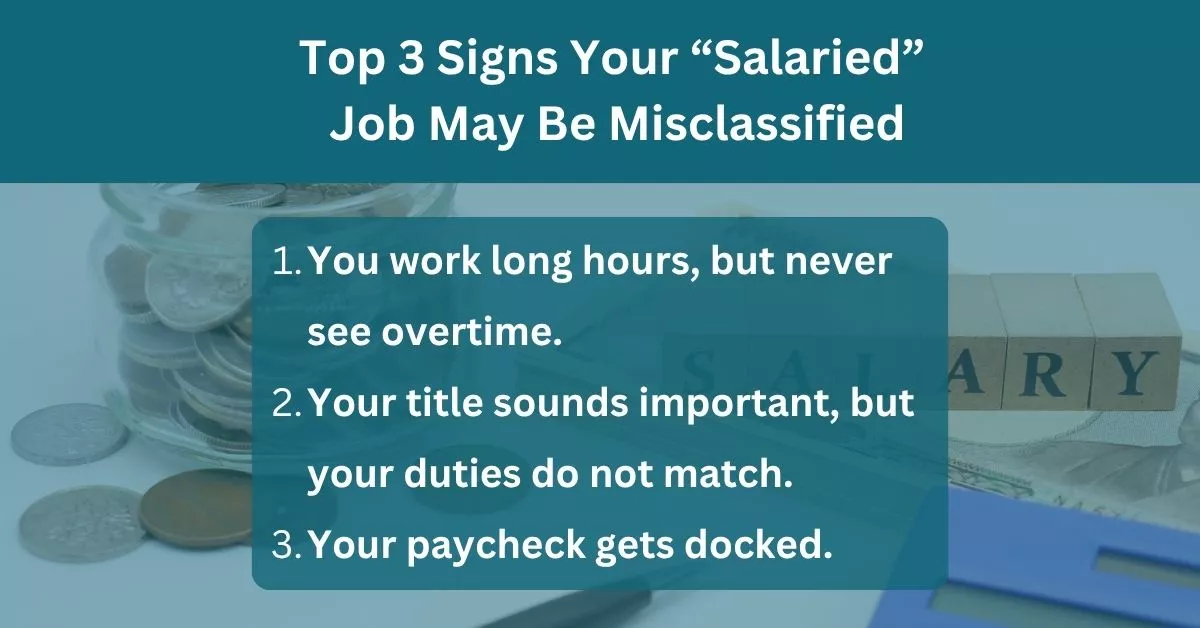 Top 3 signs your “salaried” job may be misclassified
This section is designed to be shareable in email, social, or a Google Business Profile post.
1. You work long hours, but never see overtime
If you routinely work over 40 hours and are told salary status ends the conversation, that is a red flag. Salary alone is not enough.
2. Your title sounds important, but your duties do not match
A “manager” who mostly does the same non-managerial work as everyone else may not fit the executive exemption.
3. Your paycheck gets docked
If your employer reduces your salary because business is slow or because you worked fewer hours in a week, that can undermine exempt treatment.
If any of these signs sound familiar, a closer review of your pay practices and duties may reveal a valid Oregon wage claim.
Conclusion
Understanding salaried employee rights in Oregon starts with one core point: your employer cannot erase overtime rights just by paying you a salary. The legal analysis turns on your real duties, your pay structure, and whether the exemption rules were actually met. When they were not, Oregon law may provide wage claim and penalty remedies.
If your employer denied you overtime, misclassified you as exempt, or failed to pay the wages you earned, now is the time to take action. Meyer Employment Law helps Oregon employees stand up for their rights and pursue the pay they are owed. Visit the home page to learn more, or contact the firm today to discuss your situation.
About the Author
Robert Meyer is the founder of Meyer Employment Law and has represented employees in Oregon state and federal courts for more than a decade, including jury trials involving workplace disputes. His experience includes handling claims involving unpaid wages, discrimination, retaliation, wrongful termination, and other employment law matters, as well as taking employee cases through jury trial when necessary. He focuses his practice on helping workers understand their rights, protect their livelihoods, and pursue meaningful remedies when employers violate the law.


