Knowing how to file a sexual harassment complaint can help Oregon employees protect their rights, preserve evidence, and take action when workplace conduct crosses the line. Sexual harassment can include unwanted sexual comments, advances, touching, requests for sexual favors, sexually explicit messages, gender-based harassment, or retaliation after someone reports misconduct.
Meyer Employment Law represents Oregon employees in workplace harassment, discrimination, and retaliation cases. If you are unsure whether what happened “counts” as unlawful harassment, our Oregon employment harassment team can help you understand your options.
Filing a complaint does not always mean immediately filing a lawsuit. Depending on the facts, it may mean reporting the conduct to HR, submitting a complaint through your employer’s internal process, filing with the Oregon Bureau of Labor and Industries, filing with the Equal Employment Opportunity Commission, or speaking with an Oregon sexual harassment lawyer before deciding what to do next.
Read More:
- Sexual Harassment: Know Your Rights in the Workplace
- Retaliation for Reporting Harassment in Oregon
- What to Do If Your Boss Harasses You: Oregon Employee Guide
- Employer Liability for Coworker Harassment in Oregon
- Sexually Harassed at Work? Know the Signs and What to Do Next
TL;DR
To file a sexual harassment complaint in Oregon, start by documenting what happened, saving evidence, reviewing your employer’s reporting policy, and making a clear written complaint if it is safe to do so.
You may also be able to file a complaint with Oregon BOLI, the EEOC, or in court depending on your claims, deadlines, and goals. Sexual harassment complaints are time-sensitive, so employees should act quickly and consider speaking with an Oregon employment lawyer before signing anything, resigning, or missing a filing deadline.
Key Takeaways
- Sexual harassment can include verbal, physical, visual, written, digital, or gender-based conduct.
- Oregon employees can report sexual harassment internally, to BOLI, to the EEOC, or through legal action.
- Employees should preserve texts, emails, chat messages, photos, schedules, HR reports, performance reviews, and witness information.
- Retaliation for reporting sexual harassment may be illegal.
- You do not have to wait until harassment becomes unbearable before asking for help.
- An Oregon employment lawyer can help you decide whether to report internally, file with an agency, negotiate, or pursue a legal claim.
What Counts as Sexual Harassment at Work?
Sexual harassment is a form of unlawful workplace harassment. It can involve conduct that is sexual in nature, but it can also involve conduct directed at someone because of sex, gender, sexual orientation, gender identity, pregnancy, or related protected characteristics.
Sexual harassment may include:
- Unwanted sexual comments or jokes
- Requests for dates or sexual favors
- Sexual touching or physical contact
- Comments about someone’s body, clothing, or sex life
- Sexual images, memes, videos, or messages
- Repeated unwanted flirting or attention
- Threats connected to rejecting sexual advances
- Favoritism tied to sexual relationships
- Harassment based on gender stereotypes
- Harassment based on sexual orientation or gender identity
- Retaliation after reporting harassment
Oregon BOLI explains that sexual harassment may include unwelcome sexual advances, requests for sexual favors, or verbal, physical, or visual conduct of a sexual nature directed toward someone because of gender. It can also include gender-related conduct that is not sexual in nature.
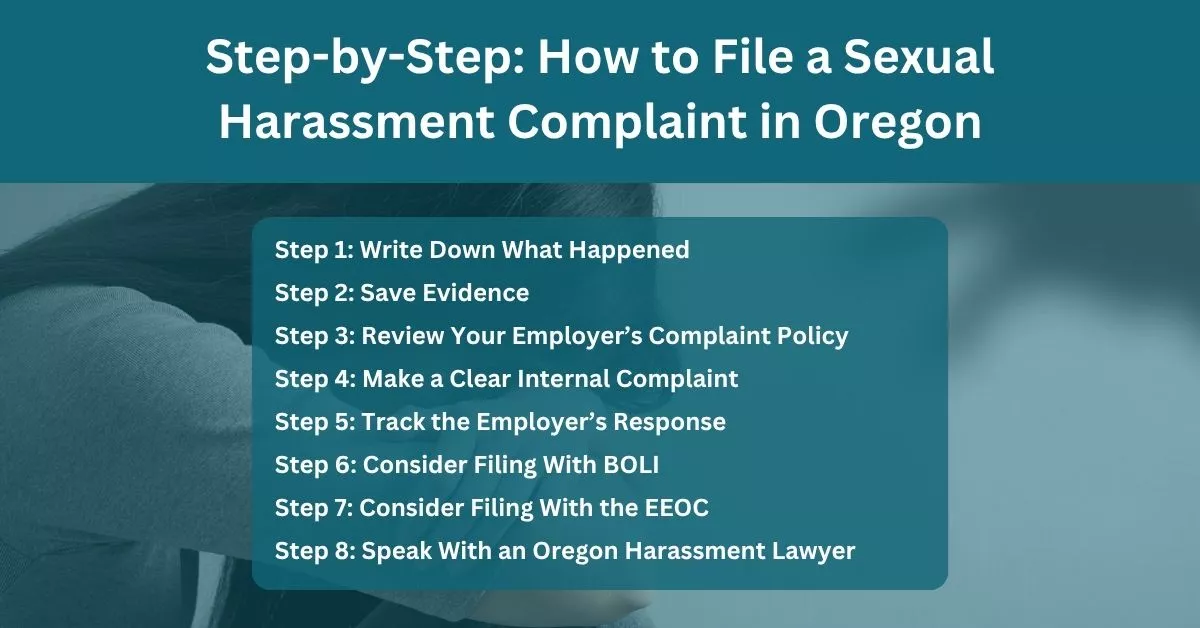 Step-by-Step: How to File a Sexual Harassment Complaint in Oregon
Filing a sexual harassment complaint can feel intimidating. Taking the process one step at a time can help you protect yourself and avoid common mistakes.
Step 1: Write Down What Happened
Start by creating a timeline. Memories fade quickly, and details matter.
Include:
- The date of each incident
- The time and location
- The person involved
- Exactly what was said or done
- Whether anyone witnessed it
- Whether you objected or reported it
- How your employer responded
- Whether the conduct affected your work, schedule, pay, assignments, or health
Try to write facts, not just conclusions. For example, “My supervisor sent me three texts asking for nude photos after I told him to stop” is more helpful than “My supervisor harassed me.”
Step 2: Save Evidence
Sexual harassment often leaves a paper trail. Preserve evidence before it disappears.
Helpful evidence may include:
- Text messages
- Emails
- Slack, Teams, or workplace chat messages
- Social media messages
- Voicemails
- Photos or screenshots
- Notes from meetings
- HR complaints
- Witness names and contact information
- Work schedules
- Performance reviews
- Disciplinary notices
- Job assignments
- Medical or counseling records related to the impact
- Termination, demotion, or transfer documents
If the evidence is stored on a work device or company account, be careful. You should not take confidential business information or violate workplace policies, but you should preserve your own communications and records when legally appropriate.
Step 3: Review Your Employer’s Complaint Policy
Many employers have a handbook, anti-harassment policy, HR reporting process, hotline, or complaint form. Reviewing the policy can help you understand who to contact and what the employer expects.
Look for:
- Who receives harassment complaints
- Whether complaints must be in writing
- Whether there is a hotline or online reporting system
- Whether you can report to someone other than your supervisor
- What the employer says it will do after receiving a complaint
- Whether the policy prohibits retaliation
If your harasser is your supervisor, or if HR has ignored prior complaints, it may be wise to talk with an employment lawyer before deciding how to report.
Step 4: Make a Clear Internal Complaint
If it is safe and practical, make your complaint in writing. A written complaint creates a record and reduces the chance that your employer later claims it did not know about the harassment.
Your complaint should include:
- That you are reporting sexual harassment or harassment based on sex, gender, sexual orientation, gender identity, pregnancy, or another protected status
- What happened
- Who was involved
- When it happened
- Whether there were witnesses
- What evidence exists
- Whether you fear retaliation
- What action you are requesting
You do not need to write a perfect legal document. The goal is to clearly put the employer on notice that you are reporting unlawful workplace conduct.
Step 5: Track the Employer’s Response
After you complain, keep notes about what the employer does next.
Track:
- Whether HR confirms receiving your complaint
- Whether an investigation begins
- Who interviews you
- What questions they ask
- Whether witnesses are contacted
- Whether the harasser is separated from you
- Whether the conduct stops
- Whether your schedule, duties, pay, or treatment changes
- Whether you experience retaliation
If your employer ignores the complaint, blames you, reveals your complaint unnecessarily, or punishes you for reporting, those facts may matter.
Step 6: Consider Filing With BOLI
Oregon employees may be able to file a discrimination or harassment complaint with the Oregon Bureau of Labor and Industries. BOLI’s Civil Rights Division handles complaints involving workplace discrimination, harassment, and retaliation.
Before filing, gather:
- Your contact information
- Employer name and contact information
- Dates of harassment
- Names of people involved
- Witness information
- A short timeline
- Supporting documents
- Copies of internal complaints
- Information about retaliation, discipline, demotion, termination, or forced resignation
BOLI states that Oregon workers have the right to a workplace free from discrimination and harassment, and that Oregon law protects workers from retaliation for making a complaint.
Step 7: Consider Filing With the EEOC
Employees may also be able to file a charge with the Equal Employment Opportunity Commission. The EEOC enforces federal laws prohibiting workplace discrimination and harassment based on protected characteristics, including sex, pregnancy, sexual orientation, and gender identity.
The EEOC states that workers may file a formal discrimination complaint when they believe they were harassed at work because of a protected characteristic or retaliated against for complaining about discrimination.
Step 8: Speak With an Oregon Sexual Harassment Lawyer
You can talk to a lawyer before filing an internal complaint, before filing with BOLI or the EEOC, or after your employer responds.
A lawyer can help you:
- Understand whether the conduct may be unlawful
- Identify filing deadlines
- Decide whether to report internally first
- Prepare a complaint
- Avoid weakening your claim
- Respond to retaliation
- Evaluate severance agreements
- Communicate with your employer
- File with BOLI or the EEOC
- Negotiate a resolution
- Pursue legal action if necessary
 What Happens After You File a Complaint?
What happens next depends on where you filed.
After an internal complaint, your employer may:
- Interview you
- Interview witnesses
- Review texts, emails, video, or other evidence
- Interview the accused person
- Separate you from the harasser
- Discipline the harasser
- Change schedules or reporting lines
- Close the investigation
- Claim the complaint was unsubstantiated
After a BOLI or EEOC complaint, the agency may:
- Review jurisdiction
- Contact the employer
- Request a response
- Ask for documents
- Interview witnesses
- Offer mediation or settlement options
- Investigate the claim
- Issue findings or notices
- Provide information about next legal steps
The process can take time. Continue documenting anything that happens after you complain, especially retaliation.
What Is Retaliation After Reporting Sexual Harassment?
Retaliation happens when an employer punishes an employee for reporting harassment, opposing discrimination, participating in an investigation, or asserting workplace rights.
Retaliation may include:
- Termination
- Demotion
- Reduced hours
- Worse shifts
- Pay cuts
- Discipline
- Negative performance reviews
- Exclusion from meetings or opportunities
- Threats
- Increased scrutiny
- Hostile treatment
- Forced resignation
- Bad references
Oregon BOLI states that it is illegal for an employer to retaliate against a worker or treat them differently because they make a complaint.
If retaliation happens, document it immediately. Retaliation may become a separate legal claim in addition to the original harassment complaint.
How Long Do You Have to File a Sexual Harassment Complaint in Oregon?
Deadlines can be complicated and depend on the type of claim, where you file, and whether you are pursuing state or federal rights.
BOLI states that, for discrimination at work, employees may have up to five years to file a complaint or lawsuit if the incidents happened on or after September 29, 2019.
Federal EEOC deadlines can be shorter. The EEOC explains that, in general, workers must file a charge within 180 calendar days, but the deadline may extend to 300 days if a state or local agency enforces a law prohibiting employment discrimination on the same basis.
Because deadlines can affect your rights, do not wait to ask for legal advice.
What Mistakes Should You Avoid When Filing a Complaint?
Employees often make understandable mistakes when they are scared, embarrassed, angry, or overwhelmed. Avoiding these mistakes can help protect your claim.
Common mistakes include:
- Waiting too long to report or seek legal advice
- Deleting texts, emails, or screenshots
- Keeping evidence only on a work device
- Making only verbal complaints with no written record
- Leaving out key facts because they feel embarrassing
- Signing a severance agreement without legal review
- Quitting without understanding how resignation may affect the claim
- Posting about the situation on social media
- Secretly recording conversations without understanding Oregon law
- Taking confidential company documents unrelated to the harassment
- Missing BOLI or EEOC filing deadlines
You do not need to handle the process alone. Sexual harassment complaints can involve sensitive facts, workplace politics, retaliation risks, and strict deadlines.
 Talk to an Oregon Sexual Harassment Lawyer
Filing a sexual harassment complaint in Oregon can be a powerful step toward stopping unlawful conduct and protecting your rights. But the process can also be stressful, especially if you are still working with the harasser or worried about retaliation.
Meyer Employment Law represents Oregon employees in workplace harassment, sexual harassment, discrimination, retaliation, hostile work environment, and wrongful termination cases.
If you are ready to discuss your options, contact Meyer Employment Law to speak with an Oregon employment attorney.
About the Author
Robert Meyer is the founder of Meyer Employment Law and has represented employees in Oregon state and federal courts for more than a decade in workplace disputes, including sexual harassment, workplace harassment, retaliation, discrimination, wrongful termination, wage claims, severance agreements, and leave violations. The firm helps workers understand their rights, evaluate their legal options, and pursue accountability when employers violate Oregon and federal employment laws.