Mental health discrimination at work happens when an employer treats you unfairly because of a condition like depression, anxiety, PTSD, or bipolar disorder, instead of judging you on your actual job performance. It can look like a sudden firing after you disclose a diagnosis, a denied promotion, a forced leave you never asked for, or a request for help that goes nowhere. These experiences are more common than most workers assume, and they are often unlawful under both federal and Oregon employment discrimination law.
At Meyer Employment Law, we represent Oregon employees who have been penalized for something the law protects. This guide explains what your rights are, when your employer has to accommodate a mental health condition, how much you have to disclose, and what to do if you are facing discrimination right now.
TL;DR
Mental health conditions are disabilities under the Americans with Disabilities Act and Oregon law, which means your employer generally cannot fire, demote, harass, or refuse to hire you because of one. You may also have the right to a reasonable accommodation, such as a flexible schedule, time for appointments, or remote work, unless it causes significant difficulty or expense. You can keep your condition private in most situations and are not required to share a specific diagnosis. Oregon law applies to smaller employers than federal law and protects more categories, and strict deadlines apply if you decide to file a complaint.
Key Points
- Mental health conditions are protected disabilities. Depression, PTSD, bipolar disorder, anxiety disorders, and others are covered under the ADA and Oregon law.
- Firing you for a condition is illegal. Employers cannot discriminate based on a mental health condition, including firing, demotion, or forced leave.
- You may be entitled to accommodations. Reasonable adjustments can include flexible scheduling, leave for treatment, a quieter workspace, or remote work.
- Oregon protects more workers. State disability law applies to employers with six or more employees, while federal coverage starts at fifteen.
- Your diagnosis can stay private. In most cases you control what you share, and general documentation is often enough.
- Myths are not a legal defense. Employers cannot act on stereotypes about mental illness; they need objective evidence.
- Harassment counts too. A pattern of slurs, mocking, or hostility tied to your condition can be unlawful.
- Deadlines are short. Federal charges generally must be filed within 300 days in Oregon, and state complaints within one year.
What Mental Health Discrimination at Work Looks Like
Mental health discrimination at work rarely arrives with a clear label. It tends to show up in decisions that feel personal and unexplained. An employer might pull a promotion after learning you see a therapist, write you up for symptoms they would overlook in anyone else, or push you onto leave you never requested. It can also take the form of harassment, including repeated comments, jokes, or hostility aimed at your condition.
The scale of the issue is easy to underestimate. The World Health Organization estimates that 15% of working-age adults were living with a mental disorder in 2019, and that depression and anxiety alone cost the global economy roughly 12 billion working days and US$1 trillion in lost productivity each year. Despite how common these conditions are, stigma persists. A 2024 NAMI workplace mental health poll found that many employees still hesitate to talk about mental health at work, even when they believe it is appropriate to do so. That silence is part of what lets discrimination go unchallenged.

Your Rights Under the ADA and Oregon Law
Two layers of law protect Oregon workers with mental health conditions, and they do not work the same way. Understanding both is the difference between assuming you have no options and knowing exactly where you stand.
Federal Protection Under the ADA
The Americans with Disabilities Act protects employees with mental health conditions, and the U.S. Equal Employment Opportunity Commission has been direct about it. According to EEOC guidance on depression, PTSD, and other mental health conditions, it is illegal for an employer to fire, refuse to hire, or force leave on you simply because you have a condition. The guidance also makes clear that a condition does not need to be permanent or severe to qualify, and that conditions like major depression, PTSD, bipolar disorder, schizophrenia, and OCD should easily qualify for protection. An employer cannot rely on myths or stereotypes about mental illness; it needs objective evidence that you cannot perform the job or pose a genuine safety risk, even with accommodation.
Broader Protection Under Oregon Law
Oregon law reaches further than the federal baseline. State disability protections under ORS 659A.112 apply to employers with six or more employees, while the ADA generally applies only at fifteen or more. That gap matters for the many Oregonians who work at smaller businesses. The Oregon Bureau of Labor and Industries enforces these protections through its Civil Rights Division, and Oregon also recognizes more protected categories than federal law. If you want a fuller picture of how the state treats these claims, our overview of disability discrimination law in Oregon breaks it down in plain terms.
Not sure whether what happened to you was illegal? The line between a tough manager and unlawful discrimination is not always obvious. Talk through your situation with an Oregon employment attorney in a free, confidential consultation.
Reasonable Accommodations for Mental Health
One of the most important rights you have is the right to ask for a reasonable accommodation, which is simply a change in how work is normally done so you can keep doing your job. Many employees do not realize this protection applies to mental health at all.
The EEOC lists practical examples, including altered break and work schedules so you can attend therapy appointments, a quiet workspace or noise-reducing devices, written instructions from a supervisor who usually gives them verbally, a specific shift assignment, and permission to work from home. When no other option allows you to perform your job, unpaid leave can itself be a reasonable accommodation. Your employer must provide an accommodation that works unless doing so would cause significant difficulty or expense.
Asking is what triggers the process. You can request an accommodation at any time by telling a supervisor, HR, or another appropriate person that you need a change at work because of a medical condition. It is generally better to ask before performance problems develop rather than after. Your employer can request documentation confirming the condition and the need, and this is often where employees benefit from guidance, because how you frame a request can shape how it is received.
At Meyer Employment Law, we help workers request accommodations and push back when an employer ignores or punishes a reasonable request, which is itself a form of retaliation the law prohibits.
Privacy: How Much Do You Have To Share?
A common fear is that asking for help means broadcasting a diagnosis to the whole office. In most situations, that is not how it works. Under the EEOC guidance, your employer can only ask medical questions in limited circumstances, such as when you request an accommodation, after a job offer if everyone in the role is asked the same questions, or when there is objective evidence you cannot do your job or pose a safety risk.
Even then, you control the details. You are often not required to name a specific diagnosis, and describing your condition more generally, for example as an “anxiety disorder,” can be enough to support an accommodation request. When you do share medical information, your employer must keep it confidential, including from coworkers. Knowing these limits helps you protect both your job and your privacy at the same time.
Worried that disclosing a condition could be used against you? You have privacy rights, and there are careful ways to ask for what you need. Understand your rights as an Oregon employee with a disability before you say anything.
What To Do If You Are Facing Mental Health Discrimination
If you believe you are experiencing mental health discrimination at work, a few deliberate steps can protect your rights and strengthen any future claim.
Start by documenting everything. Keep a dated record of incidents, including what was said, who was present, and how it connects to your condition, and save relevant emails and messages. If your employer has an internal complaint process, reporting through it can matter, unless the people involved are the source of the problem. You can also file a complaint with the EEOC or with Oregon BOLI, and understanding the broader types of workplace discrimination can help you recognize everything you may be facing.
Deadlines are the part people most often miss. A federal charge generally must be filed within 300 days in Oregon, because the state has its own anti-discrimination law, and an Oregon BOLI complaint must be filed within one year. Those windows close faster than they sound, especially while you are managing your health, so an early consultation helps you preserve your options. This article provides general information, not legal advice, and the right course of action depends on the facts of your specific situation. Mental health is a sensitive subject, and if you are struggling personally, reaching out to a qualified professional for support is always a reasonable step.
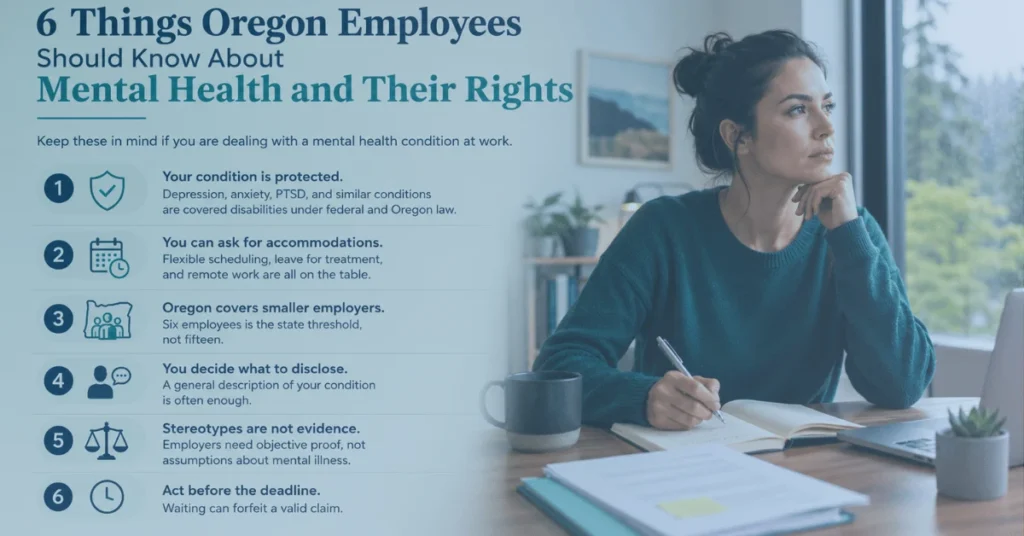
6 Things Oregon Employees Should Know About Mental Health and Their Rights
Keep these in mind if you are dealing with a mental health condition at work.
- Your condition is protected. Depression, anxiety, PTSD, and similar conditions are covered disabilities under federal and Oregon law.
- You can ask for accommodations. Flexible scheduling, leave for treatment, and remote work are all on the table.
- Oregon covers smaller employers. Six employees is the state threshold, not fifteen.
- You decide what to disclose. A general description of your condition is often enough.
- Stereotypes are not evidence. Employers need objective proof, not assumptions about mental illness.
- Act before the deadline. Waiting can forfeit a valid claim.
Conclusion
Living with a mental health condition is hard enough without an employer treating it as a reason to push you out. The law is clearer than many workers expect: your condition is protected, you may have a right to accommodations, and your privacy is yours to control. What often stands between an employee and a fair outcome is simply knowing those rights exist and acting before the deadlines run.
Founded by attorney Robert Meyer, Meyer Employment Law represents employees throughout Oregon and offers remote consultations, with a practice devoted entirely to workers rather than employers. If you believe you have faced mental health discrimination at work, a confidential case review can help you understand your options and decide what to do next.
Facing discrimination because of a mental health condition? Meyer Employment Law offers a free, confidential consultation to Oregon workers, with remote options statewide. Contact Meyer Employment Law to talk through your situation.