Your employee rights after a wrongful termination do not switch off the moment your badge stops working. That is worth knowing on the day it happens, because the first conversation usually goes the same way. A meeting appears on your calendar with no agenda. Someone from HR is already in the room. You are told the decision is final, handed a folder, and walked to your car with a box before you have processed the first sentence.
What you do over the next few days matters more than it feels like it should. Evidence gets harder to reach, memories blur, and legal deadlines start running immediately. The steps below are the ones we walk Oregon workers through most often at Meyer Employment Law, where we represent employees only and never the companies that fire them.
Also Read
- Wrongful Termination Under Oregon Law: What You Need to Know
- Oregon At Will Employment: What You Need to Know
- Unemployment Representation: What a Lawyer Actually Does From Denial to Hearing
In Plain English
Oregon is an at-will state, which means you can be fired for a bad reason or no reason at all, but not for an illegal reason. If the real motive was your race, sex, age, disability, pregnancy, religion, national origin, sexual orientation, gender identity, military service, a workers’ compensation claim, protected leave, or a complaint you made about something unlawful, the firing may be actionable. The first days after a termination decide how much of that you can prove: what documents you still have access to, whether you signed away your claims in a severance agreement, whether your final paycheck arrived on time, and whether you filed with the right agency before the deadline closed. Most of those deadlines run from the date of the firing, and some are as short as one year.
First, Was It Actually Illegal? At-Will Has Limits
At-will employment gets used as a conversation ender, and it should not be. Oregon employers can terminate for reasons that are unfair, mistaken, petty, or unexplained. What they cannot do is terminate for a reason the law protects against.
ORS 659A.030 makes it an unlawful employment practice to discriminate because of race, color, religion, sex, sexual orientation, gender identity, national origin, marital status, age, or an expunged juvenile record. Separate statutes protect disability, service in the uniformed services, filing a workers’ compensation claim, taking protected family or medical leave, using sick time, reporting safety problems, and blowing the whistle on illegal conduct. Oregon common law also protects employees fired for refusing to commit an unlawful act or for fulfilling a public duty like jury service.
Two patterns deserve special attention. The first is timing: a firing that lands two weeks after you requested an accommodation, reported harassment, or filed a claim invites a very different question than one that arrives out of nowhere. The second is the shifting explanation. When the stated reason changes between the termination meeting, the separation paperwork, and the unemployment response, that inconsistency is itself evidence. If you were not formally fired but instead made so miserable that you quit, that may still qualify as a constructive discharge.
Not sure whether what happened to you crosses the legal line? Most people who call us are not certain, and that is fine. That is the question worth answering first. Learn how wrongful termination claims work under Oregon law.
The First 72 Hours
Step 1: Ask for the reason in writing, then stop talking
In the termination meeting, ask one calm question: what is the reason for this decision, and can I have it in writing? Then let the silence sit. Do not argue, do not defend your record, and do not threaten to sue. Everything you say lands in a memo that afternoon. The written reason, or the refusal to provide one, is more useful to you than any argument you could win in that room.
Step 2: Save what you already have, and nothing you should not
Your access will be cut, often within the hour. Anything you legitimately possess already is worth preserving now: your offer letter, performance reviews, the employee handbook, pay stubs, schedules, and emails or texts about the issue you raised. Forward what is properly yours to your personal account or photograph it.
Be careful about the line here. Taking confidential company data, customer lists, trade secrets, or privileged material can seriously damage an otherwise strong case and create problems of its own. When in doubt about a particular document, ask a lawyer before you take it rather than after.
Step 3: Write the timeline while it is fresh
Sit down and write out what happened in order, with dates: when you reported the problem, who you told, what they said, what changed afterward, who was in the room when you were fired, and the exact words used. Memory degrades fast, and a contemporaneous account written days after the fact carries real weight later. Include the names of coworkers who saw or heard any of it.

The First Two Weeks
Step 4: Do not sign the severance agreement yet
Severance is not a gift. It is a purchase, and what your employer is buying is your right to sue. Once you sign a release, the claim you did not know you had is usually gone too.
Oregon law gives you more room here than most workers realize. Under ORS 659A.370, an employer generally cannot require a nondisclosure provision, a nondisparagement provision, or a no-rehire clause as a condition of a settlement involving discrimination or harassment. Those terms may be included only when the employee requests them, and it is a violation for an employer to condition a settlement offer on that request. When such an agreement is signed, you must be given at least seven days to revoke it, and it cannot take effect until that window closes. Have a severance agreement reviewed before the deadline your employer set, not after.
Step 5: Confirm your final paycheck arrives on time
Oregon has strict timing rules that many employers miss. Under ORS 652.140, if you were fired or laid off, all earned and unpaid wages are due no later than the end of the first business day after the termination. If you quit with at least 48 hours’ notice, your final wages are due on your last day. If you quit without notice, your employer has five business days or the next regular payday, whichever comes first.
When an employer willfully misses that deadline, ORS 652.150 imposes penalty wages: your compensation continues at eight hours per day at your regular rate, for up to 30 days. An employer can cap that exposure at the amount of the unpaid wages by paying in full within 12 days of receiving written notice from you. Check the math on your final check, including unused vacation if your employer’s policy pays it out, accrued commissions, and any unpaid overtime.
Step 6: File for unemployment right away
Do not wait for the severance question to resolve, and do not assume you are ineligible because you were fired. Being terminated does not automatically disqualify you. Benefits are generally denied for misconduct, which is a narrower category than most employers imply, and you can appeal a denial. Apply through the Oregon Employment Department and describe the separation accurately and briefly.
There is a second reason to file promptly. Your employer has to state its reason for the termination in the unemployment process, in writing, close to the event. If that reason contradicts what you were told in the room, you now have that on the record.
Step 7: Sort out your health coverage before it lapses
Find out the exact date your coverage ends, whether continuation coverage is available and what it costs, and whether a marketplace plan makes more sense. Losing a job is a qualifying event that opens a special enrollment window, but the window is finite. This is the step people skip while they are focused on the legal question, and it is the one that hurts most if a medical bill arrives in the gap.
Fired after you raised a concern at work? Retaliation for reporting discrimination, harassment, safety issues, or unpaid wages is its own violation, separate from the underlying problem. Talk it through in a free, confidential consultation. Contact Meyer Employment Law.
The First Few Months
Step 8: File with BOLI or the EEOC if the reason was discrimination or retaliation
For most discrimination claims, you can file a complaint with the Oregon Bureau of Labor and Industries, with the federal Equal Employment Opportunity Commission, or both. The two agencies have a work-sharing arrangement, and the choice affects your deadlines and your remedies, which is exactly why it is worth a conversation before you file rather than after.
Filing does not commit you to a lengthy administrative process. It preserves options, and in Oregon it can extend the time you have to bring a civil action.
Step 9: Keep looking for work, and keep the receipts
Back pay is the largest component of most wrongful termination recoveries, and it is reduced by what you earn after the firing and by what you reasonably could have earned. A documented job search protects that number. Keep a simple log of applications, interviews, and rejections, and save the confirmation emails. If you take a lower-paying job in the meantime, that is not a problem for your claim. Sitting out the market entirely can be.
Step 10: Talk to an employee-side attorney before the deadlines close
Bring the written reason, the timeline, the severance paperwork, and your final pay records. A consultation is not a commitment to file anything. It is how you find out whether the thing that happened to you was illegal, what it might be worth, and which clock matters most in your situation.
Employee Rights After Wrongful Termination: What the Law Actually Gives You
Understanding the remedies helps explain why the earlier steps matter. In a successful claim, Oregon and federal law can provide back pay for wages and benefits lost since the termination, front pay or reinstatement where appropriate, and compensatory damages for emotional harm. Attorney fees and costs are recoverable under ORS 659A.885 in many cases, which is what makes representation realistic for workers who have just lost their income. Punitive damages are available in some circumstances, and the EEOC’s summary of remedies explains how federal caps work.
Two honest caveats belong here. Damages are proven, not assumed, which is why the timeline, the documents, and the job search log carry real weight. And no lawyer can promise an outcome, because employee rights after wrongful termination are applied to specific facts, and the facts differ in every case.
The Deadlines That Decide Whether You Still Have a Claim
This is the part that quietly ends otherwise strong cases, and the deadlines are not uniform.
Under ORS 659A.820, a BOLI complaint generally must be filed within one year of the unlawful practice, but the window extends to five years for discrimination claims under ORS 659A.030, disability discrimination under ORS 659A.112, uniformed service discrimination under ORS 659A.082, and violations of the nondisclosure restrictions in ORS 659A.370. Civil actions follow a parallel structure under ORS 659A.875: one year for most unlawful employment practices, five years for that same enumerated group. If you filed with BOLI and received a 90-day notice, you have 90 days from the mailing of that notice to file suit, and that shorter clock controls.
Federal deadlines run separately. Because Oregon has its own enforcing agency, the EEOC charge deadline is 300 days rather than the baseline 180. Common law wrongful discharge claims fall under the two-year limit in ORS 12.110, and unpaid overtime claims have their own two-year window. Different claims arising from the same firing can expire on different dates, which is the strongest practical argument for getting advice early rather than waiting to feel ready.
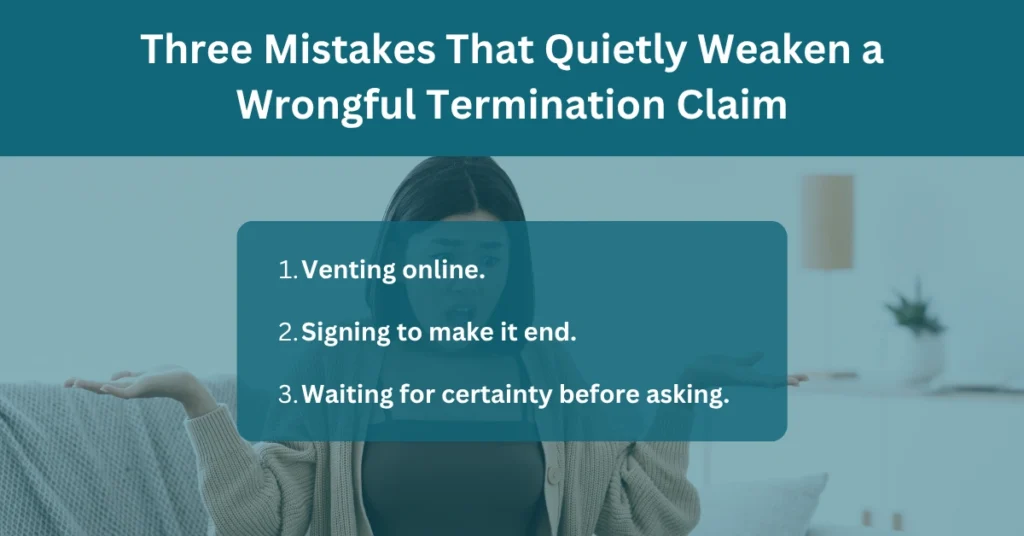
Three Mistakes That Quietly Weaken a Wrongful Termination Claim
Venting online. A post about your former boss written at midnight becomes an exhibit. Assume anything you publish will be read aloud by opposing counsel.
Signing to make it end. The severance check feels like relief when you have no income. It is also the fastest way to give up a claim worth considerably more, and the seven-day revocation window Oregon provides exists precisely because signing under pressure is common.
Waiting for certainty before asking. People often want to be sure they have a case before they call a lawyer. Determining that is the lawyer’s job, and the deadline does not pause while you decide.
Conclusion
Being fired is disorienting in a way that has nothing to do with the law. The income stops, the routine disappears, and the question of whether it was even legal sits underneath everything else. What the ten steps above really provide is a way to protect your options during the weeks when you are least equipped to think strategically. Ask for the reason. Save what is yours. Write the timeline. Do not sign yet. File for unemployment. Watch the calendar.
Founded by attorney Robert Meyer and selected to Super Lawyers from 2021 through 2024, Meyer Employment Law represents Oregon workers across the state, with remote consultations available. We answer the question you actually have, which is usually not “how much is this worth” but “was this even allowed.”
Fired and not sure where you stand? Bring the paperwork and the timeline. We will tell you honestly whether the law was on your side and what your options look like from here. The consultation is free and confidential. Talk with Meyer Employment Law or call (503) 459-4010.