The Equal Pay Act is one of several laws that may protect Oregon employees who find out they’re paid less for substantially equal or comparable work. A pay gap isn’t automatically illegal. But your employer should be able to explain it with legitimate, job-related reasons rather than sex or another protected characteristic.
Oregon workers get more protection than federal law alone provides. The state’s pay equity rules reach across protected classes, they measure work of comparable character instead of identical job titles, and they apply to every employer with at least one employee working in Oregon. Size doesn’t get your employer out of it.
That breadth matters when two people do substantially similar work under different titles, different bonus structures, or different benefits.
Meyer Employment Law represents Oregon workers in employment wage claims involving unpaid compensation, unequal pay, classification issues, and other wage disputes.
Also Read
- Oregon Pay Equity Law
- 5 Types of Discrimination in the Workplace
- How to Handle Unfair Treatment at Work
TL;DR
Federal law generally requires equal pay for men and women doing substantially equal work in the same establishment, unless the employer can justify the gap through a recognized defense. Oregon law goes further. It protects employees against compensation differences based on race, color, religion, sex, sexual orientation, gender identity, national origin, marital status, veteran status, disability, or age and requires equal compensation for work of comparable character unless the difference is based entirely on permitted factors. If you suspect an unlawful pay difference, compare actual job duties, total compensation, experience, seniority, training, performance systems, and your employer’s explanation before you decide how to proceed.
Key Takeaways
- Federal and Oregon equal pay protections aren’t identical.
- Oregon law covers more protected characteristics than the federal Equal Pay Act.
- Job titles don’t determine whether work is comparable.
- Compensation can include salary, wages, bonuses, benefits, and equity-based compensation.
- Oregon allows certain pay differences based on factors such as seniority, merit, production, location, travel, education, training, or experience.
- Your employer’s pay system has to be consistent and verifiable.
- Your employer can’t lawfully retaliate against you for asserting pay equity rights.
- Pay records, job duties, performance records, and compensation policies can become important evidence.
How the Equal Pay Act Applies to Oregon Employees
Federal law focuses specifically on sex-based wage discrimination.
The EEOC explains that men and women must receive equal pay for equal work within the same establishment when their jobs require substantially equal skill, effort, and responsibility and are performed under similar working conditions. The jobs don’t have to be identical. What matters is the content of the work.
Two employees might carry different titles but handle the same core responsibilities, exercise similar judgment, manage similar workloads, and work under comparable conditions.
A title such as “Senior Coordinator” doesn’t necessarily justify higher pay than “Coordinator” if the actual work is substantially the same.
Federal law permits differences based on:
- Seniority
- Merit
- Quantity or quality of production
- Another factor other than sex
Once you’ve shown a sex-based pay gap for substantially equal work, your employer carries the burden of proving the defense.
Oregon’s Equal Pay Law Goes Further
Oregon’s pay equity framework is broader than the federal standard in several important ways.
BOLI states that Oregon employees must receive equal compensation for work of comparable character regardless of race, color, religion, sex, sexual orientation, gender identity, national origin, marital status, veteran status, disability, or age.
An Oregon pay discrimination claim isn’t limited to differences between men and women.
The state also uses the concept of work of comparable character.
BOLI explains that employers evaluating comparable work should consider whether jobs require substantially similar knowledge, skill, effort, responsibility, and working conditions. Small differences don’t make two jobs different for pay equity purposes.
So what you actually do all day carries more weight than what your title says.
An employer can’t defend a pay gap just by pointing to different job titles or departments.
What Counts as Compensation?
Most people spot a pay gap by comparing salaries, but base wages are only part of it.
Under Oregon’s pay equity rules, compensation can include:
- Hourly wages
- Salary
- Bonuses
- Benefits
- Fringe benefits
- Equity-based compensation
BOLI names each of these when it explains Oregon’s law.
Federal compensation discrimination protections can also reach overtime, bonuses, stock options, profit-sharing plans, insurance, vacation pay, and other employment benefits.
Two people can earn identical salaries and still have a pay problem if one keeps getting larger bonuses or better benefits with no legitimate explanation.
So compare the whole compensation structure, not just the number printed next to “salary” in an offer letter.
What Can Legally Explain Different Pay in Oregon?
Not every pay difference breaks the law.
Oregon lets employers pay people differently when the entire difference comes down to one or more recognized factors.
BOLI identifies factors including:
- A seniority system
- A merit system
- A system measuring quantity or quality of production
- Workplace location
- Regular and necessary travel
- Education
- Training
- Experience
The catch is that your employer needs a consistent, verifiable system behind the factor, not just a label for it.
The label is easy. The system behind it is what gets checked.
An employer can’t just say, “We pay based on experience,” without checking whether experience actually accounts for the difference.
Suppose two people do comparable work and one earns $12,000 more a year. The employer points to experience, but both entered the field around the same time with similar credentials.
That explanation won’t survive much scrutiny.
A documented system that awards defined increases for defined years of relevant experience is a different story.
Some differences that look unfair are lawful. Shift differentials for weekends, holidays, or overnight hours can differentiate the work enough to put two jobs outside comparable character entirely. Employers can also offer different benefit options as long as the same options are available to everyone doing comparable work.

How Do You Know if the Work Is Comparable?
Start with what people actually do.
Don’t start with job titles.
Compare:
- Knowledge required
- Technical or professional skill
- Physical or mental effort
- Responsibility
- Decision-making authority
- Supervisory responsibilities
- Working conditions
- Core daily tasks
Oregon’s guidance emphasizes comparable work rather than identical positions.
Picture two employees in different departments.
One is called an Account Coordinator and the other a Client Services Specialist. Both manage customer accounts, prepare reports, coordinate projects, communicate with clients, and solve similar operational problems.
Different titles alone wouldn’t settle whether their work is comparable.
The reverse happens too.
Two people can share a title while one carries supervisory duties, travels regularly, or handles specialized work that legitimately changes the pay.
What counts is what you actually do all day, not what your offer letter calls you.
What Evidence Helps Prove Unequal Pay?
You probably can’t see your employer’s full payroll data.
That doesn’t mean you’re stuck guessing.
Start with what you can lawfully get your hands on.
Useful evidence can include:
- Your pay stubs
- Offer letters
- Compensation notices
- Bonus records
- Job descriptions
- Performance reviews
- Promotion documents
- Emails discussing compensation
- Published pay ranges
- Organizational charts
- Policies explaining merit or seniority systems
- Information about comparable duties
Then map your own job.
Your formal job description is probably outdated. Write down your recurring duties, projects, decision-making authority, supervisory responsibilities, and specialized tasks.
Then write down what you actually know about the person you’re comparing yourself to, and keep assumptions out of it.
A claim gets built on documented duties and an unexplained gap. Break room rumors about what someone earns won’t carry it.
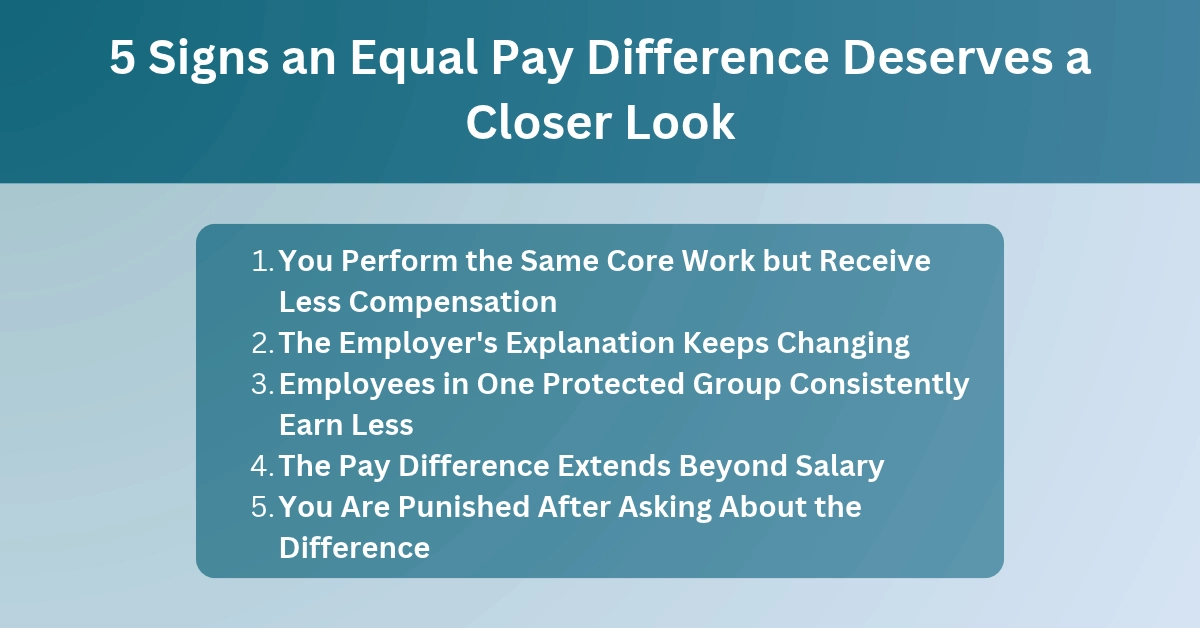
Top 5 Signs an Equal Pay Difference Deserves a Closer Look
1. You Perform the Same Core Work but Receive Less Compensation
Different titles don’t justify different pay when the actual duties are comparable.
2. The Employer’s Explanation Keeps Changing
A gap blamed first on experience, then performance, then negotiation history is worth a second look.
3. Employees in One Protected Group Consistently Earn Less
A pattern across several workers carries more weight than one isolated gap.
4. The Pay Difference Extends Beyond Salary
Unequal bonuses, benefits, incentives, or equity compensation can also matter.
5. Your Employer Punishes You After You Ask
Retaliation after you raise a pay equity concern creates a separate legal claim.
Can an Employer Use Salary History to Set Pay?
Oregon restricts the use of salary history during hiring.
BOLI states that employers may not ask about salary or pay history before making an employment offer, screen job applicants based on past or current pay, or determine compensation for a prospective employee based on past compensation. Different rules can apply to internal transfers or moves within the same employer.
The reason is practical.
If your prior salary reflected discrimination or underpayment, using it to set your next salary carries the gap from one job into the next.
If you think your past pay was used improperly, save your recruiting emails, application, offer negotiations, and any written questions about salary history.
For current Oregon guidance, review BOLI’s equal pay protections for workers.
Can Your Employer Cut Someone Else’s Pay to Fix the Problem?
No.
Oregon and federal equal pay rules both reject fixing an unlawful gap by dragging the higher-paid employee down.
BOLI says plainly that an employer can’t reduce anyone’s compensation to comply with the law.
Federal law follows the same principle for sex-based wage gaps.
One wrinkle catches people off guard: your employer can freeze the higher earner’s pay. BOLI doesn’t treat red-circling or a salary freeze as a reduction, so a company can hold one person’s pay steady while bringing others up over time. That’s legal, and it’s a common way employers close gaps.
It also means your raise might arrive as someone else’s stall rather than as money in your pocket this quarter. If that’s what’s happening, you’re entitled to ask how long the catch-up should take and what the plan is.
What If Your Employer Already Ran a Pay Analysis?
Oregon gives employers a real incentive to audit themselves, and it affects what you can recover.
If your employer completed an equal-pay analysis in good faith within three years before you filed, and that analysis was reasonable in detail and scope for a company its size, reviewed practices designed to eliminate unlawful wage differentials, and the employer made reasonable and substantial progress on fixing what it found, a court has to disallow compensatory and punitive damages.
Read that carefully, because it doesn’t mean you lose. If you win, the court still orders your employer to eliminate the unlawful differential and award back pay or unpaid wages, and it may award your costs and reasonable attorney fees. What disappears is the additional damages on top.
Two more wrinkles work in your favor. Your employer can’t use that analysis as evidence in some other proceeding, and raising your pay as a result of one isn’t an admission that it broke the law. Going the other direction, the fact that an employer never ran an analysis can’t be used as evidence that it violated the law either.
So if HR mentions a recent compensation study, that’s information you want early. It shapes what a claim is likely to be worth.
What Should You Do if You Discover a Pay Difference?
Don’t jump straight to discrimination, and don’t ignore what you found either.
Start with documentation.
Record:
- Your compensation
- The compensation difference you believe exists
- What you know about the other employee’s duties
- Your own actual responsibilities
- Relevant education, training, and experience
- Seniority differences
- Performance history
- Any explanation management provided
Then review your employer’s compensation policies if you can get them.
If you raise it internally, do it in writing and keep the message factual.
Rather than accusing your employer of intentional discrimination before you have the full record, name the difference and ask how compensation was set.
For example, ask what objective factors account for the difference between employees performing comparable work.
If you think your pay is still unlawfully unequal, consider whether the issue belongs in a broader Oregon employment wage claim.
Can an Employer Retaliate Against You for Raising Equal Pay Concerns?
Oregon law protects you from retaliation for asserting rights under the state’s pay equity rules.
BOLI says employers can’t discriminate against employees who complain or testify in a pay equity investigation.
Federal law likewise prohibits retaliation for opposing compensation discrimination or participating in protected proceedings involving the laws enforced by the EEOC.
Retaliation can look like:
- Termination
- Demotion
- Reduced hours
- Lost opportunities
- Sudden discipline
- Negative reviews
- Schedule changes
- Exclusion from projects
Timing matters.
If you raise a pay gap on Monday and get your first disciplinary warning in years the following week, save both records.
Deadlines and Potential Recovery
Equal pay claims run on different clocks depending on which law you’re using.
Under Oregon law, you generally have one year from the unlawful practice to file with BOLI’s Civil Rights Division or to go to court. Oregon also treats every paycheck issued under a discriminatory compensation decision as a new violation, which keeps the clock refreshing while the underpayment continues. Amounts your employer owes you under the pay equity law count as unpaid wages, so you can pursue them as a wage claim.
If BOLI issues a final order in your favor, the back pay award covers the lesser of two periods: the two years right before you filed your complaint plus the stretch from filing until the order issues, or the entire time you were subject to the unlawful differential plus that same filing-to-order stretch. In court, judges can order injunctive and other equitable relief, including back pay, along with compensatory damages.
The federal Equal Pay Act generally gives you two years, or three for willful violations. You don’t have to file an EEOC charge before suing under it.
You can review federal requirements through the EEOC’s guidance on equal pay and compensation discrimination.
Because the two systems differ, don’t assume one deadline or one standard of proof covers your situation.
FAQs
Does Oregon require employees to have the same job title to bring an equal pay claim?
No. Oregon focuses on work of comparable character, including substantially similar knowledge, skill, effort, responsibility, and working conditions. Different titles don’t necessarily mean the jobs are legally different.
Is the federal law limited to sex-based pay differences?
Yes. The federal Equal Pay Act specifically addresses sex-based compensation differences for substantially equal work. Other federal anti-discrimination laws can address compensation discrimination based on additional protected characteristics.
Does Oregon protect more than gender?
Yes. Oregon’s pay equity law applies to protected characteristics including race, color, religion, sex, sexual orientation, gender identity, national origin, marital status, veteran status, disability, and age.
Can an employer pay someone more because they have more experience?
Potentially. Oregon recognizes experience as one of the factors that can justify a compensation difference when the employer’s system is consistent and verifiable and the factor actually accounts for the difference.
Do bonuses count when comparing pay?
Yes. Oregon’s definition of compensation can include bonuses, benefits, fringe benefits, and equity-based compensation in addition to wages or salary.
Can I be fired for complaining about unequal pay?
Employers can’t lawfully retaliate against employees for protected activity under pay equity and anti-discrimination laws. If your treatment changes after a complaint, save the timeline and the documents.
Conclusion
A pay difference isn’t automatically unlawful. But your employer should be able to say why two people doing substantially equal or comparable work take home different amounts, and the reason should hold up when someone checks it.
The Equal Pay Act provides federal protection against sex-based wage discrimination, while Oregon’s pay equity law reaches additional protected classes and evaluates work of comparable character.
If you find a gap, focus on actual duties, total compensation, experience, training, seniority, performance systems, and your employer’s explanation. Those details separate a legitimate pay difference from one that may break Oregon or federal law.
If you think you’re doing comparable work for less, start with your own records: pay stubs, offer letters, bonus history, job descriptions, performance reviews, and anything written about how your compensation got set. Meyer Employment Law represents Oregon employees in wage and employment disputes and can evaluate whether the facts support an equal pay or related compensation claim.
About the Author
Robert Meyer is the founder of Meyer Employment Law and has represented Oregon employees in state and federal workplace disputes for more than a decade. His practice includes wage claims, compensation disputes, discrimination, retaliation, wrongful termination, protected leave, and other employment matters.
Meyer Employment Law focuses on representing employees rather than employers and helping Oregon workers understand their rights when workplace pay or employment decisions may violate state or federal law. Learn more about Robert Meyer and the firm’s employee-focused practice on the About Meyer Employment Law page.