FMLA wrongful termination happens when an employer fires you for using the medical leave that federal law guarantees. If you came back from leave to find your job gone, your hours slashed, or a sudden write-up waiting in your file, the timing alone deserves a closer look. Losing your income while you are recovering from surgery, managing a serious illness, or caring for a family member is exactly the harm that Oregon wrongful termination law is designed to prevent, and Oregon stacks its own protections on top of the federal rules.
At Meyer Employment Law, we represent Oregon workers, and only workers, in these exact situations: people who took protected leave and lost their jobs because of it. This guide explains how to tell a lawful layoff from an illegal firing, what you may be owed, and how long you have to act.
TL;DR
The federal Family and Medical Leave Act lets eligible employees take up to 12 weeks of unpaid, job-protected leave for a serious health condition or to care for family, and it bars employers from firing, demoting, or punishing you for using it. In Oregon, Paid Leave Oregon adds paid, job-protected medical and family leave, and your employer cannot fire or threaten you for taking it once you have worked 90 days. A firing becomes wrongful when your leave, not your performance, was the real reason. Suspicious timing, shifting explanations, and missing reinstatement are common red flags. Deadlines are short, so an early case review matters.
Key Points
- FMLA is job-protected leave, not just time off. Eligible employees are entitled to return to the same or an equivalent position after up to 12 weeks of leave.
- Firing you for taking leave is illegal. The law forbids both interference with your leave and retaliation for using it.
- Oregon law adds a paid layer. Paid Leave Oregon protects your job after 90 days of employment and provides wage replacement that FMLA does not.
- At-will does not mean “any reason.” Oregon is an at-will state, but your employer still cannot fire you for an unlawful reason, including taking protected medical leave.
- Timing is powerful evidence. A termination that lands during leave, on your return, or soon after a leave request often signals an illegal motive.
- Pretext is the central battleground. Employers usually claim performance or restructuring; the case turns on whether that reason is genuine or a cover.
- You can recover real money. Remedies include back pay, lost benefits, reinstatement or front pay, and in many cases additional damages and attorney’s fees.
- Deadlines are unforgiving. Federal FMLA claims generally must be filed within two years, and Oregon administrative complaints within one year.
What FMLA Protects, and Who Qualifies
The Family and Medical Leave Act gives eligible employees up to 12 weeks of unpaid leave in a 12-month period for their own serious health condition, to care for a spouse, child, or parent with a serious health condition, or to bond with a new child. The defining feature is job protection: when your leave ends, you have the right to return to the same job or an equivalent one with the same pay, benefits, and terms.
Not every worker is covered. Under U.S. Department of Labor rules in Fact Sheet #28, you generally qualify if you have worked for your employer for at least 12 months, logged at least 1,250 hours in the 12 months before leave, and work at a location with at least 50 employees within 75 miles. Employers below that size are not covered by federal FMLA, which is one reason Oregon’s own leave laws matter so much.
When an employer ignores these rules, the violation usually takes one of two forms. Interference means denying, discouraging, or shortening leave you were entitled to. Retaliation means punishing you for using it. A firing can involve either, or both.
Not sure whether your leave was even handled correctly? A quick review can tell you whether your employer followed the law before, during, and after your time off. Learn what to do if your leave was denied or mishandled.

What Counts as FMLA Wrongful Termination
FMLA wrongful termination is not about whether your employer said the word “leave” when they let you go. It is about the real reason behind the decision. Employers rarely admit an illegal motive, so these cases are built on patterns, timing, and inconsistencies.
Retaliation for Taking Leave
Retaliation is the most common form of FMLA wrongful termination. It occurs when an employer treats you worse because you requested or used protected leave. Termination is the clearest example, but cutting hours, demoting you, stripping accounts, or papering your file with new discipline can all qualify. Courts pay close attention to how close in time the adverse action was to your leave, because suspicious timing can suggest an unlawful motive even when the employer offers another explanation.
Interference With Your Leave
Interference happens when an employer blocks the leave itself. Refusing a valid request, pressuring you to come back early, counting protected leave as unexcused absences, or failing to restore your job all fall into this category. If you were fired because your employer treated lawful leave as a problem to be eliminated, that is interference, not a neutral business decision.
Constructive Discharge
Sometimes an employer does not fire you outright. Instead, working conditions after your leave become so hostile or unworkable that a reasonable person would feel forced to quit. Oregon law can treat that kind of forced resignation as a termination when the intolerable conditions trace back to your protected leave or another unlawful reason. This connects closely to broader workplace retaliation claims, which often travel alongside leave disputes.
Oregon Adds Another Layer: Paid Leave Oregon and OFLA
Oregon workers have protections that go beyond federal law, and the landscape changed significantly in 2024. Under Senate Bill 1515, effective July 1, 2024, the Oregon Family Leave Act was narrowed so its leave reasons no longer overlap with the newer paid program. Today, leave for your own serious health condition or to care for a family member runs through Paid Leave Oregon, while OFLA now covers a shorter list that includes sick child leave, bereavement, and pregnancy disability.
That matters because Paid Leave Oregon provides up to 12 weeks of paid leave in a year, with up to two additional weeks for pregnancy-related needs, and it carries its own job protection. Once you have worked at least 90 consecutive days for your employer, your position is protected, and the state is explicit that your employer cannot fire you or threaten you for taking the leave you are entitled to. For many Oregon employees, a single firing after medical leave can implicate federal FMLA and Paid Leave Oregon at the same time, which can strengthen a claim.
At Meyer Employment Law, we help workers untangle which laws apply to their situation, because the right combination often determines what you can recover. The interaction between these programs is one of the most misunderstood areas of Oregon employment law, and getting it wrong can cost you a valid claim.
Two laws can protect a single firing. Federal FMLA and Paid Leave Oregon often overlap, and the difference can change your case. Talk with an Oregon employment attorney about which protections apply to you.
Signs Your Firing After Leave May Have Been Illegal
No single fact proves FMLA wrongful termination, but certain patterns come up again and again. The more of these you recognize, the more worthwhile a closer look becomes.
The timing is the first thing to examine. A termination that lands while you are still on leave, on the day you return, or within a few weeks of a leave request raises an obvious question about motive. A clean performance history that suddenly sours right around your leave is another. So is a shifting story, where your employer gives one reason at termination and a different reason later.
Watch for treatment that singles you out. If coworkers who did not take leave kept their jobs through the same layoff, or if your duties were quietly handed to someone else while you were out, those facts matter. Being denied the same job or an equivalent one on your return is a direct sign of an interference problem. Documentation helps in every one of these scenarios, so save emails, texts, performance reviews, and your leave paperwork.
What You Can Recover, and the Deadlines That Apply
A successful claim is meant to make you whole. Under the FMLA, remedies commonly include back pay for lost wages, the value of lost benefits, and either reinstatement to your job or front pay when returning is not realistic. The law also allows additional liquidated damages in many cases and lets prevailing employees recover attorney’s fees and costs, which makes pursuing a strong claim more accessible than people expect.
Deadlines decide whether any of that is available. Federal FMLA lawsuits generally must be filed within two years of the violation, extended to three years when the violation was willful. Oregon’s administrative route is shorter: a complaint with the Bureau of Labor and Industries must be filed within one year under ORS 659A.820. Because evidence fades and deadlines pass quickly, an early conversation with a lawyer protects your options. This article offers general information, not legal advice, and outcomes depend on the specific facts of each case.
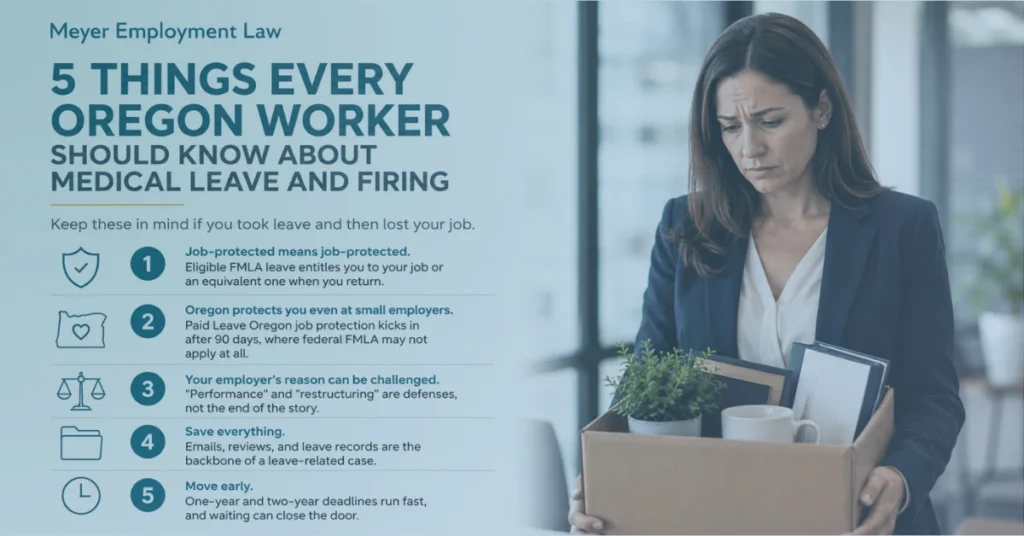
5 Things Every Oregon Worker Should Know About Medical Leave and Firing
Keep these in mind if you took leave and then lost your job.
- Job-protected means job-protected. Eligible FMLA leave entitles you to your job or an equivalent one when you return.
- Oregon protects you even at small employers. Paid Leave Oregon job protection kicks in after 90 days, where federal FMLA may not apply at all.
- Your employer’s reason can be challenged. “Performance” and “restructuring” are defenses, not the end of the story.
- Save everything. Emails, reviews, and leave records are the backbone of a leave-related case.
- Move early. One-year and two-year deadlines run fast, and waiting can close the door.
Conclusion
Being fired after doing nothing more than caring for your health or your family is disorienting, and it can feel impossible to prove. It often is not. FMLA wrongful termination cases turn on timing, consistency, and documentation, and Oregon’s combination of federal and state leave laws gives workers here a stronger position than many realize. The key is acting before deadlines and evidence slip away.
Founded by attorney Robert Meyer, Meyer Employment Law represents employees across Oregon and offers remote consultations, with a practice built entirely around protecting workers rather than the companies they work for. If you took protected leave and lost your job because of it, an honest case review can tell you where you stand.
Fired after taking medical leave? Find out where you stand. Meyer Employment Law offers a free, confidential consultation to Oregon workers, with remote options across the state. Contact Meyer Employment Law to talk through your situation.

About the Author
Robert Meyer is the founder of Meyer Employment Law and has represented employees in Oregon state and federal courts for more than a decade in workplace disputes, including sexual harassment, quid pro quo harassment, hostile work environment, retaliation, discrimination, wrongful termination, wage claims, severance agreements, and leave violations. The firm helps workers understand their rights, evaluate their legal options, and pursue accountability when employers violate Oregon and federal employment laws.