Hostile work environment retaliation can begin after an employee reports discrimination, harassment, or another workplace practice protected by law. The original complaint may go to HR, a supervisor, management, or an outside agency. Then the workplace changes. Meetings stop appearing on the calendar. A previously supportive supervisor becomes critical. Hours disappear. Coworkers are told to avoid the employee. Minor mistakes suddenly generate written warnings.
Retaliation doesn’t have to end with termination. A campaign of scrutiny, isolation, undesirable assignments, threats, schedule changes, or discipline can also matter when it begins because an employee exercised protected rights.
At Meyer Employment Law, we represent Oregon employees facing discrimination, harassment, retaliation, and other workplace disputes. The practical question in these cases is usually not whether work became unpleasant. It’s why the treatment changed and whether the evidence connects that change to protected activity.
Also Read
TL;DR
Retaliation can occur when an employer punishes an employee for reporting discrimination or harassment, participating in an investigation, requesting a protected accommodation, or engaging in other protected activity. The punishment doesn’t have to be a firing. Increased scrutiny, undesirable assignments, threats, reduced hours, exclusion, poor evaluations, demotion, or retaliatory harassment may also qualify depending on the facts. The strongest cases usually show a clear timeline: protected activity, employer knowledge, a meaningful change in treatment, and evidence connecting the two. Employees should preserve complaints, performance records, schedules, emails, disciplinary notices, witness names, and the employer’s explanations as soon as retaliation begins.
Key Takeaways
- Retaliation is a separate legal issue from the harassment or discrimination originally reported.
- An employee may be protected even when the original complaint is ultimately unsuccessful.
- Retaliation doesn’t require termination or a pay cut.
- A pattern of harassment after protected activity can itself support a retaliation claim.
- Close timing between the complaint and negative treatment can be useful evidence.
- Sudden discipline, increased scrutiny, exclusion, schedule changes, and shifting explanations deserve documentation.
- Employees should compare treatment before and after the protected activity.
- Employers can still enforce legitimate rules and performance standards, so evidence of motive matters.
What Is Hostile Work Environment Retaliation?
The phrase can describe a situation where an employee reports unlawful discrimination or harassment and then faces a hostile pattern of treatment because of that complaint.
It’s important to separate two related concepts.
A traditional hostile work environment claim usually focuses on harassment based on a protected characteristic such as race, sex, religion, disability, national origin, or another legally protected status.
A retaliation claim focuses on what happened because the employee engaged in protected activity.
The EEOC explains that retaliation generally involves three components: protected activity, a materially adverse action, and a connection between the two. A materially adverse action is one that could discourage a reasonable person from asserting protected rights.
That standard can reach conduct beyond termination.
For example, an employee reports repeated sexual comments from a supervisor. HR investigates. The employee keeps the job, but afterward the supervisor removes important accounts, excludes the employee from meetings, scrutinizes every arrival time, and begins issuing warnings for minor issues that coworkers routinely get away with.
The question is no longer limited to whether the original comments were unlawful harassment.
The employer’s response after the complaint may create a separate retaliation issue.
What Activity Is Protected From Retaliation?
Protected activity often involves either participating in an employment discrimination process or opposing conduct the employee reasonably believes violates anti-discrimination law.
Examples can include:
- Reporting sexual harassment
- Complaining about race discrimination
- Reporting discriminatory pay
- Requesting a disability accommodation
- Resisting unwanted sexual advances
- Providing information during an internal investigation
- Filing a complaint with an enforcement agency
- Serving as a witness in another employee’s discrimination matter
- Complaining about discriminatory treatment affecting a coworker
The EEOC states that employees can be protected when they reasonably oppose perceived discrimination even if they don’t use technical legal terminology. Participation in an EEO complaint process is also protected.
Oregon law also recognizes retaliation as a protected employment category. BOLI’s discrimination guidance identifies retaliation among the protections available to Oregon workers.
The complaint should still be clear enough for the employer to understand what the employee is raising.
Saying, “My manager is unfair,” may not communicate the same issue as, “I believe my manager is treating me differently because of my pregnancy.”
Specific facts make it easier to establish what was reported and when.
Can Retaliation Create a Hostile Work Environment?
Yes, depending on the conduct.
The retaliation standard isn’t always identical to the legal test for a discriminatory hostile work environment.
EEOC guidance explains that retaliatory harassment may be actionable when the conduct would deter a reasonable employee from engaging in protected activity, even if the behavior wouldn’t independently satisfy the severe-or-pervasive standard often associated with a traditional hostile work environment claim.
That distinction matters.
A supervisor’s single cold comment may not establish a retaliation claim. But a broader pattern can look different:
- Daily scrutiny after the complaint
- Being isolated from coworkers
- Repeated threats about job security
- Removal from desirable assignments
- Constant criticism not applied to other employees
- Public humiliation
- Schedule changes designed to create hardship
- Supervisors encouraging coworkers not to communicate with the employee
The analysis looks at the practical effect of the conduct and whether it could discourage an employee from asserting protected rights.

What Does Retaliation Look Like After an HR Complaint?
Many employees expect retaliation to look obvious.
It often doesn’t.
The workplace may change gradually enough that each event can be explained away on its own.
Sudden Performance Problems
An employee has consistently received satisfactory reviews. Shortly after reporting harassment, the supervisor begins documenting small mistakes and questioning work that was previously accepted.
The issue isn’t that an employee can never receive criticism after making a complaint. Protected activity doesn’t make someone immune from legitimate performance management.
The question is whether the performance problem is genuine and whether the same standards are applied consistently.
Increased Scrutiny
The employee’s work may suddenly receive a level of review that coworkers don’t experience.
Managers might:
- Monitor arrival times by the minute
- Require extra status reports
- Question routine decisions
- Demand documentation for ordinary tasks
- Review communications that were previously trusted
- Begin enforcing minor rules selectively
The EEOC specifically identifies unjustified increased scrutiny as conduct that may support retaliation depending on the circumstances.
Isolation and Exclusion
Retaliation can also affect access to information and opportunity.
An employee may stop being invited to meetings, lose important projects, or find that coworkers have been instructed to route communications through someone else.
Those changes become more significant when they affect the employee’s ability to succeed.
Schedule or Assignment Changes
A schedule change may appear neutral on paper but create a serious practical problem.
Moving an employee from a desirable day shift to nights, reducing hours, assigning less favorable work, or transferring the employee after a complaint may support a retaliation claim when the evidence connects the change to protected activity.
What Evidence Helps Prove Hostile Work Environment Retaliation?
Most retaliation cases don’t contain a written confession.
Employees usually prove motive through the timeline and surrounding evidence.
Preserve the Original Complaint
Keep the email, HR form, text message, agency filing, or other record showing what you reported.
The document can help establish:
- What you complained about
- When you complained
- Who received it
- Whether the employer knew you were asserting protected rights
If the complaint was verbal, make a contemporaneous note describing what was said and who was present.
Compare Before and After
This is often the most useful exercise.
Collect records showing how you were treated before the complaint:
- Performance reviews
- Schedules
- Assignments
- Bonuses
- Attendance history
- Disciplinary history
- Supervisor communications
Then compare what happened afterward.
A clean performance record followed by multiple warnings within weeks of a complaint may deserve closer examination.
Preserve the Employer’s Explanations
Write down what management says about each change.
If one supervisor says the employee was removed from a project because of performance and HR later says it was part of restructuring, preserve both explanations.
Changing reasons can matter when determining whether the stated explanation is the real one.
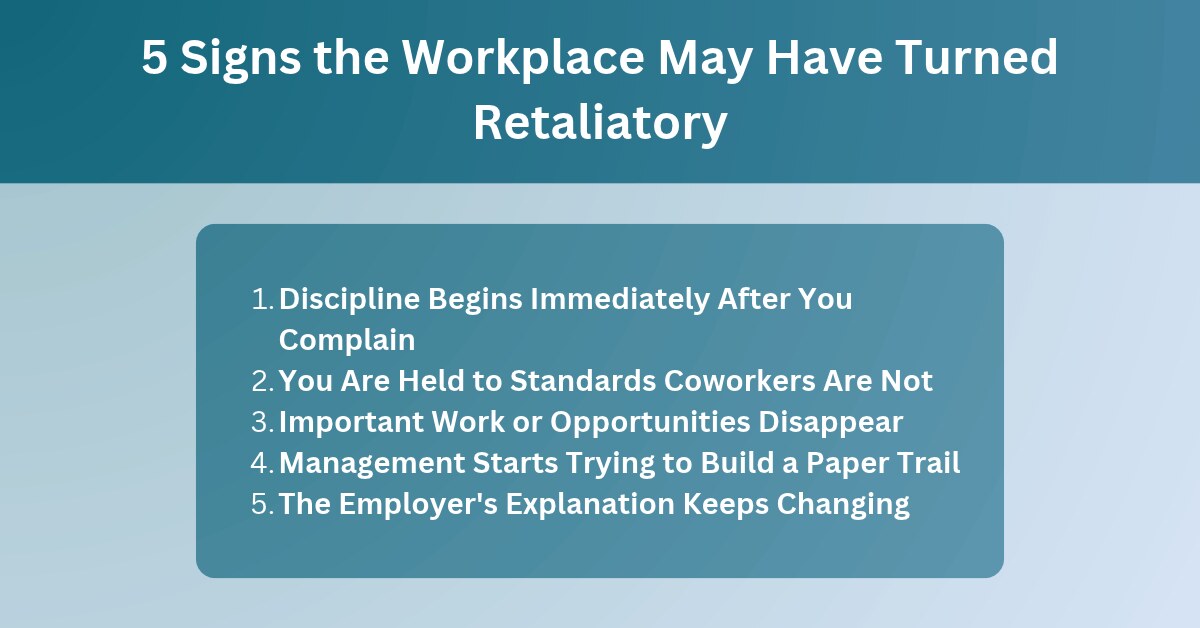
Top 5 Signs the Workplace May Have Turned Retaliatory
1. Discipline Begins Immediately After You Complain
Close timing alone doesn’t prove retaliation, but a sudden disciplinary pattern after protected activity can be important.
2. You Are Held to Standards Coworkers Are Not
Selective enforcement can help show that the employer’s explanation isn’t being applied consistently.
3. Important Work or Opportunities Disappear
Losing projects, clients, meetings, supervisory responsibilities, or advancement opportunities can materially change an employee’s position.
4. Management Starts Trying to Build a Paper Trail
Unexpected write-ups, repeated HR meetings, and performance documentation that begins only after a complaint deserve careful review.
5. The Employer’s Explanation Keeps Changing
Inconsistent explanations can raise questions about whether the stated reason is covering a retaliatory motive.
What If the Original Harassment Complaint Was Not Proven?
An unsuccessful complaint doesn’t automatically eliminate retaliation protection.
Employees are often hesitant to report discrimination because they worry they can’t prove every allegation.
Federal anti-retaliation law generally protects reasonable opposition to perceived discrimination, even when the underlying complaint doesn’t ultimately succeed. Participation in an EEO process receives broad protection as well.
That doesn’t mean every workplace complaint is protected.
Complaining about general unfairness, personality conflicts, or a manager simply being difficult is different from reporting conduct connected to discrimination or another protected legal right.
The EEOC notes that personality conflicts by themselves aren’t unlawful harassment unless the treatment is connected to a protected characteristic.
Employees should therefore describe the conduct they believe is unlawful rather than relying solely on labels such as “toxic” or “hostile.”
Can an Employer Still Discipline You After You Make a Complaint?
Yes.
Protected activity doesn’t prevent an employer from addressing legitimate performance or misconduct.
The EEOC specifically recognizes that employees who report discrimination can still be disciplined or terminated for genuine non-retaliatory reasons.
That’s why comparison evidence matters.
Suppose an employer says an employee was disciplined for missing a deadline.
Relevant questions might include:
- Was the deadline actually missed?
- Was the employee responsible for it?
- How were similar mistakes handled before the complaint?
- Did coworkers receive the same discipline?
- Was this issue documented before protected activity occurred?
- Did management follow its normal disciplinary process?
A real performance problem can be legitimate.
A minor issue selectively turned into a major offense immediately after a complaint may tell a different story.
What Should You Do When Retaliation Starts?
The most useful response is usually disciplined documentation rather than confrontation.
Start a timeline.
Record:
- The protected complaint or activity
- Who knew about it
- Each negative change afterward
- Dates and people involved
- What explanation management provided
- Witnesses who observed the treatment
Save documents you already lawfully possess, including relevant emails, schedules, reviews, HR communications, and disciplinary notices.
Don’t take confidential business records, customer information, trade secrets, or other material you’re not entitled to keep.
If the employer has a retaliation reporting process, consider whether another written complaint is appropriate. Describe the change in treatment factually.
For example:
“I reported discrimination to HR on August 4. Since that complaint, I have been removed from three recurring meetings, received two written warnings for conduct that was not previously treated as disciplinary, and had my schedule changed. I am concerned these actions are retaliation for my complaint.”
That creates a clearer record than simply telling HR that the workplace feels hostile.
Employees dealing with retaliation can learn more about their options through Meyer Employment Law.
When Can Oregon Employees File a Retaliation Complaint?
The filing route and deadline depend on what protected activity triggered the retaliation.
For example, BOLI maintains a process for employees alleging retaliation connected to workplace health or safety activity and states that those complaints must be filed within one year of the discriminatory action.
Employees can review Oregon’s official retaliation complaint information for that process.
Other discrimination and retaliation claims can involve different state or federal procedures and deadlines.
The EEOC also accepts charges involving retaliation under federal employment discrimination laws. Its retaliation guidance explains protected activity, materially adverse actions, and common evidence used to evaluate these claims.
Because multiple statutes can apply to the same workplace events, employees shouldn’t assume that every retaliation claim has the same deadline.
Should You Quit if the Workplace Becomes Hostile?
Don’t resign impulsively.
Retaliation can make employees feel that quitting is the only practical option, but resignation can change the legal issues in a case.
Before leaving, preserve the record and consider getting advice about:
- The severity of the conduct
- What complaints have already been made
- Whether management has been given a chance to respond
- Whether another reporting channel exists
- Whether medical leave or an accommodation is relevant
- Whether the conditions could support a constructive discharge argument
- How resignation could affect unemployment benefits or damages
Sometimes leaving is necessary for health, safety, or personal reasons. The point isn’t that an employee must stay indefinitely. The timing and documentation surrounding resignation can matter later.
FAQs
Can retaliation happen without being fired?
Yes. Depending on the facts, retaliation can include demotion, reduced hours, undesirable assignments, negative evaluations, threats, increased scrutiny, exclusion, harassment, or other materially adverse treatment.
What counts as protected activity?
Protected activity can include reporting discrimination or harassment, participating in an investigation or EEO proceeding, requesting certain accommodations, resisting discriminatory conduct, or supporting another employee’s discrimination complaint.
Is a hostile manager automatically creating an illegal hostile work environment?
No. General hostility, personality conflicts, or poor management aren’t automatically unlawful. Traditional hostile work environment claims generally require harassment connected to a legally protected characteristic. Retaliatory harassment focuses on treatment caused by protected activity.
Does HR have to agree with my original complaint for me to be protected?
Not necessarily. Employees can be protected from retaliation even when an underlying discrimination complaint is ultimately unsuccessful, depending on the type of protected activity and applicable law.
What evidence is most useful in a retaliation case?
The original complaint, emails, performance records, schedules, disciplinary notices, witness information, employer explanations, and a detailed timeline showing treatment before and after protected activity can all be important.
Should I quit if retaliation is making the workplace unbearable?
Don’t make the decision solely from a legal perspective or without considering your personal circumstances, but speak with an employment lawyer before resigning when possible. The timing and reasons for resignation may affect later claims.
Conclusion
Speaking up about discrimination or harassment shouldn’t become the reason your working conditions suddenly deteriorate.
Hostile work environment retaliation is often proved through a pattern rather than one dramatic event. The original complaint establishes protected activity. The next question is what changed afterward. Did discipline begin? Were opportunities removed? Did management start applying rules differently? Did the explanation for those decisions remain consistent?
Build the timeline before the details disappear.
Preserve the complaint, performance history, emails, schedules, disciplinary documents, and management explanations. Compare how you were treated before speaking up with what happened afterward.
Meyer Employment Law represents Oregon employees in retaliation, discrimination, harassment, wrongful termination, and related workplace disputes. If your work environment became materially worse after you asserted protected rights, a focused review of the timeline and evidence can help determine whether the change was ordinary workplace management or unlawful retaliation.
About the Author
Robert Meyer is the founder of Meyer Employment Law and has represented employees in Oregon state and federal courts for more than a decade. His practice includes workplace retaliation, discrimination, harassment, wrongful termination, wage disputes, protected leave, and other employment law matters.
Meyer Employment Law represents employees rather than employers and helps Oregon workers evaluate what happened, preserve relevant evidence, and understand the legal options available when asserting workplace rights leads to negative treatment. Learn more about Robert Meyer and the firm’s employee-focused practice on the About Meyer Employment Law page.