An unpaid overtime lawyer can help when the hours you worked and the wages you received don’t match. Maybe you regularly worked more than 40 hours but never saw overtime. Perhaps your employer put you on salary and said overtime no longer applied. Or you clocked out on time but were still expected to answer messages, finish reports, or complete closing work.
Oregon overtime disputes usually require more than checking one paycheck. The real questions are how many compensable hours you worked, whether you were properly classified, what your regular rate should have been, and what records can prove the difference.
Meyer Employment Law represents Oregon employees in employment wage claims involving unpaid wages, overtime, classification, final pay, and related workplace disputes.
Also Read
- Overtime for Salaried Employees: When Oregon Workers Are Still Entitled to Extra Pay
- Salaried Employee Rights in Oregon: Overtime, Hours, and Misclassification
- Employee Rights to Meal and Rest Breaks in Oregon
TL;DR
Most nonexempt Oregon employees must receive overtime when they work more than 40 hours in a workweek. Being paid a salary, holding a management title, or working overtime without prior approval doesn’t automatically eliminate that right. An overtime claim may involve missing hours, off-the-clock work, an incorrect regular rate, automatic meal deductions, or improper classification. An attorney can review the pay structure, reconstruct hours, evaluate exemptions, calculate unpaid wages, and determine which legal options fit the situation.
Key Takeaways
- Most nonexempt Oregon employees receive overtime at 1.5 times their regular rate for hours worked over 40 in a workweek.
- Salary alone doesn’t make an employee exempt.
- Work performed before clocking in or after clocking out can still be compensable.
- Employers generally must pay for overtime worked even when the employee didn’t obtain required advance approval.
- Bonuses and other compensation can sometimes affect the regular rate used to calculate overtime.
- Pay stubs, schedules, emails, messages, timecards, and electronic records can help establish missing hours.
- Oregon overtime claims generally have a two-year limitations period, making early review important.
When Should You Contact an Unpaid Overtime Lawyer?
One payroll mistake can usually be fixed without legal action. A recurring pattern deserves a closer look.
Legal review becomes especially useful if you regularly worked more than 40 hours without receiving overtime, your employer disputes the hours, you were classified as exempt, or you performed substantial off-the-clock work.
The same is true if the company changed time records or told employees that overtime wouldn’t be paid unless it was preapproved.
You Regularly Work More Than 40 Hours
Oregon generally requires most employers to pay covered nonexempt employees 1.5 times their regular rate for hours worked beyond 40 during a workweek. The workweek is a recurring seven-day period and isn’t necessarily the same as the employer’s payroll period.
Suppose you work 46 hours during one week and 34 during the next. The employer can’t ordinarily average the two weeks into 40 hours each simply because they fall within the same two-week pay period. The first week still gets its own overtime analysis.
You Were Told Salary Means No Overtime
Being salaried and being exempt aren’t the same thing.
BOLI states that salaried employees must receive overtime unless they meet a legal exemption and that the employer bears the burden of establishing exempt status.
Actual job duties matter. An employee may have a title such as manager, administrator, coordinator, or supervisor while spending most of the workday performing routine frontline tasks.
If the legal exemption doesn’t fit the actual job, the employee may still have overtime rights. Oregon workers dealing with this issue can also review how exempt and non-exempt classifications work.
Common Ways Overtime Goes Unpaid
Some overtime violations are obvious. Others are built into normal workplace routines and may continue for months before anyone questions them.
Working Before or After the Shift
Employees may be expected to:
- Set up equipment before clocking in
- Finish reports after clocking out
- Close a workplace after their paid shift ends
- Check email from home
- Respond to required messages
- Complete administrative work after customer-facing duties end
- Attend required meetings or training
Oregon BOLI explains that compensable work includes time an employee is required to give the employer and time the employee is suffered or permitted to work.
A few minutes may not look significant on one day. Repeated every shift, it can become substantial.
For example, 15 minutes of unpaid work before a shift and 15 minutes afterward equals two and a half additional hours during a five-day week.
Automatic Meal Deductions
Some payroll systems automatically remove a meal period from each shift. That system becomes a wage problem when an employee regularly works during the deducted period.
An employee may answer phones, respond to customers, complete paperwork, supervise workers, or remain actively engaged in job duties while payroll still deducts the meal period.
Over months of employment, those deductions can add up.
Changed or Rounded Time Records
Another warning sign is a timecard that doesn’t match what the employee remembers working.
Examples include:
- Clock-out times moved earlier
- Overtime hours deleted
- Time repeatedly rounded downward
- Supervisors instructing employees to change time entries
- Recorded hours reduced to match the scheduled shift
One correction might have a legitimate explanation. When the edits keep happening, they deserve scrutiny.
Unrecorded Remote Work
Remote work can make overtime less visible.
An employee may leave the workplace at 5:00 p.m. but continue answering messages, reviewing documents, taking calls, or completing assignments later that evening.
If that work is expected and management knows it is occurring, those hours may belong in the wage analysis.

What Evidence Helps Prove Unpaid Overtime?
Overtime cases often turn on ordinary records rather than a single dramatic document.
The goal is to build a timeline showing when work occurred, what the employer recorded, and what the employee was actually paid.
Start With Payroll and Time Records
Useful records include:
- Pay stubs
- Timecards
- Work schedules
- Payroll summaries
- Bonus records
- Commission statements
- Attendance records
Compare the records week by week.
Don’t look only at the total hours in the pay period. Overtime generally depends on the employer’s defined workweek.
Preserve Evidence of Work Outside Recorded Hours
Other documents can help establish when work actually occurred:
- Emails
- Text messages
- Slack or Teams messages
- Calendars
- Customer appointments
- Dispatch records
- Work orders
- Computer login information
- Building access records
- Supervisor instructions
A single late-night email doesn’t necessarily prove an overtime claim, but a recurring pattern of after-hours work that management requests or acknowledges carries more weight.
Employees should preserve records they can lawfully access. Don’t take trade secrets, protected customer information, or confidential business files simply because they might relate to a dispute.
What Does an Unpaid Overtime Lawyer Actually Do?
An attorney does more than multiply an hourly rate by the number of missing hours.
The first step is usually identifying why the overtime went unpaid.
Determine Whether an Exemption Applies
A lawyer may review:
- Actual job duties
- Management responsibilities
- Decision-making authority
- Salary structure
- Payroll deductions
- Job descriptions
- Employment agreements
- Contractor classifications
This helps determine whether the employer’s classification matches the legal requirements.
Reconstruct Missing Work Time
When timecards are incomplete, other evidence may help reconstruct the workweek.
An attorney can compare schedules, communications, payroll records, electronic activity, witness information, and the employee’s recollection to identify a consistent pattern.
Reconstruction rarely means proving every minute from memory; it means building the clearest record the available evidence supports.
Check the Regular Rate
The overtime rate isn’t always tied only to the employee’s stated hourly wage.
The U.S. Department of Labor explains that the regular rate generally includes compensation for employment unless a statutory exclusion applies. Certain nondiscretionary bonuses and incentive payments can therefore increase the rate used to calculate overtime.
Employees receiving bonuses, commissions, shift differentials, or multiple hourly rates should have the calculation reviewed rather than assuming payroll used the correct number.
Can Your Employer Refuse to Pay Unauthorized Overtime?
An employer can require employees to obtain approval before working overtime.
The employer may also discipline an employee who ignores that policy.
But Oregon BOLI states that employees must still be compensated for overtime hours they actually work, even if the overtime was unauthorized.
This distinction often matters when a manager says:
“You’re not authorized to work overtime, but all of this needs to be finished tonight.”
The policy may say one thing while the actual workload requires another.
When that happens repeatedly, save the assignments, emails, messages, and schedules showing what was expected.
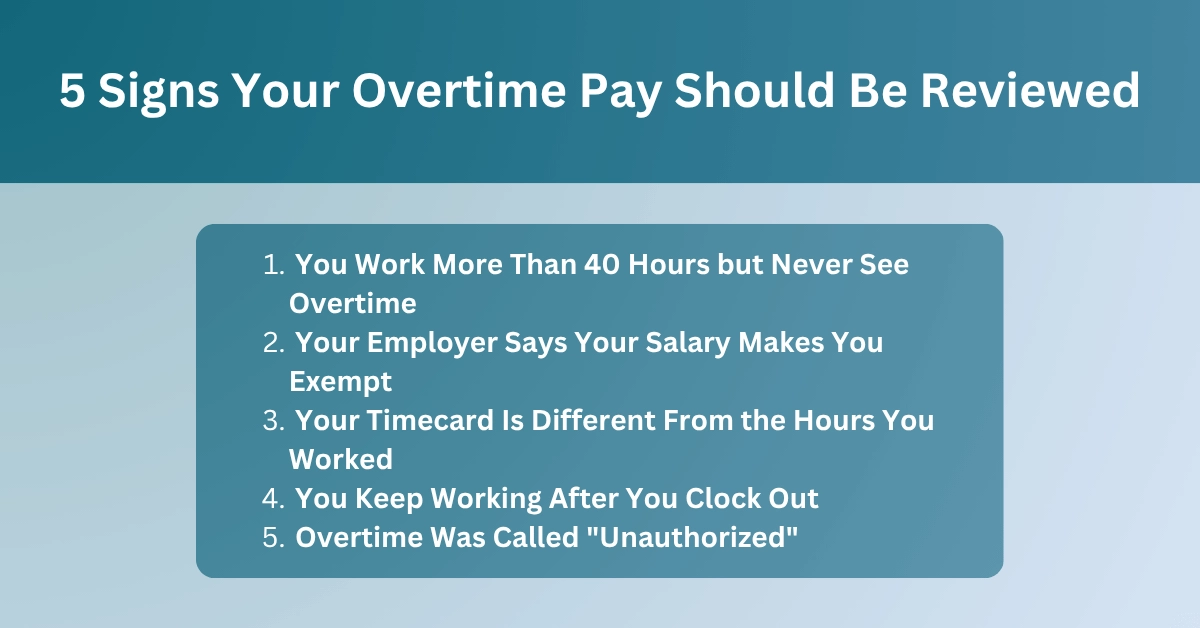
Top 5 Signs Your Overtime Pay Should Be Reviewed
1. You Work More Than 40 Hours but Never See Overtime
Consistent work beyond 40 hours without an overtime premium is the most obvious reason to review your pay.
2. Your Employer Says Your Salary Makes You Exempt
Salary alone doesn’t establish exempt status. Actual duties and the applicable exemption requirements matter.
3. Your Timecard Is Different From the Hours You Worked
Repeated edits, automatic deductions, or missing time may indicate that payroll records don’t reflect what you actually worked.
4. You Keep Working After You Clock Out
Emails, reports, phone calls, closing responsibilities, and remote tasks can create unpaid work time.
5. Overtime Was Called “Unauthorized”
An approval policy may affect workplace discipline, but it doesn’t remove the obligation to compensate hours the employer permitted an employee to work.
What Can You Recover in an Oregon Overtime Claim?
The starting point is the overtime compensation that should have been paid.
Depending on the facts and claims involved, additional remedies may also be available, including statutory damages, penalties, interest, attorney fees, or costs.
Misclassification can increase the scope of the dispute because the employee may have gone without overtime for an extended period.
BOLI’s 2026 employment law guidance notes that misclassification can expose employers to back wages and other financial consequences, including unpaid overtime.
The exact recovery depends on the facts, so damages should come from actual payroll and time records, not an estimate off a single paycheck.
How Long Do You Have to Pursue Unpaid Overtime?
Oregon law provides a two-year limitations period for actions involving overtime or premium pay, including related penalties or liquidated damages.
That doesn’t mean employees should wait two years.
Delay can create practical problems long before the legal deadline arrives. Former employees may lose access to scheduling apps, work email, timekeeping systems, coworkers, and other evidence.
Employers also have record-retention obligations. BOLI states that employers must generally retain time records for two years and payroll records for three years. If you think overtime has been missing, start collecting your records now.
What to Do Before Speaking With a Lawyer
You don’t need to prepare a complete legal case before asking for advice.
Start with the basics:
- Gather several recent pay stubs.
- Save available schedules and timecards.
- Write down your typical start and end times.
- Identify recurring work performed off the clock.
- Save messages showing supervisors knew about the extra work.
- Write down when the practice started.
- Note whether coworkers were affected the same way.
If you were classified as exempt, also write down what you actually did during a normal workday. Focus on real duties rather than the wording in your job description.
Meyer Employment Law handles Oregon employment wage claims involving unpaid overtime, classification, and other wage disputes. Early review can help determine whether the issue is a correctable payroll mistake or part of a broader wage violation.
FAQs
Can salaried employees get overtime in Oregon?
Yes. Salaried employees may still be entitled to overtime unless they qualify for a recognized exemption. Salary alone doesn’t determine exempt status.
Can I recover overtime if I didn’t keep my own time records?
Potentially. Timecards are useful, but schedules, emails, messages, electronic records, witness testimony, and other evidence may help establish hours worked.
Is overtime based on eight hours per day in Oregon?
Generally, overtime is based on more than 40 hours in a workweek. Certain industries, including some manufacturing work, have special daily overtime rules.
Can my employer average two weeks together?
Generally, no. Overtime is calculated using the defined workweek, not by averaging hours across separate workweeks.
What if I worked overtime without permission?
An employer may enforce a policy requiring authorization, but BOLI states that employees must still be compensated for hours they actually worked.
How long do I have to bring an Oregon overtime claim?
Oregon’s statute generally provides two years for actions involving overtime or premium pay. Review the specific claims and circumstances promptly, because different wage issues can involve different rules.
Conclusion
Unpaid overtime isn’t always obvious. It can show up as a salaried position classified incorrectly, automatic meal deductions, work performed after clocking out, altered time records, or an overtime rate calculated from the wrong regular rate.
An unpaid overtime lawyer can review the workweek, pay youructure, classification, and available records to determine whether compensation is missing and what options are available.
If you have worked beyond your recorded hours or were told that salary status or an overtime approval policy meant you couldn’t be paid, save your pay records and communications while they are still available. The sooner the pattern is reviewed, the easier it is to determine what happened and whether an Oregon wage claim may be appropriate.
Meyer Employment Law represents Oregon employees, not employers, in wage and hour disputes and helps workers understand whether the wages they received match the hours they actually worked.
About the Author
Robert Meyer is the founder of Meyer Employment Law and has represented Oregon employees in state and federal workplace disputes for more than a decade. His practice includes unpaid wages, overtime disputes, misclassification, retaliation, discrimination, wrongful termination, and other employment law matters.
Meyer Employment Law focuses on representing employees and helping workers understand and enforce their workplace rights. Learn more about Robert Meyer and the firm’s employee-focused approach on the About Meyer Employment Law page.