Wrongful termination after injury happens when an Oregon employer treats a workplace accident, workers’ compensation claim, medical restriction, or recovery period as a reason to push an employee out. Almost no employer says that out loud. You’ll hear restructuring, attendance, performance, or an inability to do the job.
So the real question usually isn’t whether you were fired after an injury. It’s whether the reason you were given is the reason you were fired.
Oregon law protects injured workers, and those protections can start before a workers’ compensation claim is finished. Reporting an on-the-job injury, asking about benefits, or taking part in the workers’ compensation system can be enough to trigger them.
Proving why the termination happened takes more than timing. It takes a record: what your performance looked like before the injury, how your employer treated other workers in the same situation, whether anyone followed the company’s own discipline policy, and whether the explanation stayed the same from the termination meeting to the unemployment hearing.
Meyer Employment Law represents Oregon employees in wrongful termination matters involving retaliation, workplace injuries, discrimination, protected leave, and other unlawful reasons for termination.
Also Read
- Retaliation After a Workplace Injury: Understanding Workers’ Comp Retaliation in Oregon
- Understanding Wrongful Termination
- Oregon Workers’ Rights
TL;DR
Oregon employers generally can’t fire, demote, discriminate against, or otherwise punish you because you got hurt at work, asked about workers’ compensation benefits, filed a claim, or used rights the workers’ compensation system gives you. A termination after an injury isn’t automatically illegal. But close timing, sudden discipline, inconsistent explanations, a refusal to discuss reinstatement, and different treatment after the injury can all support a retaliation or discrimination claim. Save your medical restrictions, injury reports, claim records, performance reviews, messages, and termination documents as soon as you can.
Key Takeaways
- Oregon law protects employees from discrimination because of workplace injuries or illnesses.
- Protection can start before you finish a formal claim.
- An employer can still make legitimate decisions after an injury, but it can’t use the injury or the claim as the real reason.
- Employers with six or more employees generally owe reemployment rights, and larger employers owe reinstatement to the former job.
- Timing alone doesn’t prove retaliation, but a firing soon after an injury is important evidence.
- Sudden write-ups, attendance problems, schedule changes, and shifting explanations can strengthen a claim.
- Save your records before you lose access to the workplace.
- A workers’ compensation claim and a wrongful termination claim can involve different rights and remedies.
When Can a Workplace Injury Lead to Wrongful Termination?
Getting hurt doesn’t make you fireproof. Your employer can still make lawful decisions for legitimate reasons that have nothing to do with the injury.
The legal problem starts when the injury, the claim, your restrictions, or your use of protected rights becomes the reason.
Oregon’s Bureau of Labor and Industries says employers can’t discriminate against workers because of a workplace injury or illness. Those protections apply to every Oregon employer, and reinstatement and reemployment obligations can apply on top of them, depending on the employer and the circumstances.
A termination raises real questions when you had a stable work history before the injury and your treatment changed right after it.
For example, an employee might:
- Report an injury on Monday
- Receive medical restrictions later that week
- File or ask about a workers’ compensation claim
- Suddenly receive disciplinary notices for issues never raised before
- Lose scheduled hours
- Be told the company can’t accommodate restrictions
- Be terminated shortly afterward
No single fact there proves anything. Together they build a timeline that deserves a hard look.
Wrongful Termination After Injury Does Not Require a Completed Claim
One of Oregon’s most important protections: you don’t necessarily have to finish filing a workers’ compensation claim before anti-discrimination rights apply.
BOLI explains that an employee may be protected after informing an employer about an on-the-job injury, asking about filing a claim, or participating in another worker’s claim.
Employers sometimes move fast after they learn about an injury.
One worker reports back pain after lifting equipment and loses his shifts the same day. Another asks HR how to start a workers’ compensation claim and gets fired before anyone makes a formal determination.
An employer can’t escape Oregon’s protections just because the paperwork wasn’t finished.
The question is usually whether your employer knew about the injury or the claim, and whether that knowledge shaped the decision to fire you.
How an Employer’s Stated Reason Gets Tested
When you challenge a termination, your employer offers a lawful explanation. Your job is to show that the explanation doesn’t hold up. Four kinds of evidence do most of that work.
How Your Employer Treated Other Workers
This is often the strongest evidence, and most people never think to look for it. If three other workers broke the same attendance rule and got a verbal warning while you got fired, the rule isn’t what ended your job. Write down who else did what you were fired for, what happened to them, and how you know. Names, dates, and specifics carry more weight than impressions.
Whether Anyone Followed the Company’s Own Policy
Most employers publish a progressive discipline process: verbal warning, written warning, final warning, termination. If your handbook describes four steps and your employer jumped to the last one two weeks after your claim, that gap is evidence. Save the handbook before you lose access to it.
Who Made the Decision and What They Knew
A retaliation claim needs a connection between your protected activity and the person who ended your job. Ask who actually decided, when they learned about your injury or claim, and how they found out. A supervisor who complained about your restrictions in a team meeting and then recommended your termination is a very different record from a regional manager who never heard about the injury at all.
Whether the Explanation Stayed the Same
An employer who tells you one thing on your last day, writes something else on your separation paperwork, and argues a third version to the unemployment office has a credibility problem. Keep every version in writing.
What Workplace Injury Retaliation Looks Like
Retaliation isn’t limited to termination.
Oregon workers often see a gradual change in treatment after they report an injury.
Common examples include:
- Reduced hours
- Worse shifts
- Removal from preferred assignments
- Sudden negative performance reviews
- New attendance discipline
- Unwarranted write-ups
- Demotion
- Loss of responsibilities
- Hostile comments about the injury
- Pressure to return before medical release
- Pressure not to pursue workers’ compensation
- Termination
Oregon OSHA similarly identifies dismissal, demotion, reduction in pay or hours, undesirable assignments, harassment, loss of seniority, and denial of benefits as examples of potential retaliation in the health and safety context.
The change in treatment matters because employers rarely write, “You are being fired because you got hurt.”
Lawyers build most cases from the facts around the firing.
We cover the full range of retaliation, along with your reinstatement rights and how to file a complaint with BOLI, in Retaliation After a Workplace Injury: Understanding Workers’ Comp Retaliation in Oregon. This article picks up where that one leaves off. If you have already been fired and your employer gave you a reason, the rest of this page is about testing that reason.
Two Terminations, Two Very Different Records
Timing is where an employment lawyer starts, but timing alone proves very little.
Compare these two records.
Picture a termination that likely holds up for the employer. Six months of documented warnings for the same issue. A final written warning in the file, signed. The employee breaks the same rule again. Two other workers were fired for the same thing in the past year. The injury was minor, unrelated, and three months earlier. Every explanation matches.
Now picture one that invites scrutiny. Four years of strong reviews and a raise last spring. The employee reports an injury on a Monday, gets restrictions that Friday, and asks HR about filing a claim. The first write-up in four years arrives nine days later for communication issues. The handbook calls for a verbal warning first. Two weeks after that, the employee is gone. The termination notice says restructuring. The unemployment response says performance.
Both employees got hurt and then lost their jobs. Only one of those records raises a real question about why.
Build your own timeline while the details are fresh. Include:
- Date of the injury
- Date the employer learned about it
- Date the employee requested or discussed workers’ compensation
- Medical appointments and restrictions
- Communications about returning to work
- Changes in schedule, duties, or treatment
- Discipline issued after the injury
- Termination date
- The employer’s stated reason
Write it down before the details blur. Memory fades fast after a firing, and the documents won’t fill every gap.

Can an Employer Fire You for Not Being Able to Do Your Old Job Yet?
Not necessarily, and Oregon’s rules here surprise people.
If your employer has six or more employees, it generally has to reemploy you in an available, suitable position when you can work but can’t yet perform your former job. A suitable position means one that’s substantially similar in pay, duties, skills, location, and shift. Larger employers carry a further obligation to return workers to their actual former positions, and timing limits apply to both.
Your exact rights depend on your condition and your employer’s circumstances.
Your employer can ask for medical evidence that you’re able to return. What it shouldn’t do is treat a temporary restriction as the end of your employment rights.
If you’re in that position, save:
- Medical releases
- Work restrictions
- Return-to-work communications
- Modified-duty discussions
- Job descriptions
- Emails with HR
- Available-position information
These records show what your employer knew and whether it seriously evaluated bringing you back.
What If the Employer Has an Automatic Termination Policy?
A neutral-looking attendance policy doesn’t settle the question.
An employer might have a policy stating that workers absent for a certain number of days are automatically terminated.
BOLI specifically warns that applying such a policy to a worker receiving temporary disability leave or who still has reinstatement or reemployment rights can create discrimination concerns under Oregon law.
So an employer shouldn’t assume a general attendance policy overrides rights tied to an occupational injury.
The same principle makes documentation important. If HR says, “Our policy automatically terminates anyone gone 30 days,” save the policy and the communication.
A policy can become part of the evidence rather than the end of the analysis.
What Evidence Helps Prove the Termination Was Connected to the Injury?
Ordinary workplace records prove most cases.
The strongest evidence compares what your job looked like before the injury with what happened after.
Performance Records
Save reviews, commendations, raises, bonuses, and prior discipline.
A long record of solid work followed by sudden criticism after an injury carries weight.
Injury and Workers’ Compensation Records
Preserve:
- Injury reports
- Claim paperwork
- Medical restrictions
- Work releases
- Communications with claims representatives
- HR emails about the injury
- Return-to-work correspondence
These documents establish what your employer knew and when.
Messages and Emails
Save communications involving supervisors, HR, scheduling, restrictions, and termination.
Statements such as “we need someone who can actually be here” or complaints about workers’ compensation costs may become important when connected to the employment decision.
Termination Documents
Keep the termination notice, separation agreement, unemployment paperwork, and any written explanation.
If the reason changes later, preserve every version.
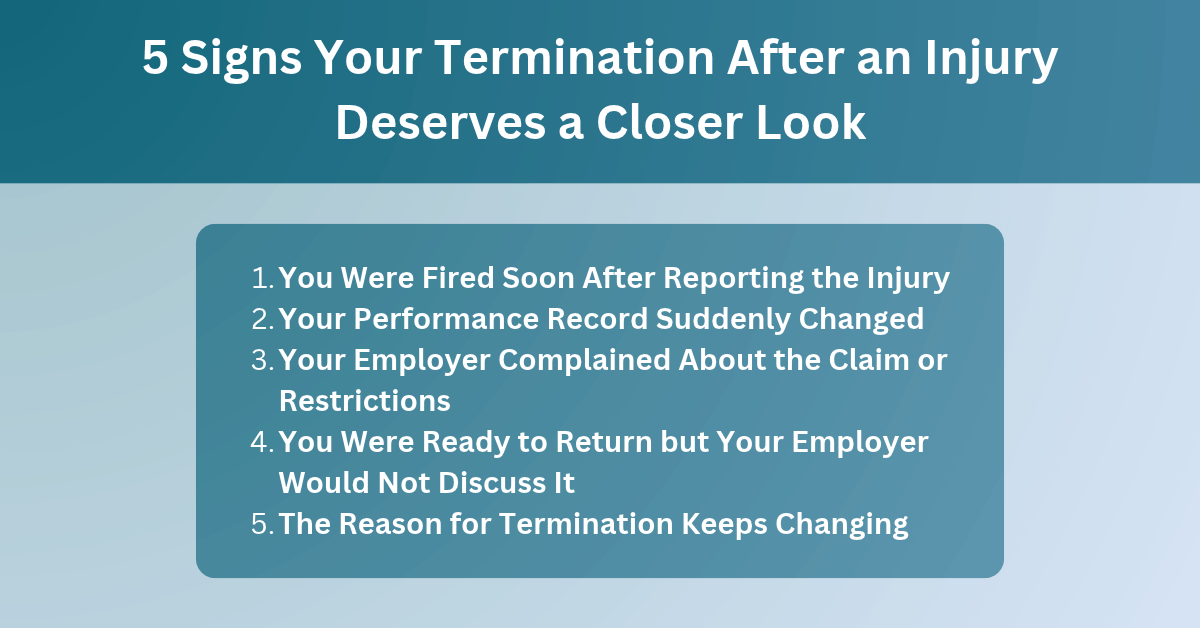
Top 5 Signs Your Termination After an Injury Deserves a Closer Look
1. You Were Fired Soon After Reporting the Injury
Close timing doesn’t establish retaliation by itself, but it’s one of the first facts anyone checks.
2. Your Performance Record Suddenly Changed
A clean record followed by sudden discipline after an injury raises questions about motive.
3. Your Employer Complained About the Claim or Restrictions
Comments about workers’ compensation costs, inconvenience, staffing, medical appointments, or restrictions may become relevant.
4. You Were Ready to Return but Your Employer Wouldn’t Discuss It
Oregon’s reinstatement and reemployment rules may apply when an injured worker can return to the former position or another suitable position.
5. The Reason for Termination Keeps Changing
One explanation at termination and a different one later damages your employer’s credibility, and it becomes evidence that the stated reason wasn’t the real one.
What Should You Do If You Are Fired After a Workplace Injury?
The first few days matter.
Start by saving records you already lawfully have. Don’t take confidential company information, customer data, trade secrets, or documents you aren’t entitled to keep.
Save:
- Injury reports
- Pay stubs
- Medical restrictions
- Workers’ compensation notices
- Schedules
- Performance reviews
- Relevant emails and texts
- Termination paperwork
- Employee handbook provisions
Then write a detailed timeline.
Ask for the termination reason in writing if nobody gave you one. Avoid arguing extensively with HR or posting about the dispute publicly.
If you receive a severance agreement or release, review it carefully before signing. A release can affect legal claims arising from the termination.
Keep handling the workers’ compensation process separately. A workers’ compensation case and an employment retaliation claim may arise from the same injury but address different legal problems.
Where Can Oregon Employees Report Workplace Injury Retaliation?
BOLI enforces Oregon’s workplace injury discrimination protections and runs the complaint process for workers who believe an employer broke the law.
You can review Oregon’s official workplace injury protections for workers for information about discrimination, reinstatement, and reemployment rights.
Safety-related retaliation may involve additional protections. Oregon OSHA says workers who believe they faced retaliation for reporting or opposing health and safety violations can file a complaint with BOLI within one year of the retaliation.
If your case involves safety retaliation, review Oregon OSHA’s retaliation protections for workers.
Different claims run on different clocks, so don’t assume one deadline covers your whole situation.
What Can a Wrongful Termination Claim Address?
A workers’ compensation proceeding generally focuses on benefits connected to the occupational injury.
A wrongful termination or retaliation claim focuses on what the employer did because of the injury or protected activity.
Depending on the legal claims and facts, potential remedies can include lost wages, reinstatement, other economic losses, and additional relief authorized under Oregon employment law.
The employment claim may also overlap with disability discrimination, protected leave, safety complaints, whistleblower activity, or other unlawful employment practices.
That overlap is why you shouldn’t treat the firing as one more piece of workers’ compensation paperwork.
If you think your injury became the reason your job ended, review the broader framework for Oregon wrongful termination claims and determine which protections fit the actual facts.
FAQs
Can my employer fire me after I file a workers’ compensation claim in Oregon?
Your employer can still make legitimate decisions after a workplace injury. What Oregon law prohibits is discrimination because you applied for benefits or used workers’ compensation protections. So the reason for the firing is what matters.
Do I have to file a workers’ compensation claim before I am protected?
Not necessarily. BOLI states that informing the employer about an on-the-job injury, asking about filing a claim, or participating in another worker’s claim can trigger anti-discrimination protections.
Can my employer fire me because I am temporarily unable to perform my normal job?
The answer depends on the circumstances. Oregon provides reinstatement and reemployment protections for many injured employees, including rights that may apply when an employee can perform a suitable position even if the former job is temporarily unavailable to them.
What evidence should I save after being fired?
Save your injury reports, workers’ compensation records, medical restrictions, schedules, performance reviews, emails, text messages, disciplinary documents, termination paperwork, and anything about returning to work.
Does being fired immediately after an injury prove retaliation?
No. Timing is important evidence, but the entire record matters. Courts and agencies may also consider performance history, employer knowledge, statements, treatment of other workers, disciplinary history, and whether the employer’s explanation is consistent.
Can I have both a workers’ compensation case and a wrongful termination case?
Potentially. Workers’ compensation benefits and employment retaliation or discrimination claims address different legal issues. The same workplace injury can sometimes lead to both.
Conclusion
A workplace injury can change what you’re able to do for a while. It doesn’t hand your employer a reason to end your job and call it something else.
Wrongful termination after injury cases get decided on the record. What did your performance look like before? Who knew about the injury, and when? How did your employer treat other workers in the same position? Did anyone follow the company’s own policy? Did the explanation hold still?
Documents answer those questions. Assumptions don’t.
If you were fired after reporting an injury, asking about workers’ compensation, receiving restrictions, or trying to return, start saving documents now, before your access disappears. Your termination may have been lawful. But if the reason you were given doesn’t match what actually happened, that’s worth a second look.
Meyer Employment Law represents Oregon employees in wrongful termination, retaliation, discrimination, and related workplace disputes and can evaluate whether an employer’s stated reason for termination matches what actually happened.
About the Author
Robert Meyer is the founder of Meyer Employment Law and has represented Oregon employees in state and federal workplace disputes for more than a decade. His experience includes wrongful termination, workplace retaliation, discrimination, wage claims, protected leave, and other employment matters affecting Oregon workers.
Meyer Employment Law focuses on representing employees rather than employers and helps workers understand their rights when workplace decisions may violate Oregon or federal law. Learn more about Robert Meyer and the firm’s employee-focused practice on the About Meyer Employment Law page.