Wrongful termination after maternity leave can leave new parents overwhelmed, financially stressed, and unsure of what to do next. In Oregon, an employer generally cannot fire an employee for taking protected leave, requesting pregnancy-related accommodations, or asserting rights connected to childbirth and recovery. Even in an at-will employment state like Oregon, wrongful termination laws can protect employees from firings that are unlawful.
The legal protections may come from several sources at once. Depending on the facts, a worker may have rights under the Oregon Family Leave Act, Paid Leave Oregon protections, federal FMLA rules, the Pregnancy Discrimination Act, or the Pregnant Workers Fairness Act. That overlap matters because the strongest claim is often built by looking at the entire timeline, not just the day of termination.
Also Read
- Unlawful Termination Due to Maternity Leave in Oregon
- Can Employers Deny Maternity Leave in Oregon? Know the Law
- Pregnancy Discrimination Attorney Oregon
- Oregon Wrongful Termination Lawyer
- Employment Law Services in Oregon
TL;DR
If you were fired during pregnancy leave, right after returning from maternity leave, or soon after asking for accommodations related to pregnancy or childbirth, you may have a legal claim in Oregon. State and federal law can protect leave, prohibit retaliation, and ban discrimination based on pregnancy, childbirth, and related medical conditions. Oregon workers may also have protections when they ask about or use Paid Leave Oregon.
5 Key Takeaways
- Oregon law may protect leave connected to childbirth, recovery, and certain pregnancy-related conditions.
- FMLA can provide up to 12 weeks of job-protected leave for birth and bonding for eligible employees.
- Employers may not retaliate against eligible workers for asking about or using Paid Leave Oregon.
- Pregnancy, childbirth, and related medical conditions are protected under federal anti-discrimination law, and covered employers may need to provide reasonable accommodations.
- A firing that happens right after maternity leave is not automatically unlawful, but timing, comments, shifting explanations, and leave interference can all be important evidence.
When is termination after maternity leave illegal in Oregon?
Not every unfair firing is illegal, but some terminations after maternity leave clearly cross the line.
Oregon generally follows at-will employment rules, but employers still cannot terminate workers for unlawful reasons. Oregon employees may have claims when they are fired for reasons that violate anti-discrimination laws, retaliation protections, or other protected rights.
Common situations that may support a claim
- You were fired for taking protected leave: If you were eligible for FMLA, OFLA, or job-protected Paid Leave Oregon, a termination tied to that leave may be unlawful.
- You were terminated because of pregnancy or childbirth: Federal law treats discrimination based on pregnancy, childbirth, or related medical conditions as unlawful sex discrimination.
- You asked for accommodations and lost your job: The PWFA generally requires covered employers to provide reasonable accommodations for known limitations related to pregnancy, childbirth, or related medical conditions unless doing so would create undue hardship.
- Your employer retaliated after you asserted your rights: Oregon workers are protected from retaliation in several maternity-leave-related contexts, including Paid Leave Oregon and discrimination complaints.
A firing after maternity leave may be illegal when the real reason is leave-taking, pregnancy, childbirth, recovery, or the employee’s effort to enforce workplace rights.
 What leave and accommodation rights protect new parents in Oregon?
One reason these cases are so fact-specific is that several laws can apply at the same time.
BOLI explains that Oregon workers may have rights under OFLA, Paid Leave Oregon, sick time laws, and pregnancy accommodation rules. Federal law may also apply through the FMLA and anti-discrimination statutes.
Oregon Family Leave Act and pregnancy-related leave
BOLI states that eligible workers can receive protected leave under OFLA, and workers may also qualify for up to an additional 12 weeks of leave due to pregnancy-related conditions, either before or after giving birth.
Paid Leave Oregon protections
Paid Leave Oregon provides wage replacement benefits and job-protected time off for many qualifying Oregon employees. BOLI also states that employers may not discriminate or retaliate against eligible employees for invoking rights under the Paid Leave program.
FMLA bonding leave
The U.S. Department of Labor states that eligible employees may take up to 12 workweeks of FMLA leave in a 12-month period, including for the birth of a child and bonding. The DOL also makes clear that both mothers and fathers have the same right to use FMLA leave for bonding with a newborn.
Pregnancy and childbirth accommodations
The EEOC explains that the PWFA generally requires covered employers to provide reasonable accommodations related to pregnancy, childbirth, or related medical conditions unless the accommodation would create undue hardship. BOLI separately explains that Oregon workers have pregnancy and nursing accommodation rights as well.
New parents in Oregon may be protected by a mix of leave, anti-retaliation, and accommodation laws, which is why “we had the right to replace you” is not always the end of the analysis.
What are the warning signs of wrongful termination after maternity leave?
A strong case is often built from details that may seem small at first.
The most useful evidence usually comes from changes in treatment before leave, during leave, and immediately after return. Meyer’s article on unlawful termination due to maternity leave highlights how timing and employer behavior can reveal a discriminatory or retaliatory motive.
Red flags to watch for
- You were replaced while on leave, then told there was “no role” for you on return
- Your duties, schedule, or pay changed right after leave ended
- Your employer suddenly documented performance issues that were never raised before
- You were denied a temporary accommodation related to recovery, pumping, lifting, or medical restrictions
- Supervisors complained that your leave was inconvenient or disruptive
- You were fired shortly after requesting leave, using leave, or returning from leave
- The employer gave shifting explanations for the termination
These patterns can support claims involving retaliation, interference, or discrimination, especially when combined with protected leave or accommodation requests.
Timing matters, but it is not the only factor
A firing the day after maternity leave ends can raise obvious concerns, but even a termination weeks later may still be unlawful if the surrounding facts show a connection. Courts and agencies generally look at the broader pattern, including comparators, comments, documentation, and whether the employer followed its own policies. That is one reason employees should preserve emails, leave notices, messages, and performance records. This is an inference based on how retaliation and discrimination claims are typically evaluated, supported by the anti-retaliation and discrimination frameworks reflected in Oregon and federal guidance.
The strongest wrongful termination cases often rely on a pattern of conduct, not a single “smoking gun” statement.
Pregnancy discrimination vs. leave retaliation: what is the difference?
These claims often overlap, but they are not exactly the same.
A pregnancy discrimination claim focuses on adverse treatment because of pregnancy, childbirth, or related medical conditions. A retaliation or leave-interference claim focuses on punishment for requesting, taking, or asserting rights connected to leave or accommodations. In many real cases, both theories may apply.
Pregnancy discrimination
The EEOC states that discrimination on the basis of pregnancy, childbirth, or related medical conditions constitutes unlawful sex discrimination under Title VII. Meyer Employment Law’s pregnancy discrimination page similarly explains that it is illegal in Oregon to discriminate against employees based on pregnancy in decisions like termination.
Leave retaliation or interference
Leave retaliation happens when an employer penalizes an employee for using or asking about legally protected leave. BOLI states that employers may not retaliate against eligible employees for invoking Paid Leave Oregon rights, and federal FMLA guidance also addresses prohibited retaliation tied to leave use.
Why the distinction matters
The legal labels affect proof, deadlines, and possible remedies. A careful review of the timeline can show whether the employer acted because of pregnancy itself, because the employee took protected leave, because the employee requested accommodation, or because of a combination of all three. That is often where legal strategy becomes important. This is an inference drawn from the overlap in the cited laws and guidance.
Many Oregon maternity-leave cases are not just “leave cases” or just “discrimination cases.” They can involve multiple overlapping violations.
What should you do if you were fired after maternity leave?
The first steps you take can make a real difference.
If you were fired during leave or soon after returning, try to preserve the timeline before documents disappear or memories fade. BOLI provides complaint routes for discrimination and retaliation, and federal agencies handle FMLA and EEOC-covered claims.
Practical next steps
- Save your leave records: Keep approval notices, HR emails, medical certifications, and return-to-work communications.
- Preserve performance documents: Save reviews, commendations, warnings, and any evidence showing a sudden change in how the employer treated you.
- Write down key events: Make a timeline of requests, comments, meetings, leave dates, return dates, and the termination.
- Keep accommodation records: Save notes about restrictions, pumping needs, schedule requests, or modified duty conversations.
- Avoid signing away rights too quickly: Separation agreements, releases, and severance paperwork can affect your options.
- Speak with an Oregon employment lawyer promptly: BOLI notes that some discrimination-related complaints must be initiated within one year, so timing matters.
Preserve the timeline, save your documents, and get informed quickly so you do not lose leverage or miss a filing deadline.
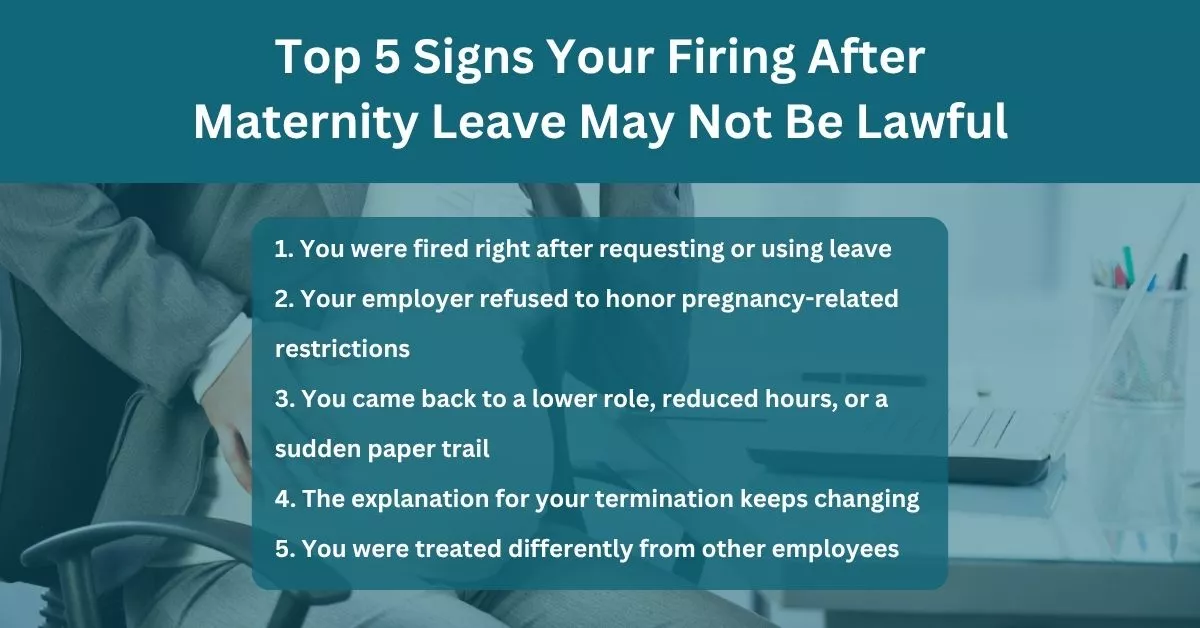 Top 5 signs your firing after maternity leave may not be lawful
This section is built to work as a shareable snippet for social, email, or Google Business Profile content.
1. You were fired right after requesting or using leave
Close timing alone does not prove illegality, but it is often one of the first warning signs.
2. Your employer refused to honor pregnancy-related restrictions
A refusal to accommodate recovery, lifting limitations, lactation needs, or other pregnancy-related limitations can point to a larger legal problem.
3. You came back to a lower role, reduced hours, or a sudden paper trail
A sharp change in treatment after leave can support an inference of retaliation or discrimination when the facts line up.
4. The explanation for your termination keeps changing
Shifting reasons are often important evidence in employment cases because they can suggest the stated reason is not the real one. This is an inference supported by general anti-retaliation and discrimination frameworks.
5. You were treated differently from other employees
If similarly situated workers who did not take maternity-related leave were treated better, that comparison may matter.
When a new parent is pushed out for taking leave, requesting accommodations, or returning to work after childbirth, that is not just unfair: it may be unlawful.
Conclusion
Being fired after maternity leave can feel isolating, but employees in Oregon may have powerful legal protections when an employer crosses the line. Whether the issue involves pregnancy discrimination, leave retaliation, failure to accommodate, or a wrongful termination tied to childbirth and recovery, the facts matter, and so does acting quickly.
If you were terminated after taking maternity leave, denied your right to return, or pushed out after asking for pregnancy-related accommodations, now is the time to protect your rights. Meyer Employment Law represents Oregon employees in wrongful termination, retaliation, leave, and discrimination matters and helps workers take informed action when employers violate the law. Visit the Meyer Employment Law home page to learn more, or use the contact the firm today to reach out about your situation.
About the Author
Robert Meyer is the founder of Meyer Employment Law and has spent more than a decade representing employees in Oregon state and federal courts in a wide range of workplace disputes. His experience includes claims involving wrongful termination, retaliation, pregnancy discrimination, leave violations, unpaid wages, and other employment law matters, and his work has included taking employee cases through jury trial when necessary. He focuses his practice on helping workers understand their rights, protect their livelihoods, and pursue meaningful remedies when employers violate the law.