FMLA discrimination usually doesn’t arrive as a firing. In fiscal year 2025, the U.S. Department of Labor found violations in 301 FMLA compliance actions, and the Wage and Hour Division’s enforcement data recorded 116 violations for denying leave outright, 106 for discrimination in discipline and similar decisions, and 84 for failing to restore a worker to the same or an equivalent job. Termination accounted for 65. A single case can land in more than one category, but the pattern holds: most of what the agency finds happens to workers who still have a job.
That’s the version workers rarely recognize in time. You return from surgery to a schedule nobody explains, a write-up for absences you were entitled to take, or a promotion that went to someone with half your tenure. At Meyer Employment Law, we represent Oregon employees and only employees, and these quieter forms of workplace retaliation are some of the most winnable cases we see, precisely because employers assume nobody’s counting.
Also Read
- FMLA Wrongful Termination: Fired After Taking Medical Leave in Oregon?
- Retaliation After a Workplace Injury: Understanding Workers’ Comp Retaliation in Oregon
- Can You Be Retaliated Against for Reporting Harassment? An Oregon Employee Guide
The Short Version
Federal law makes it illegal for your employer to hold protected medical leave against you in any employment decision, not just the decision to keep you employed. That covers attendance points, discipline, performance ratings, raises, bonuses, promotions, shift assignments, and the job you’re given when you return. Oregon stacks its own protections on top, through the Oregon Family Leave Act, Paid Leave Oregon, and the state’s sick time law, and those state protections often reach workers and employers the federal FMLA doesn’t touch. Proving FMLA discrimination rarely requires a confession. It usually turns on timing, on how comparable coworkers were treated, and on whether your employer’s explanation stayed consistent. Deadlines are short, so the record you build in the first few weeks matters more than most people expect.
The Punishments That Don’t Look Like Punishment
The regulation at the center of these cases is short and blunt. Under 29 CFR 825.220(c), employers “cannot use the taking of FMLA leave as a negative factor in employment actions, such as hiring, promotions or disciplinary actions,” and they can’t count FMLA leave under “no fault” attendance policies. That single sentence covers a lot of ground, and most of it has nothing to do with termination.
Here’s what it looks like in practice.
Attendance Points and No-Fault Discipline
Point-based attendance systems are everywhere in warehousing, healthcare, call centers, and manufacturing. The system is usually automated, and that’s the problem: the software assigns a point for the absence, nobody goes back to strip the protected days out, and three months later you’re at a final written warning built partly on leave you had a legal right to take. Any discipline resting on those points is suspect, and so is any decision that used the resulting record, including a denied transfer or a failed probation.
The Bonus, the Raise, and the Promotion That Never Came
This one has a real nuance worth understanding. Under 29 CFR 825.215(c)(2), a bonus tied to a goal like hours worked, products sold, or perfect attendance “may be denied” when FMLA leave kept you from hitting the goal, “unless otherwise paid to employees on an equivalent leave status for a reason that does not qualify as FMLA leave.” Translated: your employer can’t be stricter with you than it is with the coworker who missed the same hours on vacation or non-FMLA sick time. If the guy out for six weeks on a paid sabbatical still got his attendance bonus and you didn’t, that’s the whole case in one sentence.
Schedule Squeezes and Hour Cuts
The Department of Labor names this one directly. Fact Sheet #77B lists “manipulating an employee’s work hours to avoid responsibilities under the FMLA” as prohibited conduct, alongside discouraging an employee from using leave at all. In the real world that shows up as a sudden move off day shift, a cut from 32 hours to 20, a route or territory handed to someone else, or an on-call rotation that makes your medical appointments impossible to keep.
The “Equivalent” Job That Isn’t
You’re entitled to come back to the same position or an equivalent one, and the regulations define equivalent narrowly. Under 29 CFR 825.215(a), an equivalent position is “one that is virtually identical to the employee’s former position in terms of pay, benefits and working conditions, including privileges, perquisites and status.” Same title with fewer direct reports isn’t equivalent. Same pay with a two-hour commute isn’t equivalent. Same salary with the client list reassigned isn’t equivalent, either.
Not sure whether what happened to you counts? Most workers don’t call a lawyer over a schedule change, and that’s exactly why these violations persist. A short conversation can tell you whether there’s a pattern worth pursuing. Talk with an Oregon employment attorney about what changed after your leave.
Discrimination, Interference, and Retaliation Are Three Different Claims
Workers use these words interchangeably. Courts don’t, and in Oregon the distinction can decide how hard your case is to prove.
Interference means your employer denied, discouraged, shortened, or made it harder to use leave you were entitled to. Retaliation, in the narrow statutory sense, means your employer punished you for complaining about an FMLA violation or for participating in an investigation. Discrimination sits in between, and it’s the one that covers being treated worse because you used leave.
The good news for Oregon workers is where that third category lands. In Bachelder v. America West Airlines, 259 F.3d 1112 (9th Cir. 2001), the Ninth Circuit, which covers Oregon, held that using FMLA leave as a negative factor in an employment decision is an interference claim under the statute’s first subsection, and that the employee doesn’t have to run the full burden-shifting gauntlet courts apply to ordinary discrimination cases. If you show your protected leave was a negative factor in the decision, that’s the violation. The court also placed the risk of getting the classification wrong on the employer, not on the worker who requested the time.
That matters because employers often argue their reason was performance or restructuring and expect the conversation to end there. Under this framework, their stated reason isn’t the last word.

Where Oregon Law Reaches Further Than the FMLA
Federal FMLA reaches you only if you’re an eligible employee, which takes 12 months of employment, 1,250 hours of service in the prior year, and a worksite where the employer has at least 50 people within 75 miles. A lot of Oregon workers fall outside that, and they’re still protected.
The Oregon Family Leave Act covers smaller employers. OFLA applies at 25 employees rather than 50, and eligibility runs on 180 days of employment with an average of 25 hours a week. Since July 2024, OFLA’s scope is narrower than it used to be. It now covers sick child leave, bereavement leave, and pregnancy disability, while the categories it used to handle moved over to Paid Leave Oregon. Under ORS 659A.183, it’s an unlawful practice to “retaliate or in any way discriminate against an individual with respect to hire or tenure or any other term or condition of employment” because they asked about, requested, or used family leave.
Paid Leave Oregon protects the job after 90 days. ORS 657B.060 restores you to your position or an equivalent one and states plainly that “it is an unlawful employment practice to discriminate against an eligible employee who has invoked any provision of this chapter.” Those protections cover workers who’ve been employed at least 90 days before taking leave, which Paid Leave Oregon states as 90 consecutive days, and there’s no hours threshold and no 12-month wait. At employers with fewer than 25 employees, if your old position is genuinely gone, the employer may place you in a different job with similar duties at the same pay and benefits.
Oregon sick time has no part-time carve-out. Workers accrue one hour of sick time for every 30 hours worked, up to 40 hours a year, and qualifying absences can’t be used as the basis for discipline. Employers with 10 or more employees statewide, or 6 or more in Portland, have to pay for that time.
The practical upshot is that “you don’t qualify for FMLA” is not the end of the analysis. It’s the start of a different one.
Your employer’s leave policy isn’t the same thing as the law. Oregon workers are often covered by two or three overlapping statutes at once, and employers routinely apply only the one that’s most convenient. Contact Meyer Employment Law for a free, confidential consultation about which protections apply to you.
The Paper Trail That Builds a Case
Almost nobody has an email that says “we’re demoting her because she took leave.” Cases get built out of ordinary documents that seemed unremarkable at the time.
Start with a timeline. Write down the date you requested leave, the date you told your supervisor, the dates you were out, the date you returned, and the date of every change that followed. Suspicious timing carries real evidentiary weight, and precision is what makes it persuasive.
Then gather the comparison. Your performance reviews from before leave and after. Your schedules from before and after. The bonus or commission statements. The attendance record with its point history, which often shows exactly which days generated the discipline. Save the leave paperwork itself, including the certification forms and any written designation notice your employer sent, because those documents establish that the absences were protected.
Finally, watch for the shifting explanation. Employers who tell you one thing in the moment and something different in an unemployment hearing or a position statement create the inconsistency that makes a case. Write down what you were told and when, while it’s fresh.
Our team handles employment discrimination claims across Oregon, and a surprising number of them start with a client who kept one folder of ordinary paperwork.
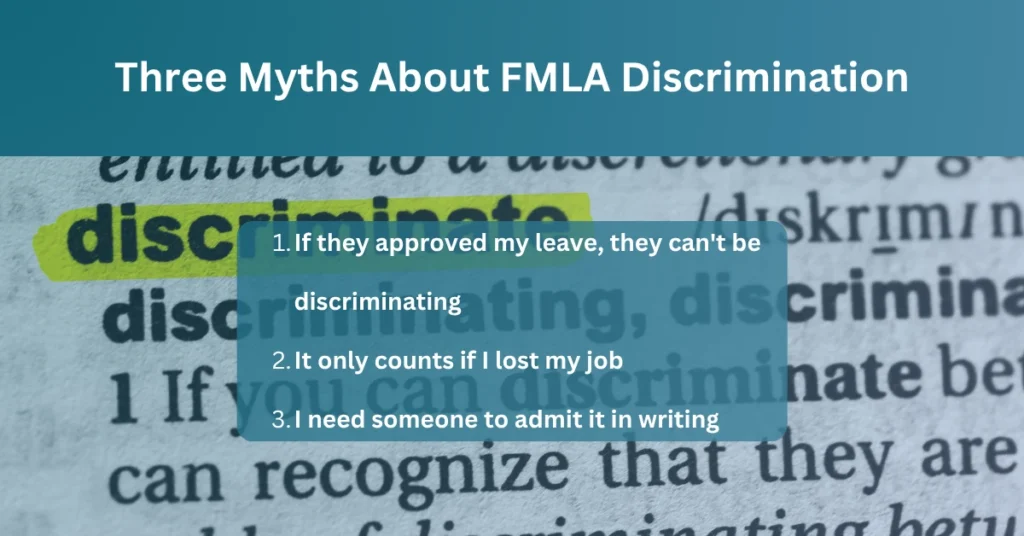
Three Myths About FMLA Discrimination
These three assumptions stop more valid claims than any legal defense does.
- Myth: If they approved my leave, they can’t be discriminating. Approval and punishment are separate acts. An employer can grant every day you asked for and still hold those days against you in the next review cycle, and the second decision is the illegal one.
- Myth: It only counts if I lost my job. The regulation covers hiring, promotions, and disciplinary actions by name, and the Department of Labor’s own enforcement numbers show discipline and failure to reinstate outpacing termination.
- Myth: I need someone to admit it in writing. Very few cases have a confession. They have a clean record that turned bad within weeks of a leave request, a coworker who missed the same hours and kept their bonus, and an employer whose explanation changed twice.
Bring the paperwork, not a conclusion. You don’t need to know which statute applies or whether you can prove intent. That’s the work we do. Schedule a free consultation or call (503) 459-4010 to have someone look at the record with you.
The Deadlines That Decide Everything
Leave-related claims run on more than one clock, and the shortest one usually controls.
Federal FMLA claims generally must be brought within two years of the last event constituting the violation, extended to three years when the violation was willful, under 29 U.S.C. 2617(c). Oregon’s route is shorter. A civil action under the state’s unlawful employment practice statutes, including the OFLA retaliation provision, generally has to be filed within one year under ORS 659A.875, and a complaint with the Bureau of Labor and Industries runs on a similar one-year window under ORS 659A.820. Paid Leave Oregon claims travel the same road: ORS 657B.070 sends them to a civil action under ORS 659A.885 or a BOLI complaint under ORS 659A.820.
What’s recoverable is worth knowing before you decide whether to act. The FMLA allows back pay and lost benefits, interest, reinstatement or promotion, and attorney’s fees and costs paid by the employer. It also allows liquidated damages in an amount equal to the rest, though a court may reduce that award if the employer proves it acted in good faith. Oregon’s statutes add compensatory damages for emotional harm and, in some cases, punitive damages. This article is general information rather than legal advice, and outcomes always depend on the specific facts.
Conclusion
The hardest part of an FMLA discrimination case is usually recognizing it. A firing announces itself. A schedule change, a point on an attendance record, or a bonus that came in $400 light does not, and by the time the pattern is obvious the one-year clock has often been running for months. If your working life got measurably worse after you took protected leave, that’s worth a second look from someone who reads these records for a living.
Meyer Employment Law was founded by attorney Robert Meyer and represents workers across Oregon, never employers, with remote consultations available statewide. We spend our days on exactly this question: whether what happened to you after your leave was a coincidence or a decision.
Something changed after your leave, and nobody will explain why. A free, confidential case review can tell you whether the timing, the paperwork, and the comparisons add up to a claim. Contact Meyer Employment Law or call (503) 459-4010 to talk it through.