Workplace harassment can come from many sources. When the harasser is a co‑worker — rather than a supervisor or manager — employees often wonder whether the employer can be held responsible. In Oregon, employers can be liable for harassment between co‑workers if they know about it and fail to intervene.This article explains how Oregon law defines co‑worker harassment, when an employer is responsible, and what victims can do to protect their rights.
Read More:
Oregon Employment Harassment
Navigating Hostile Work Environments: A Guide from Meyer Employment Law
Common Signs You’re Being Sexually Harassed at Work (And What to Do Next)
Bullying in the Workplace: Employee Rights in Oregon

What Counts as Co‑Worker Harassment?
Harassment includes unwelcome conduct based on protected characteristics such as sex, race, national origin, sexual orientation, religion or disability. It can take the form of offensive jokes, name‑calling, intimidation, threats, insults, unwanted physical contact or any behavior that creates a hostile work environment. Unlike isolated petty slights or annoyances, harassment becomes illegal when it is so frequent or severe that it unreasonably interferes with an employee’s work or creates an intimidating, hostile or offensive environment.
In co‑worker situations, the harasser has no direct authority over the victim. However, the harasser may still exert power through intimidation or group dynamics. Employers have a duty to maintain a workplace free of unlawful harassment and discrimination. Oregon law imposes specific obligations on employers once they become aware of a problem.
Employer Liability Under Oregon’s Harassment Rule
Oregon’s administrative rule on sexual harassment in employment sets out when employers are liable for harassment committed by different categories of people. Section 6 of OAR 839‑005‑0030addresses harassment by co‑workers or other agents who do not have authority over the victim. Under this rule, an employer is liable if it “knew or should have known” of the conduct and failed to take immediate and appropriate corrective action.
In other words, if managers or human resources personnel are told about co‑worker harassment (or should have discovered it), they must act promptly to stop the behavior. If they ignore complaints, delay investigating, or take action that is not reasonably calculated to end the harassment, the employer can be held responsible for the harm caused.
What is “appropriate corrective action”?
A 2025 permanent administrative order from Oregon’s Bureau of Labor & Industries (BOLI)clarifies what corrective action must look like. Employers must intervene immediately to stop the harassing behavior, promptly investigate, take remedial measures proportionate to the severity of the harassment, minimize the burden on the reporting employee, prohibit retaliation and take steps to prevent future harassment. Failing to take one or more of these steps can mean the employer did not act appropriately.
Knowledge requirement: “Knew or should have known”
Oregon courts have held that employers are not automatically liable for co‑worker harassment. In Garcez v. Freightliner Corp., the court explained that an employer is liable only if it knew or should have known of the harassment and failed to take prompt and effective remedial steps. Evidence that a supervisor received complaints or that the harassment was widespread may establish that the employer had the requisite knowledge.
Mandatory Anti‑Harassment Policies
Oregon law requires employers to adopt and distribute written policies to prevent workplace harassment. For public employers, ORS 243.319sets out the mandatory contents of such a policy. The policy must prohibit all forms of workplace harassment, provide information about the process for reporting harassment, and include a statement that employees who report harassment have the right to be protected from retaliation. It must also advise employees to document any incidents of workplace harassment.
Private employers are subject to similar requirements under the Oregon Workplace Fairness Act(OWFA), which is enforced by Oregon’s Bureau of Labor & Industries. The statute requires employers to provide a copy of their anti‑harassment policy to all employees when they are hired and upon receipt of a complaint.
Employers must also provide the policy when an employee asks for it or when an employee makes a harassment complaint. The policy must state that employees can file complaints with BOLI or the Equal Employment Opportunity Commission (EEOC) and that it is illegal for the employer to retaliate against employees who report harassment. For more information, see BOLI’s discrimination guidance.
Retaliation is Prohibited
Employees who report harassment often worry about retaliation — such as termination, demotion, unfavorable shifts or workplace hostility. Oregon law makes retaliation illegal. ORS 659A.030(1)(f)states that it is an unlawful practice for an employer to discriminate or retaliate against someone because they opposed an unlawful practice or filed a complaint.
BOLI’s discrimination guidancesimilarly notes that employers cannot retaliate against employees for reporting harassment. Even if the employer ultimately concludes that no harassment occurred, retaliation for making a good‑faith complaint is still unlawful.
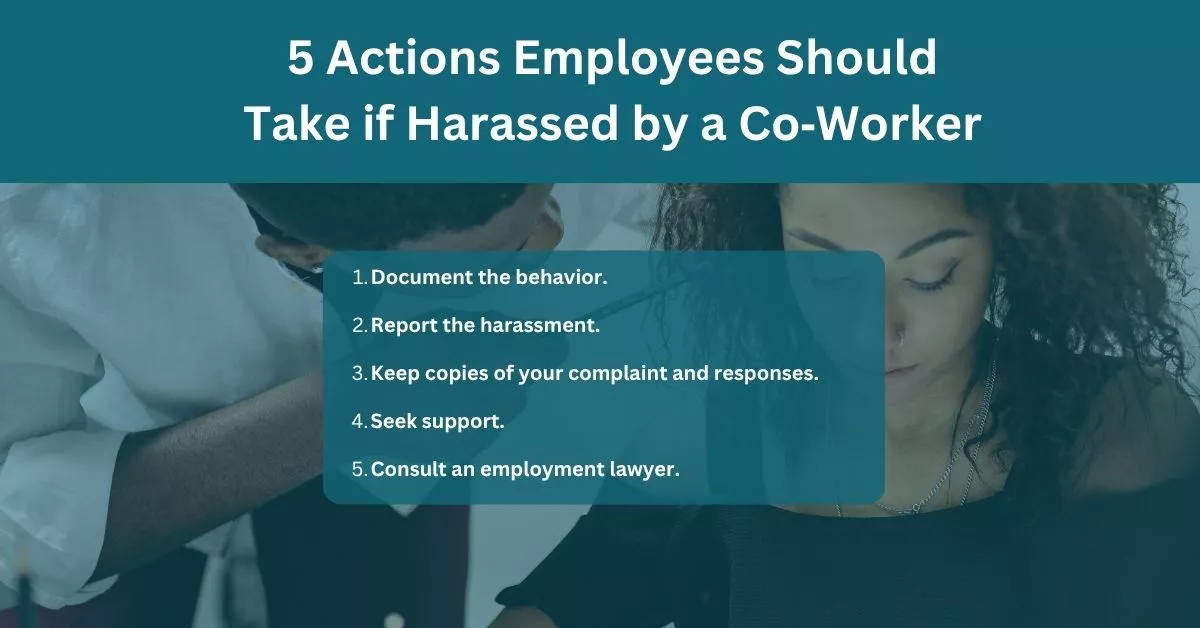
5 Actions Employees Should Take if Harassed by a Co‑Worker
If you are experiencing harassment from a co‑worker, consider taking the following steps:
- Document the behavior.Keep a detailed record of each incident, including dates, times, locations, what was said or done, and any witnesses. Save copies of text messages, emails or social media messages.
- Report the harassment.Follow your employer’s procedure for reporting harassment. If the policy requires you to report to a supervisor and that person is involved in the harassment, report to another manager or human resources. Provide as many details as possible and submit your report in writing to create a paper trail.
- Keep copies of your complaint and responses.Save copies of any complaints you submit, as well as your employer’s responses. If your employer provides an anti‑harassment policy, keep a copy for reference.
- Seek support.Talk to trusted family or friends about what is happening. You may also contact BOLI or the EEOC to discuss your rights and the process for filing a complaint.
- Consult an employment lawyer.If the harassment continues or if you experience retaliation after reporting, consult a lawyer who represents employees. An attorney can review your documentation, explain your rights, and help you decide whether to file a claim with BOLI, the EEOC or in court. Under the Oregon Workplace Fairness Act, employees have up to five years to file a civil action related to workplace discrimination or harassment, but shorter deadlines may apply to certain claims.
Filing a Complaint with BOLI or the EEOC
If your employer fails to stop the harassment or retaliates against you for reporting, you can file a charge with BOLI or the EEOC. BOLI investigates complaints of discrimination and harassment under Oregon law.
The EEOC investigates similar complaints under federal law. You generally must file within 300 days of the most recent incident of harassment or retaliation, though some claims may have different deadlines. An attorney, like Meyer Employment Lawcan help you meet these deadlines and determine whether your claim should be filed with one or both agencies.
Conclusion
When employers ignore co‑worker harassment, they not only violate the law; they create a work environment where harassment thrives. Liability standards like OAR 839‑005‑0030provide strong incentives for employers to address problems promptly.
By holding employers accountable, Oregon law encourages safer workplaces and empowers employees to speak up without fear of retaliation. If your workplace is hostile due to harassment from your co-workers, don’t hesitate to seek legal guidance. Meyer Employment Lawcan help you navigate claims, enforce your rights, and ensure you receive the compensation you deserve.
FAQs
Can my employer be held liable for co‑worker harassment?Yes. Under Oregon’s harassment rule, employers are liable if they knew or should have knownabout harassment committed by co‑workers and failed to take immediate and appropriate corrective action. Once notified of harassment, employers must act promptly to stop it.
What does “knew or should have known” mean?An employer “knew” about harassment if employees or supervisors reported it or if the conduct was obvious. An employer “should have known” when the circumstances were such that a reasonable employer would have discovered the harassment. In Garcez v. Freightliner Corp., the court noted that evidence a supervisor received complaints or that harassment was widespread may establish knowledge.
What happens if I report harassment and the employer fails to act?If your employer ignores your complaint or takes inadequate action, you can pursue a claim with Oregon’s Bureau of Labor & Industries (BOLI) or the Equal Employment Opportunity Commission (EEOC). The law holds employers responsible for failing to take appropriate corrective actionwhen they know about harassment.
How long do I have to file a complaint?The Oregon Workplace Fairness Act generally gives employees up to five years from the date of harassment to file a lawsuit. However, complaints filed with BOLI or the EEOC often have shorter deadlines (as little as 300 days) so it is important to act quickly.
Can my employer retaliate against me for complaining?No. Oregon law makes it unlawful for employers to retaliate against employees for opposing an unlawful practice or filing a complaint. Retaliatory actions such as termination, demotion, schedule changes or hostile treatment violate the law and can lead to additional claims.
How Meyer Employment Law can help
At Meyer Employment Law, we represent Oregon workers who have been harassed or discriminated against by co‑workers, supervisors or others in the workplace. If you have reported harassment and your employer failed to act – or if you have experienced retaliation – we can investigate, explain your rights, and help you pursue a claim. Because our firm represents employees only, we have no conflicting loyalties and are dedicated solely to helping workers seek justice.
Contact ustoday to schedule a confidential consultation and learn more about your options.
About the Author
Meyer Employment Lawis a Portland-based firm dedicated to protecting Oregon employees from discrimination, harassment, and retaliation. Learn more about our team and practice areas at oregonworkplacelaw.com.