FMLA for part time employees is not a separate question with a separate answer. The statute sets no full-time threshold, and neither do the eligibility rules. What they set is a number, and that number is 1,250 hours of service in the 12 months before your leave starts. Work enough hours, and your part-time schedule is irrelevant. Fall short, and a full-time title wouldn’t have saved you either.
The number does a lot of quiet work, though. Nationally, 56 percent of employees are eligible for FMLA according to the Department of Labor’s survey research, and 21 percent are ineligible for no reason other than hours or tenure. At Meyer Employment Law, we hear from Oregon workers who were told they “don’t get FMLA because you’re part-time,” which isn’t a legal standard, and who turned out to have three other protections nobody mentioned.
Also Read
- FMLA Interference: What to Do When Your Leave Is Denied
- Is It Illegal to Fire Someone for Being Sick in Oregon? Sick Leave Rights
- Can Your Employer Deny Maternity Leave in Oregon?
The Quick Answer
Part-time employees can absolutely qualify for FMLA, and many do. Eligibility turns on three tests that have nothing to do with your job classification: 12 months of employment with the company, 1,250 hours of service in the 12 months right before your leave, and a worksite with at least 50 employees within 75 miles. The 1,250-hour test works out to just over 24 hours a week, and only the hours you work count toward it, so paid time off and holidays don’t help you get there. If you miss on any of the three, Oregon still gives you real options. Paid Leave Oregon has no hours requirement at all, Oregon’s sick time law has no part-time carve-out, and the Oregon Family Leave Act reaches employers too small for the federal statute to touch.
Key Points
- Part-time status isn’t a disqualifier. The FMLA sets an hours threshold, not a classification test, and a 30-hour-a-week employee clears it comfortably.
- 1,250 hours is roughly 24 hours a week. Divide 1,250 by 52 and you get 24.04, which means a steady 24-hour schedule lands two hours short.
- Only the hours you work count. Vacation, sick leave, holidays, and prior FMLA leave are excluded from the 1,250, though they do count toward the 12 months of employment.
- The 12 months don’t have to be consecutive. Earlier stints with the same employer generally count unless there was a break in service of seven years or more.
- Overtime and extra shifts count. If you picked up coverage, those hours are yours.
- Your employer carries the recordkeeping risk. When an employer hasn’t kept accurate hour records, it bears the burden of proving you didn’t meet the threshold.
- Oregon fills most of the gap. Paid Leave Oregon has no hours test and no tenure test, just $1,000 in base-year wages from covered Oregon employment.
- Being told “no” isn’t the end of it. Denying or discouraging leave you were entitled to is itself a violation, separate from anything that happens later.
The Three-Part Test, and Where Part-Timers Get Stuck
Every question about FMLA for part-time employees runs through the same three eligibility gates in 29 CFR 825.110. You have to clear all three, and part-time workers tend to trip on different ones than they expect.
Twelve Months of Employment
You need 12 months with the employer, and the Department of Labor is clear that “the 12 months of employment are not required to be consecutive in order for the employee to qualify for FMLA leave.” Seasonal workers, people who left and came back, and anyone who moved between departments can add those periods together. Employment before a break in service of seven years or more generally drops out of the count, with exceptions for military service and for any written agreement, including a collective bargaining agreement. What matters isn’t how long ago the earlier stint was; it’s how long the gap ran.
Weeks matter more than hours here. If you’re kept on the payroll for any part of a week, including weeks of paid or unpaid leave, that week counts toward the 12 months. For intermittent, occasional, or casual employment, the regulation treats 52 weeks as equal to 12 months.
Twelve Hundred Fifty Hours of Service
This is the gate that catches part-time workers, and it’s worth doing the arithmetic yourself rather than trusting an HR summary.
| Average hours per week | Hours over 52 weeks | Meets the 1,250-hour test? |
|---|---|---|
| 20 | 1,040 | No |
| 24 | 1,248 | No, by two hours |
| 25 | 1,300 | Yes |
| 30 | 1,560 | Yes |
| 35 | 1,820 | Yes |
A steady 24-hour week misses by two hours across an entire year, which is the kind of margin that makes overtime, holiday coverage, and picked-up shifts genuinely decisive. Hours are counted under Fair Labor Standards Act principles, and the regulation says the calculation isn’t limited by an employer’s recordkeeping methods or by compensation agreements that don’t reflect all the hours you worked. Time over 40 in a week counts, and so does compensable work you were never paid for.
Fifty Employees Within Seventy-Five Miles
The third gate has nothing to do with you. Your worksite has to be one where the employer has at least 50 employees within a 75-mile radius. This is what knocks out most small Oregon employers, and the Department of Labor’s research found that 15 percent of employees are ineligible for no reason other than worksite size. It’s also the gate you can’t fix by working more.
What Doesn’t Count Toward the 1,250 Hours
This is where most self-assessments go wrong. People add up their paid hours, hit 1,300, and assume they’re covered.
The Department of Labor’s FMLA guidance is direct about it: “The 1,250 hours include only those hours actually worked for the employer. Paid leave and unpaid leave, including FMLA leave, are not included.” So your two weeks of vacation, your paid holidays, your sick days, and any FMLA leave you already took last year all come off the total. A worker who was paid for 1,300 hours but worked 1,180 of them doesn’t meet the test.
Hours with a genuinely separate employer don’t combine either. If you hold two unrelated part-time jobs, each is evaluated on its own, which is one reason multi-job workers so often fall outside federal FMLA while still qualifying for Oregon’s programs.
There’s an exception worth knowing if you work through an agency. When two businesses jointly employ you, such as a staffing firm and the client site where you’re placed, 29 CFR 825.106 requires both of them to count you when determining coverage and eligibility.
Run your own numbers before you rely on anyone else’s. Employers get the 1,250-hour calculation wrong in both directions, and the difference decides whether your leave is protected. Contact Meyer Employment Law for a free, confidential review of where you stand.

If FMLA Doesn’t Cover You, Oregon Probably Does
Roughly 22.8 million people in the United States worked part time for noneconomic reasons in July 2026, along with another 4.8 million for economic reasons, according to the Bureau of Labor Statistics. Congress built the FMLA’s thresholds around a full-time workforce that no longer describes how a lot of people work. Oregon’s laws were written later, and it shows.
Paid Leave Oregon Has No Hours Requirement
This is the big one for part-time workers. Paid Leave Oregon asks for $1,000 in base-year wages and covered Oregon employment, with no hours test and no tenure test, and the state says so plainly: “Whether you work full-time, part-time, seasonally, or for more than one employer, it counts.” Wages from multiple employers combine, which is exactly the opposite of how FMLA treats them.
Benefits run up to 12 weeks in a year, with up to two additional weeks for pregnancy-related needs. For benefit years beginning on or after June 28, 2026, the Oregon Employment Department set the weekly benefit at a minimum of $70.51 and a maximum of $1,692.16, based on a 2025 state average weekly wage of $1,410.13. Job protection is separate from the benefit. ORS 657B.060 extends it to employees who’ve been employed at least 90 days before taking leave, and Paid Leave Oregon describes that as 90 consecutive days.
Oregon Sick Time Has No Part-Time Carve-Out
Every covered Oregon employee accrues one hour of sick time for every 30 hours worked, up to 40 hours a year, with no minimum schedule to qualify. Employers with 10 or more employees statewide, or 6 or more in Portland, have to pay for it. You can start using accrued time after 90 days, and qualifying absences can’t be used as a basis for discipline. It’s a smaller entitlement than FMLA, and for a series of medical appointments it’s often the one that matters most.
OFLA Reaches Smaller Employers
The Oregon Family Leave Act applies at 25 employees rather than 50, so it covers workplaces the federal statute skips entirely. Eligibility runs on 180 days of employment with an average of 25 hours a week, a shorter tenure requirement than FMLA but a slightly steeper weekly bar. Since mid-2024 OFLA’s scope has narrowed to sick child leave, bereavement leave, and pregnancy disability, with the rest handled through Paid Leave Oregon. Oregon added a narrow route in 2025: under SB 69, an employee based in Oregon who is subject to the federal flight crew rules can satisfy OFLA’s hours requirement through the federal hours-of-service test instead of the 25-hour weekly average.
Three Oregon programs run on three different eligibility tests, and your handbook probably mentions one. Sorting out which Oregon protections apply to your schedule takes about ten minutes with someone who does it daily. Schedule a free consultation or call (503) 459-4010.
When Your Employer Gets FMLA for Part-Time Employees Wrong
“You’re part-time, so you don’t get FMLA” is not a legal conclusion. It’s a guess, and it’s frequently wrong, particularly for workers whose hours fluctuate or who’ve picked up significant overtime.
The regulations put the risk of sloppy records where it belongs. When an employer hasn’t maintained accurate records of hours worked, the employer carries the burden of showing that the employee didn’t work the required hours. If your schedule was irregular and nobody was tracking it carefully, that ambiguity doesn’t cut against you.
There’s a second problem worth naming. Discouraging you from requesting leave is itself an FMLA violation, not just a customer service failure. Telling a worker they’re ineligible without running the numbers, or suggesting they resign instead of requesting leave, is the kind of conduct that turns into an interference claim. If that’s what happened to you, the situation is closer to a denied FMLA leave case than to a simple misunderstanding, and it’s worth documenting what you were told and by whom.
Meyer Employment Law represents Oregon workers in exactly these disputes, including retaliation claims that follow a leave request. Federal FMLA claims generally carry a two-year deadline, extended to three years for willful violations, while Oregon’s state law claims typically run on a one-year clock. This article is general information rather than legal advice, and outcomes depend on the specific facts of each case.
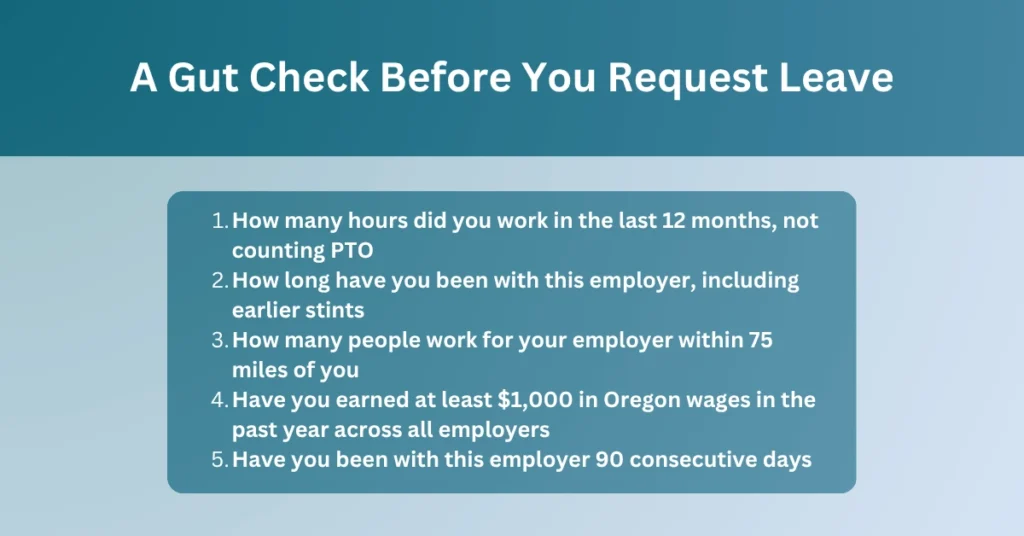
A Gut Check Before You Request Leave
Five questions, answered honestly, will tell you most of what you need to know.
- How many hours did you work in the last 12 months, not counting PTO? Pull your pay stubs or your timekeeping records and add the worked hours only. If you’re anywhere near 1,250, it’s worth a closer look.
- How long have you been with this employer, including earlier stints? You need twelve months in total, and earlier stints count unless a break in service ran seven years or longer.
- How many people work for your employer within 75 miles of you? Count everyone in the whole radius, not just the people at your location.
- Have you earned at least $1,000 in Oregon wages in the past year across all employers? If yes, Paid Leave Oregon is likely open to you regardless of everything above.
- Have you been with this employer 90 consecutive days? That’s the threshold for Paid Leave Oregon job protection and for using accrued Oregon sick time.
If you answered yes to questions 4 and 5 but no to the first three, you’re in the position a lot of Oregon part-time workers are in: outside federal FMLA, and squarely inside state protection.
Conclusion
The frustrating thing about FMLA for part-time employees is that the answer is knowable. It’s arithmetic and a headcount, not a judgment call, and it takes one afternoon with your pay records to settle. What makes it hard is that the person telling you the answer is often the same person who’d rather you not take the leave.
Founded by attorney Robert Meyer, Meyer Employment Law represents employees across Oregon and never employers, with remote consultations available statewide. If you’ve been told your schedule disqualifies you, or if something changed at work after you asked about leave, we can tell you which of Oregon’s overlapping protections applies to you.
Were you told you don’t qualify? Get a second opinion on the math. A free, confidential consultation can confirm your hours, check the worksite count, and identify the Oregon programs your employer didn’t mention. Contact Meyer Employment Law or call (503) 459-4010.