A constructive discharge lawsuit argues that you did not truly quit. You were forced out by working conditions so intolerable that a reasonable person would have felt compelled to resign. This guide focuses on litigation: what you must prove, common employer defenses, the best evidence, and potential damages in Oregon.
Most employees assume a “quit” ends the story. In litigation, that is not always true. In Oregon, a resignation can still be treated like a termination if your employer intentionally created or maintained unlawful conditions that effectively pushed you out. That is the core idea behind a constructive discharge lawsuit.
If you are considering this type of claim, it helps to understand the legal elements, what judges and juries look for, and what employers usually argue in response. This article focuses on litigation strategy, not just definitions about wrongful termination.
Read More from Meyer Employment Law:
- Oregon Constructive Discharge: What Employees Should Know
- Wrongful Termination in Oregon: Was Your Firing Illegal?
- Understanding Wrongful Termination
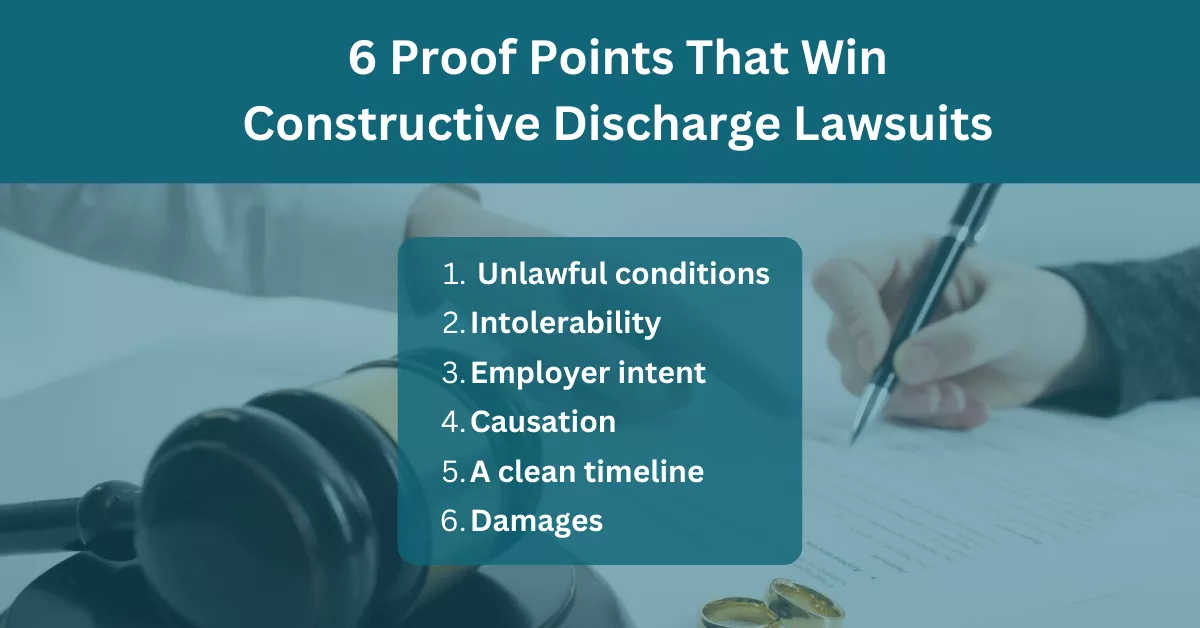 6 Proof Points That Win Constructive Discharge Lawsuits
If you are building a constructive discharge lawsuit in Oregon, these six proof points matter in almost every case:
- Unlawful working conditions tied to discrimination, harassment, retaliation, or another protected right.
- Intolerability: conditions were so bad a reasonable person would resign.
- Employer intent or knowledge: the employer wanted you to leave, or knew you were substantially certain to leave.
- Causation: you resigned because of the unlawful conditions, not for unrelated reasons.
- A clean timeline: documentation showing escalation, complaints, and the employer’s failure to fix it.
- Damages: lost wages, lost benefits, emotional distress, and in some cases punitive damages and attorney fees.
What “Constructive Discharge” Means Under Oregon Law
Oregon’s civil rights rules include a specific constructive discharge framework in the discrimination context. The rule is OAR 839-005-0011, which lists four elements you must prove.
Under that rule, constructive discharge occurs when:
- The employer intentionally created or intentionally maintained discriminatory working conditions related to a protected class
- The working conditions were so intolerable that a reasonable person would have resigned
- The employer desired the resignation or knew (or should have known) the employee was substantially certain to resign because of those conditions
- The employee left employment because of those conditions
In plain terms, a constructive discharge lawsuit is not about a bad day at work or even a rough month. It is about unlawful conduct plus unbearable conditions plus employer fault that forces a resignation.
Litigation Elements: What You Must Prove in Court
1) Unlawful Working Conditions
A constructive discharge lawsuit is usually anchored to an underlying legal violation, such as:
- Discrimination or harassment based on protected status
- Retaliation for reporting misconduct, requesting leave, or opposing discrimination
- A hostile work environment that the employer fails to correct
- Other rights protected by Oregon and federal employment laws
This is where many cases succeed or fail. Even if conditions were unpleasant, you typically need to connect them to an unlawful practice.
What helps in litigation: clear facts linking the conduct to protected status or protected activity. Examples include slurs, sexual comments, discriminatory scheduling patterns, retaliation that begins right after a complaint, or management statements revealing motive.
2) Intolerability Under the Reasonable Person Standard
The legal test is not “could you have endured it.” The question is whether a reasonable person in your situation would feel compelled to resign. Oregon courts have discussed a reasonable-person standard in this context.
Common fact patterns that may support intolerability include:
- Ongoing harassment combined with employer inaction
- Repeated retaliation after protected complaints
- Severe humiliation, threats, or safety-related pressure
- Sabotage of job performance that makes continued employment unrealistic
What courts and juries look for: frequency, severity, duration, whether it escalated, and whether management had the power to fix it but did not.
3) Employer Intent or Knowledge
This element is often misunderstood. You do not always need an email saying “we want them to quit.” But you do need proof that the employer either:
- Desired you to resign, or
- Knew (or should have known) you were substantially certain to resign under the circumstances
Evidence can be direct (statements, threats, explicit pressure) or circumstantial (pattern of discipline after complaints, refusal to investigate, removal of responsibilities, isolating you, setting you up to fail).
4) Causation: You Resigned Because of Those Conditions
Defense lawyers often argue: “They quit for personal reasons.” Your case improves when your resignation is tightly tied to:
- documented complaints
- worsening conditions
- HR responses or lack of responses
- medical records showing stress and anxiety that tracks the workplace timeline
The more your story looks like a steady causal chain, the harder it is for the employer to break it.
The Evidence That Builds a Litigation-Ready Constructive Discharge Case
If your goal is litigation, evidence is everything. Here is what typically carries the most weight.
Emails and Written Complaints
- HR complaints
- follow-up emails (“I reported X on Y date and it is continuing”)
- supervisor emails showing hostility, threats, or sudden performance criticisms
Written complaints also help prove employer knowledge, which is critical under Oregon’s constructive discharge rule.
Texts, Slack Messages, and Direct Messages
Screenshots with timestamps are especially useful when they show:
- harassment
- retaliation
- shifting explanations (“budget cuts” one day, “performance” the next)
Performance Records Before and After Protected Activity
Many retaliation-driven constructive discharge cases show a pattern:
- positive reviews or no discipline
- a protected report or complaint
- sudden write-ups, PIPs, criticism, or demotion
Witness Statements
Coworkers may have seen:
- discriminatory comments
- harassment
- changes in how you were treated after complaining
- management discussions about “getting rid of” you
Even if witnesses are afraid to testify, documenting what they told you early can help your lawyer evaluate the strength of the case.
Medical Documentation
In many cases, employees seek medical care because the workplace situation becomes unbearable. Medical notes are not required, but they can corroborate intolerability and causation, especially when the timing matches workplace events.
 Common Employer Defenses in Constructive Discharge Lawsuits
Defense 1: “The Conditions Were Not That Bad”
Employers often minimize: “It was a personality conflict.” Your response is evidence and detail:
- frequency of conduct
- severity and escalation
- how it affected your ability to perform
- management’s failure to correct it
Defense 2: “We Did Not Know”
This is why written complaints matter. If you reported internally, keep copies. If you were afraid to report, your lawyer may build proof that the employer should have known based on widespread conduct or manager involvement.
Defense 3: “We Offered Solutions and You Quit Anyway”
If HR offered a transfer, schedule change, or investigation, employers argue you quit prematurely. Courts and juries then look at whether the “solution” was real, timely, and effective.
Defense 4: “You Quit for Personal Reasons”
This is a causation defense. Employers may point to relocation, a new job, family issues, or health. Your timeline, resignation letter, and communications around the resignation matter a lot here.
Defense 5: “You Failed to Use Our Complaint Process”
This is not always fatal, but employers use it to argue lack of notice and to reduce liability. If you did complain, preserve proof. If you did not, your lawyer may need to explain why (for example, fear of retaliation, the harasser was HR, or prior complaints were ignored).
Damages in an Oregon Constructive Discharge Lawsuit
Damages depend on the underlying legal claim, but wrongful termination laws outline the categories that often apply:
- Back pay (lost wages)
- Front pay (future lost earnings when reinstatement is not realistic)
- Lost benefits (health insurance, retirement contributions, stock options)
- Emotional distress damages
- Punitive damages in certain cases
- Attorney fees where authorized by statute
A constructive discharge lawsuit also frequently involves mitigation arguments. Employers may claim you did not search for work or turned down comparable jobs. Keep records of your job search.
Agency Complaints and Litigation Timing
Even if your end goal is court, agency filings can matter depending on the type of claim and the forum. BOLI provides a complaint process and emphasizes time limits, including one-year windows for certain claims handled by its Civil Rights Division.
Because deadlines can vary by claim type and whether federal law applies, it is smart to talk with counsel early if you are considering resignation or have already resigned.
How Meyer Employment Law Can Help
Constructive discharge lawsuits are litigation-heavy. They require careful evidence gathering, a disciplined timeline, and a clear legal theory that connects intolerable conditions to an unlawful practice.
Meyer Employment Law represents Oregon employees in wrongful termination and constructive discharge matters, including cases where employers create intolerable conditions tied to discrimination or retaliation.
If you suspect you are being pushed out, it is often best to contact us for advice before resigning, so you do not accidentally weaken your claim.
Conclusion
A constructive discharge lawsuit is not simply about quitting because work was stressful. In Oregon, you generally need to prove unlawful working conditions, intolerability under a reasonable-person standard, employer intent or knowledge, and a causal link between the conditions and your resignation.
If you are dealing with escalating harassment, retaliation, or discrimination and you feel trapped, the most important step is to preserve evidence early. Emails, texts, witness statements, and a clean timeline often decide these cases. Then talk to an employment lawyer about the best path forward.
FAQs
Do I have a constructive discharge lawsuit if my job was just toxic?
Not always. The strongest cases involve unlawful conduct tied to discrimination, harassment, or retaliation, plus working conditions so intolerable a reasonable person would resign.
Should I resign before talking to a lawyer?
Often, no. The timing and documentation around resignation can make or break your case, especially on causation and employer knowledge.
What evidence matters most in court?
Written complaints, emails and texts, witness statements, and records showing escalation after protected activity. Evidence that your employer knew and failed to correct the conditions is especially important.
Can I still sue if I never reported internally?
It depends. Employers often argue lack of notice. Some employees have legitimate reasons for not reporting (for example, fear of retaliation or HR involvement). Talk to counsel to evaluate risk.
What can I recover in damages?
Potential damages can include lost wages, lost benefits, emotional distress damages, and in some cases punitive damages and attorney fees, depending on the underlying claims.