Unemployment hearing representation is more than having a lawyer appear on the phone when your Oregon unemployment appeal begins. The work usually starts earlier: reviewing the denial, identifying the legal issue, organizing documents, preparing testimony, and deciding which employer claims to challenge.
That preparation matters because an unemployment hearing is an evidence proceeding. The administrative law judge isn’t weighing whether the job loss was generally unfair; the judge decides a specific eligibility issue on the testimony and evidence in the record.
For employees, that issue may involve alleged misconduct, a voluntary resignation, attendance, availability for work, or another reason the Oregon Employment Department denied or reduced benefits. Sometimes the unemployment dispute also overlaps with Oregon employment wage claims, retaliation, wrongful termination, or final pay issues.
Also Read
- Unemployment Representation: What a Lawyer Actually Does From Denial to Hearing
- Employee Rights After Wrongful Termination in Oregon: 10 Steps to Take Immediately
- How to Prove a Constructive Discharge Lawsuit in Oregon
TL;DR
An administrative law judge handles Oregon unemployment hearings after a claimant or employer challenges an Employment Department decision. A lawyer can identify the issue being appealed, organize exhibits, prepare the employee and witnesses, question the employer’s witnesses, and keep the hearing focused on the facts that control eligibility. Discharge and voluntary quit cases can involve different burdens of proof, which makes preparation especially important. The hearing also creates the record that may be reviewed later if either side challenges the administrative law judge’s decision.
Key Takeaways
- An unemployment hearing is a formal administrative proceeding, not an informal conversation with the Employment Department.
- The specific reason for the denial or employer appeal should guide how you prepare the case.
- In a discharge case, the employer generally must prove misconduct.
- In a voluntary quit case, the claimant generally has the burden of proving good cause.
- Emails, policies, schedules, warnings, text messages, and firsthand witnesses may become important evidence.
- Employer witnesses can be questioned about what they actually observed and whether their explanation matches the records.
- Missing an appeal deadline can create an additional legal problem.
- The hearing record matters if the dispute later goes to the Employment Appeals Board.
What Unemployment Hearing Representation Actually Includes
A lawyer doesn’t open with a long speech about everything that went wrong at work.
The first task is narrowing the dispute.
Oregon unemployment cases can involve several different eligibility questions, including:
- Discharge for alleged misconduct
- Voluntarily leaving work without good cause
- Attendance or tardiness
- Refusing suitable work
- Ability and availability for work
- Work-search requirements
- Wage or benefit calculation disputes
Those issues require different evidence.
If the employer claims misconduct, the lawyer may focus on what rule existed, whether the worker knew about it, what actually happened, and whether the employer can prove the alleged violation.
If the employee resigned, the issue may instead involve what caused the resignation and whether the circumstances legally amounted to good cause.
That is why strong representation starts by reading the actual decision rather than preparing a general argument about the workplace.
How a Lawyer Prepares an Oregon Unemployment Appeal
The hearing can move quickly. Preparing the record beforehand helps you avoid searching for documents or recalling dates while the judge asks questions.
Review the Decision and Deadline
The first document to preserve is the full Employment Department decision.
A lawyer will usually review:
- The reason benefits were denied or challenged
- The date of the decision
- The deadline for requesting a hearing
- Statements already provided to the agency
- Any documents submitted by the employer
- Prior communications with the Employment Department
Under Oregon law, you generally must file a request for a hearing on many unemployment decisions within 20 days after delivery of the notice or, when mailed, within 20 days after it was mailed.
Employees should follow the deadline stated on their specific notice rather than assuming they have time to wait.
Build a Clear Timeline
The next step is putting events in chronological order.
A useful timeline may include:
- The workplace problem or incident
- Any warnings or complaints
- Communications with supervisors
- The final event before separation
- The termination or resignation
- The unemployment application
- Statements made by the employer
- The agency decision
- The appeal request
The timeline should focus on facts.
Instead of writing, “Management was trying to get rid of me,” record what management did, when it happened, and which documents or witnesses support it.
What Evidence Matters at an Unemployment Hearing?
More documents rarely help. Relevant ones do.
A lawyer should identify which documents actually help answer the eligibility question.
Common records include:
- Employer policies
- Written warnings
- Attendance records
- Work schedules
- Emails
- Text messages
- Workplace chat messages
- Performance reviews
- Termination documents
- Resignation emails
- Medical information when relevant
- Witness names
- Pay records
For example, if an employer claims an employee knowingly violated a policy, the policy itself may matter. So may evidence showing whether the employee received it and whether the employer enforced the rule consistently.
If an employer says the termination followed months of performance problems, earlier positive reviews or the absence of prior discipline may become relevant.
Organize documents so the employee knows what each one proves.

Who Has the Burden of Proof?
The burden of proof shifts depending on why the employment ended, one of the most important distinctions in these cases.
When the Employee Was Fired
In an unemployment discharge case, the employer generally must prove the employee was discharged for misconduct.
Oregon law identifies discharge for misconduct connected with work as a basis for unemployment disqualification.
That means a firing by itself doesn’t settle unemployment eligibility.
The hearing may examine:
- What conduct occurred
- Whether a rule existed
- Whether the employee understood the rule
- Whether the employer’s evidence is firsthand
- Whether the employer’s explanation is consistent
- Whether the incident fits the unemployment standard for misconduct
When the Employee Quit
Voluntary quit cases work differently. The claimant generally has the burden of showing good cause for leaving employment. Oregon’s Office of Administrative Hearings confirms the different burdens in discharge and voluntary leaving cases.
That makes documentation before resignation particularly important.
Useful records may include prior complaints, safety reports, schedule changes, wage problems, medical restrictions, harassment reports, or communications showing efforts to address the situation before leaving.
A resignation may also raise separate employment-law questions. Employees who believe they were deliberately pushed out may want to review how a constructive discharge lawsuit differs from an unemployment claim.
What Happens During the Hearing?
The administrative law judge controls the hearing and asks questions about the dispute.
The parties can provide testimony, present evidence, call witnesses, and question the other side’s witnesses.
The objective is to create a clear record.
Presenting the Employee’s Testimony
Good testimony is organized and specific.
The employee should be prepared to explain:
- What happened
- When it happened
- Who was involved
- What instructions were given
- What the employee did
- Why the employer’s account may be inaccurate
- Which documents support the employee’s version
A lawyer can organize the questioning so the judge hears the story in a logical order.
Preparation also helps employees avoid guessing.
If you don’t remember a date or don’t know why management made a particular decision, it’s better to say so than to speculate.
Questioning Employer Witnesses
Cross-examination can be especially important when the employer’s witness didn’t personally observe what happened.
An attorney may ask:
- Did you witness the incident?
- Who reported it to you?
- When was the report made?
- Where is the policy the employee allegedly violated?
- Was the employee previously warned?
- Who made the decision to terminate?
- Are there documents supporting that decision?
- Has the reason for termination changed?
Cross-examination tests how much the witness actually knows and whether the employer’s evidence supports its conclusion. It isn’t about arguing with the witness.
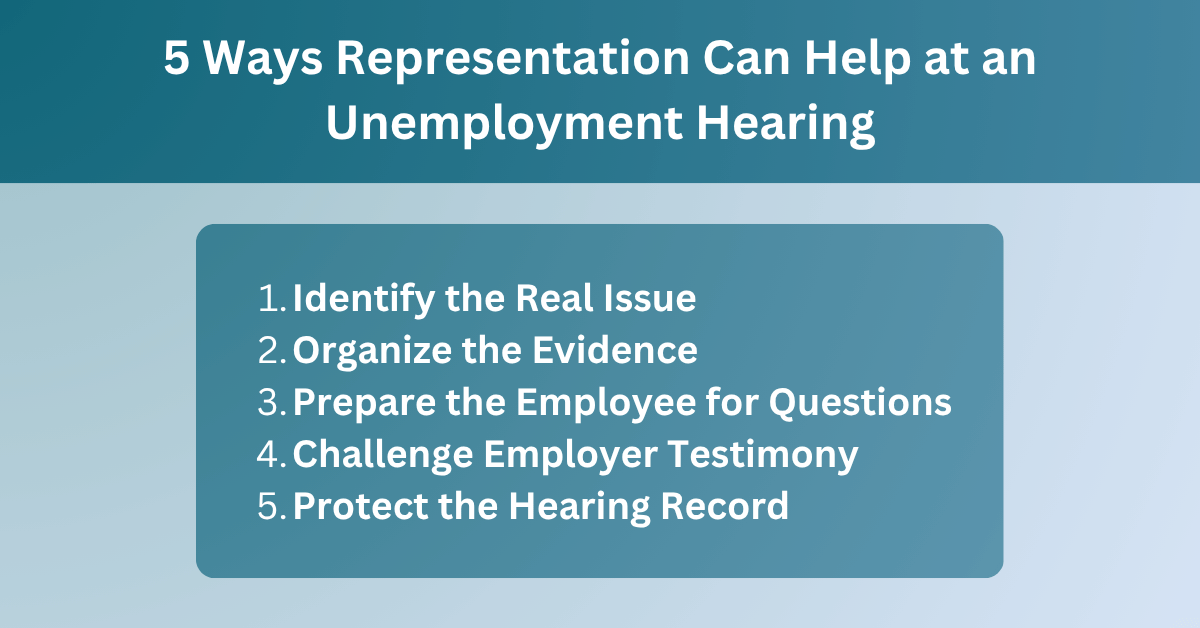
Top 5 Ways Representation Can Help at an Unemployment Hearing
1. Identify the Real Issue
A lawyer can separate the unemployment question from unrelated workplace grievances and concentrate on what the judge must decide.
2. Organize the Evidence
Emails and records become more useful when each one supports a specific point rather than being submitted as a large pile of documents.
3. Prepare the Employee for Questions
Practice helps employees answer directly and avoid giving long, unfocused responses.
4. Challenge Employer Testimony
Questions can expose secondhand information, missing records, inconsistent explanations, or weaknesses in the employer’s timeline.
5. Protect the Hearing Record
What happens at the hearing may matter later if the decision is appealed. Building the record correctly the first time is important.
What Should You Do Before the Hearing?
Once the hearing is scheduled, don’t wait until the day before to prepare.
Start with these steps:
- Read the hearing notice completely.
- Organize the decision and appeal paperwork.
- Build a dated timeline.
- Collect relevant documents.
- Identify witnesses with firsthand knowledge.
- Review statements you already made to the agency.
- Make sure your contact information is current.
- Continue complying with unemployment claim requirements while the appeal is pending.
The Oregon Employment Department advises claimants who disagree with a decision to continue claiming benefits while waiting for the hearing outcome.
Don’t assume the hearing is the only employment issue that needs attention. If the separation involved missing wages, overtime, final pay, or misclassification, those issues may also belong in an Oregon wage claim review.
What Happens After the Hearing?
After the hearing, the administrative law judge issues a written decision.
If either side disagrees, the case may proceed to the Oregon Employment Appeals Board.
The EAB reviews decisions made by administrative law judges in unemployment insurance matters. It generally reviews the record created before the administrative law judge rather than conducting a new hearing.
An application for review generally must be filed within 20 days after the administrative law judge’s order was mailed.
This is why preparation at the first hearing matters.
A party shouldn’t assume they can add missing testimony or evidence later if the result is unfavorable.
When the Unemployment Case Overlaps With Another Employment Claim
An unemployment hearing decides benefit eligibility. It doesn’t necessarily resolve whether an employer violated wage, discrimination, retaliation, leave, or wrongful termination laws.
Still, the same evidence may matter in both disputes.
For example, an employer may state one reason for termination during the final meeting and give another reason during the unemployment process. That inconsistency may deserve closer review.
Keep:
- Agency decisions
- Hearing exhibits
- Employer statements
- Written orders
- Termination paperwork
- Pay records
- Relevant workplace communications
Those records can help an employment attorney determine whether another claim exists separately from the unemployment case.
FAQs
Do I need a lawyer for an Oregon unemployment hearing?
No. Employees can represent themselves. Legal representation may be especially helpful when the employer is actively contesting benefits, facts are disputed, witnesses are involved, or the unemployment dispute overlaps with another employment claim.
Who conducts the unemployment hearing?
An administrative law judge from Oregon’s Office of Administrative Hearings conducts the hearing.
Who has the burden of proof if I was fired?
In a discharge case, the employer generally has the burden of showing that the discharge was for misconduct.
Who has the burden if I quit?
In a voluntary leaving case, the claimant generally has the burden of proving good cause for leaving employment.
Can my former employer testify?
Yes. Employers may participate, present evidence, call witnesses, and respond to the employee’s testimony.
Can I appeal if I lose the hearing?
Yes, depending on the circumstances. A party may generally seek review by the Employment Appeals Board. Review deadlines are short, so read the administrative law judge’s order immediately.
Conclusion
An Oregon unemployment hearing does more than let you explain why losing your job felt wrong. The administrative law judge must decide a specific eligibility issue using the testimony and documents placed into the record.
Effective unemployment hearing representation focuses on that issue from the beginning. A lawyer can review the decision, identify the burden of proof, organize evidence, prepare testimony, question employer witnesses, and make sure the hearing record reflects the facts that matter.
That preparation matters most when an employer alleges misconduct, argues the employee voluntarily quit, or presents records that don’t tell the full story.
Meyer Employment Law represents Oregon employees in disputes that arise when employment ends, including matters involving unemployment, wages, retaliation, and wrongful termination. If your former employer is challenging your version of events, preparing before the hearing can help you understand what you must prove and which records matter most.
About the Author
Robert Meyer is the founder of Meyer Employment Law and has represented Oregon employees in state and federal workplace disputes for more than a decade. His practice includes wrongful termination, retaliation, wage disputes, discrimination, harassment, protected leave, and employment issues that arise when a job ends.
Meyer Employment Law represents employees rather than employers and helps Oregon workers understand their rights and legal options. Learn more about Robert Meyer and the firm’s employee-focused practice on the About Meyer Employment Law page.