The most expensive myth in Oregon workplaces is that overtime for salaried employees does not exist. You get a salary, so you work until the job is done, and the extra hours are simply part of the deal. That is how it was explained to you, and it may be how your manager honestly understands it. It is also wrong often enough that unpaid overtime remains one of the most common wage violations in the country.
Being paid a salary is not what makes someone exempt from overtime. It is one piece of a three-part test, and your employer has to satisfy every part of it. At Meyer Employment Law, we represent Oregon employees in wage claims, including workers who spent years assuming their salary settled the question when it never did.
Also Read
- Salaried Employee Rights in Oregon
- Oregon Exempt vs. Non-Exempt: What Every Worker Needs to Know
- Overtime Laws in Oregon & How to Calculate Overtime Pay
The Short Version
Every salaried employee in Oregon is entitled to overtime pay at one and a half times their regular rate for hours over 40 in a workweek unless the employer can prove the job meets an exemption. Proving it requires three things at once: the worker is paid a true salary that is not docked for partial days, the salary meets the legal minimum of $684 per week under federal law, and the actual day-to-day duties fit the executive, administrative, or professional definitions. Job titles, salary alone, and being told “you are exempt” prove nothing. If the exemption fails on any of the three, the unpaid overtime is owed, and Oregon gives you two years to bring that claim.

The Three Tests Your Employer Has To Pass
Oregon’s white collar exemptions come from ORS 653.020(3) and mirror the federal Fair Labor Standards Act. The Oregon Bureau of Labor and Industries puts the burden squarely where it belongs, stating plainly that all salaried employees must be paid overtime unless they meet the test for exempt status, and that it is the employer’s burden to prove exempt status. You do not have to prove you are entitled to overtime. Your employer has to prove you are not.
Test one: are you actually paid on a salary basis?
A salary is a fixed amount for a period of at least a week that does not go up or down based on the quality or quantity of your work. That last part matters more than most workers realize. If your pay gets reduced when you leave three hours early, or when the business slows down and there is no work available, you may not be paid on a salary basis at all, which means the exemption can collapse even if everything else lines up.
BOLI is specific about this. In private sector jobs, an employer generally cannot reduce an exempt employee’s pay for a partial day absence, and cannot dock pay for a partial week shutdown when the employee is ready, willing, and able to work. Employers can require you to use accrued leave. Reaching into the salary itself is a different matter.
Test two: does your salary clear the legal minimum?
Under the federal rule restored by the Department of Labor in May 2026, most exempt executive, administrative, and professional employees must be paid at least $684 per week, which works out to $35,568 per year. Employers may count nondiscretionary bonuses and commissions toward up to 10 percent of that amount if they are paid at least annually. There is also a separate total annual compensation threshold of $107,432 for certain highly compensated employees.
If you earn less than $684 in a week and you are not in one of the narrow occupations with special rules, the analysis is finished. You are owed overtime for every hour past 40, no matter what your offer letter calls you.
Test three: what do you actually do all day?
This is where most misclassification cases live. The executive exemption requires that management is your primary duty, that you regularly direct the work of two or more employees, and that you have real hiring or firing authority or that your recommendations carry particular weight. The administrative exemption requires office work directly tied to management policies or general business operations, plus the authority to make decisions of significance, and BOLI expressly distinguishes that work from production or sales work. The professional exemption covers advanced knowledge acquired through prolonged specialized study, original creative work, or teaching.
Notice what is absent from all three: your title. A “shift manager” who spends 90 percent of the week running a register, stocking shelves, and working the line alongside everyone else is doing production work with a management label attached. That is the pattern we see constantly in misclassification cases, and it is worth taking seriously.
Not sure whether your job really qualifies as exempt? The classification questions that matter are about your actual duties, not your title or your salary. Learn how Oregon wage claims work and where your situation might fit.
What Actually Happened to the Federal Salary Threshold
If you have read conflicting numbers online, there is a reason. In April 2024, the U.S. Department of Labor issued a rule raising the exempt salary threshold to $844 per week, with a further increase to $1,128 per week scheduled for January 1, 2025, and automatic inflation adjustments after that. Millions of salaried workers were expected to become newly eligible for overtime.
That rule never fully took effect. On November 15, 2024, a federal court in the Eastern District of Texas set it aside nationwide, rolling the threshold back to the 2019 level. The Department of Labor then closed the loop on May 14, 2026, announcing a technical amendment that removed the vacated 2024 language from the regulations and republished the 2019 rule. The operative number today is $684 per week.
The practical consequence for Oregon workers is worth naming. Some employers reclassified staff in 2024 in anticipation of the higher threshold, then quietly reversed course. If your pay structure, hours expectations, or overtime eligibility shifted during that window and nobody explained why, that history is worth a closer look.
Oregon’s Own Salary Floor, and Why the Federal Number Usually Wins
Oregon sets its own minimum salary for exempt status, and it is calculated differently. Under ORS 653.010(9), the required weekly salary is tied to the regional minimum wage multiplied by 2,080 hours, then divided by 12 to produce a monthly figure. Because Oregon uses three minimum wage regions, the state’s exempt salary floor changes depending on where you work.
As of July 1, 2026, Oregon’s minimum wage rates are $16.80 per hour in the Portland metro area, $15.55 in standard counties, and $14.55 in nonurban counties. Run the math on the highest of those and the Portland metro figure comes to $34,944 per year, which still sits below the federal $35,568. When state and federal rules conflict, employers must apply whichever standard benefits the employee, so the federal salary level currently governs across the state.
That does not make Oregon law irrelevant. Oregon’s rules on deductions, rest and meal periods, and final pay all still apply, and they frequently matter more to the outcome of a claim than the threshold itself. Workers who are properly classified as nonexempt, for instance, are also entitled to meal and rest breaks that exempt employees generally do not receive.
How Overtime Is Calculated When You Are Paid a Salary
Once an exemption fails, the salary does not disappear. It becomes the basis for the calculation. BOLI’s method is straightforward: multiply your monthly salary by 12 to get the annual figure, divide by 52 to get the weekly figure, then divide by 40 to reach your regular hourly rate. Overtime is 1.5 times that rate for every hour past 40 in the workweek.
A few details tend to surprise people. Nondiscretionary bonuses have to be folded into the regular rate, which raises the overtime rate above the simple hourly math. The workweek is a fixed, recurring seven-day period chosen by the employer, so pay periods are irrelevant to the calculation. And unauthorized overtime still has to be paid: your employer can discipline you for working hours you were not approved to work, but cannot refuse to pay you for them.
Oregon generally has no daily overtime requirement, with one significant exception. Employees of manufacturing establishments must receive overtime after 10 hours in a day and cannot be worked more than 13 hours in a 24-hour period. Special rules also apply to canneries, hospitals, agricultural work, and public works projects. Private sector employers also cannot offer compensatory time off instead of overtime pay. Only government agencies can do that.
Fired or pushed out after asking about your pay? Raising a wage question is protected activity, and retaliation for it is a separate violation. Talk it through with an Oregon employment attorney in a free, confidential consultation. Contact Meyer Employment Law.
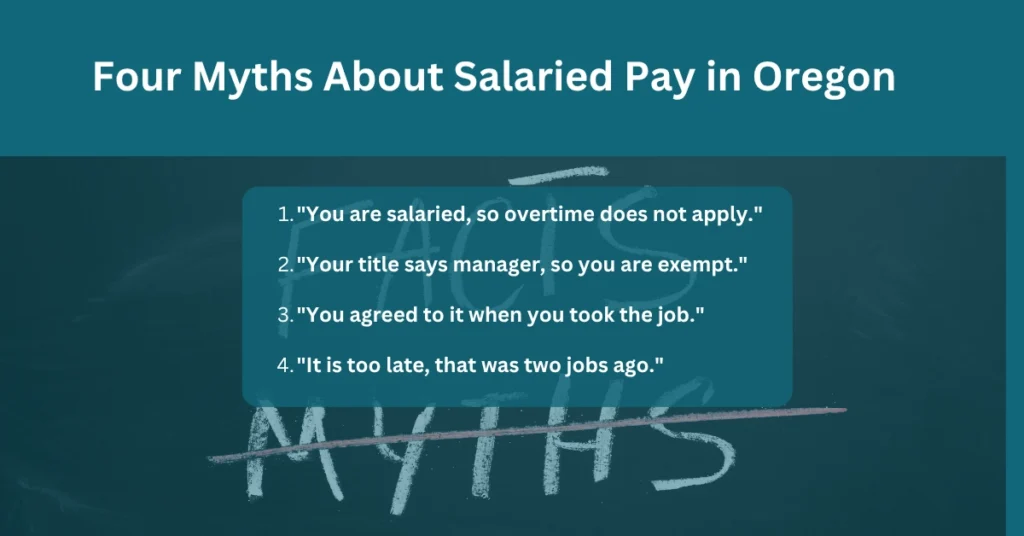
Four Myths About Salaried Pay in Oregon
Myth: “You are salaried, so overtime does not apply.” Salary is one of three tests, not a trump card. A salaried worker who fails the duties test is entitled to overtime regardless of how they are paid.
Myth: “Your title says manager, so you are exempt.” BOLI evaluates what you actually do. A title without genuine management duties, supervision of two or more employees, and real authority does not create an exemption.
Myth: “You agreed to it when you took the job.” You cannot agree away wage and hour protections. An employment agreement does not override the FLSA or ORS chapter 653.
Myth: “It is too late, that was two jobs ago.” Maybe, but check before you assume. Oregon allows two years for overtime claims, and the federal window stretches to three years for willful violations.
What You Can Recover, and How Long You Have
Unpaid overtime claims recover the wages themselves, and Oregon law also provides for liquidated damages, attorney fees, and court costs in appropriate cases. If your employer willfully failed to pay your final wages when your job ended, ORS 652.150 adds penalty wages that continue at eight hours per day at your regular rate for up to 30 days, though an employer can limit that exposure by paying in full within 12 days of written notice from you.
The deadlines are firm. ORS 12.110(3) requires that an action for overtime or premium pay, including penalties or liquidated damages tied to it, be commenced within two years. Under federal law, the FLSA window is two years, extended to three for willful violations. Those clocks are already running while you decide, which is a reason to get clarity early rather than a reason to panic.
The scale of the problem says something about how routine these violations are. The U.S. Department of Labor’s Wage and Hour Division recovered more than $259 million in back wages for nearly 177,000 workers in fiscal year 2025, an average of $1,465 per person and the agency’s highest recovery since 2019. Those are only the cases the federal government touched.
Conclusion
If you are salaried and working well past 40 hours, the question worth asking is not whether you feel like an exempt employee. It is whether your employer could actually prove the exemption if it had to: a true salary, at or above $684 per week, attached to duties that genuinely match the executive, administrative, or professional definitions. When any one of those fails, overtime for salaried employees is not a favor your employer chose not to grant. It is money you already earned.
The workers who get this resolved are usually the ones who asked a question early, before two years quietly passed. Founded by attorney Robert Meyer, Meyer Employment Law represents Oregon employees only, never employers, and handles wage claims across the state with remote consultations available wherever you work.
Think your overtime was never really optional? Bring your pay stubs, your schedule, and your questions. We will look at how you are classified and tell you honestly where you stand. The consultation is free and confidential. Talk with Meyer Employment Law or call (503) 459-4010.