In Oregon, being called an independent contractor—or receiving a 1099—does not necessarily make a worker an independent contractor under the law. Worker classification depends on the actual working relationship and the legal test that applies. Under Oregon law, important factors can include whether the worker is free from direction and control and whether the worker operates an independently established business.
Oregon independent contractor laws matter because misclassification can affect a worker’s rights to wages, overtime, benefits, workers’ compensation, unemployment benefits, and other employment protections. A written independent contractor agreement alone does not necessarily determine a worker’s legal status.
This guide explains Oregon’s independent contractor requirements, the factors used to distinguish employees from independent contractors, common signs of misclassification, and the options workers may have if they believe they have been improperly classified.
Meyer Employment Law represents Oregon workers in employment disputes, including claims involving worker misclassification and unpaid wages. If you have questions about whether you have been properly classified, contact our firm to discuss your situation.
Also Read:
Oregon Labor & Employment Laws: What You Need to Know
Overtime Laws in Oregon & How to Calculate Overtime Pay
Misclassification Lawsuits: Independent Contractor Wrongful Termination
What Is an Independent Contractor Under Oregon Law?
In Oregon, whether someone is an employee or an independent contractor depends on the actual working relationship. A business cannot necessarily make someone an independent contractor simply by giving them that title, paying them with a 1099, or asking them to sign an independent contractor agreement.
One of the key Oregon laws addressing worker classification is ORS 670.600. The statute defines an independent contractor for purposes of laws administered by several Oregon agencies.
In general, the law looks at whether the worker is free from direction and control over how the work is performed, whether the worker operates an independently established business, and whether required licenses or certifications have been obtained.
The details matter. A worker may be treated as an independent contractor by a company but still qualify as an employee under the law.
ORS 670.600 Is Not the Only Worker Classification Test in Oregon
ORS 670.600 is important, but it should not be treated as the only test used to determine whether a worker is an employee or independent contractor in Oregon.
Different laws can apply different standards.
For example, the Oregon Bureau of Labor and Industries explains that wage and hour cases use an economic realities test. This test looks at the economic relationship between the worker and the business. BOLI also identifies a right-to-control test that applies in certain civil rights matters.
This means a worker’s classification can depend on both the facts of the working relationship and the particular legal right at issue.
Oregon’s Independent Contractor Requirements Under ORS 670.600
For the Oregon laws and programs that use ORS 670.600, several requirements may need to be satisfied before a worker qualifies as an independent contractor.
1. Freedom From Direction and Control
A key question is how much control the business has over the way the worker performs the job.
An independent contractor generally must be free from direction and control over the means and manner of providing the services. The person hiring the contractor can specify the desired result, but that is different from controlling how the worker accomplishes it.
For example, requiring a particular result or completion date does not necessarily create an employment relationship. On the other hand, telling a worker exactly when, where, and how to perform the work may indicate a greater level of control.
The State of Oregon provides additional examples in its Independent Contractor Frequently Asked Questions.
2. Operating an Independently Established Business
Oregon law also considers whether the worker is genuinely operating a business that exists independently from the company paying for the services.
Under ORS 670.600, a worker generally must satisfy at least three of five criteria used to determine whether the person is operating an independently established business.
Those criteria consider whether the worker:
- Maintains a qualifying business location
- Bears the risk of loss associated with the business or services
- Provides services to multiple customers or actively markets the business to obtain new customers
- Makes a significant investment in the business
- Has the authority to hire and fire people who perform or assist with the services
There are specific requirements and exceptions within these criteria, so no single factor should be viewed in isolation. The State of Oregon provides more information about independent contractor compliance and ORS 670.600.
3. Required Licenses and Certifications
Some types of work require a professional license, business license, or other certification. When a license is legally required to perform the services, satisfying the applicable licensing requirements may be part of the independent contractor analysis.
Having a license does not automatically make someone an independent contractor, however. A licensed worker may still need to meet the other requirements that apply to the working relationship.
Does Receiving a 1099 Make You an Independent Contractor in Oregon?
No. Receiving a Form 1099 does not automatically mean you are legally an independent contractor.
The same is true if you signed an independent contractor agreement. What the company calls the relationship is relevant, but it does not necessarily decide the issue.
Oregon agencies can look at what actually happens on the job. Factors such as who controls the work, whether the worker operates an independent business, and the particular law involved may all be important.
For example, a company may call a worker an independent contractor and issue a 1099, while still controlling the worker’s schedule, methods, and day-to-day activities. Depending on the circumstances and the law involved, the worker may have been misclassified.
Oregon and Federal Independent Contractor Rules Are Not Always the Same
Worker classification can become confusing because there is not one independent contractor test that applies to every legal issue. A worker may need to be evaluated under Oregon law, federal law, or both, depending on the type of claim or benefit involved.
Oregon Agencies May Use Different Classification Tests
ORS 670.600 provides the independent contractor definition used by several Oregon agencies, including the Oregon Department of Revenue, Oregon Employment Department, Workers’ Compensation Division, Construction Contractors Board, and Landscape Contractors Board.
However, not every Oregon employment issue is decided under ORS 670.600. The State of Oregon specifically notes that different agencies may use different criteria when determining whether someone is an employee or an independent contractor.
For wage and hour matters, the Oregon Bureau of Labor and Industries uses an economic realities test. This analysis focuses on whether the worker is economically dependent on the business or is genuinely operating an independent business.
BOLI uses a different right-to-control analysis for certain civil rights matters. As a result, the legal test that applies can depend on the specific rights or benefits at issue.
Federal Law Has Its Own Classification Rules
Federal law may also apply to the same working relationship.
For claims involving federal minimum wage and overtime protections, the U.S. Department of Labor applies an economic realities analysis under the Fair Labor Standards Act. The central question is whether the worker is economically dependent on the employer for work or is instead in business for themselves.
This means a company cannot determine a worker’s legal status simply by issuing a Form 1099, using an independent contractor agreement, or describing the worker as self-employed. The facts of the relationship matter.
Why the Different Tests Matter
Consider a worker who is labeled an independent contractor and receives a 1099. That classification could raise different questions depending on whether the dispute involves unpaid overtime, unemployment benefits, workers’ compensation, taxes, or another workplace right.
The correct analysis therefore starts with two questions:
- What does the working relationship actually look like?
- Which law or agency’s classification test applies to the issue?
This is one reason independent contractor disputes can be more complicated than they initially appear. A worker who has been treated as an independent contractor may still have rights as an employee under the law that applies to the particular claim.
Examples of Employee vs. Independent Contractor Classification in Oregon
Worker classification depends on the specific facts of each working relationship. No single fact, such as receiving a 1099, setting your own hours, or using your own tools, automatically determines whether you are an employee or an independent contractor.
The following examples illustrate some of the differences that may be relevant when evaluating a worker’s status.
Example 1: Construction Worker
Suppose a construction company hires a worker, calls him an independent contractor, and pays him with a 1099. The company tells him when to report to work, assigns his daily tasks, supervises how the work is performed, and expects him to work primarily for that company.
Those facts may point toward an employment relationship, even though the worker is called an independent contractor.
Now consider a contractor who operates a separate business, works for several customers, negotiates prices for individual projects, controls how the work is completed, makes a significant investment in the business, and carries the licenses required for the work.
Those facts may be more consistent with operating an independent business.
Example 2: Freelance Web Designer
A web designer operates her own business and provides services to several companies. She advertises her services, negotiates project fees, decides when and where she works, uses her own equipment, and can accept or reject projects.
Those circumstances may support independent contractor status.
The situation could look different if a company requires the designer to work a regular schedule, closely supervises her daily work, restricts her ability to work for other clients, and treats her as part of its regular workforce.
Calling the designer a “freelancer” would not resolve the classification question. The actual relationship still matters.
Example 3: Salon Worker
Consider a hairstylist who rents a chair at a salon but operates a separate business. The stylist maintains a client list, sets prices and hours, purchases supplies, carries appropriate licenses or insurance, and is free to serve clients elsewhere.
Those facts may be consistent with an independent business.
On the other hand, simply renting a chair does not automatically make a stylist an independent contractor. If the salon controls the stylist’s schedule, prices, customers, products, and manner of providing services, the classification may require closer examination.
The State of Oregon provides additional industry-specific examples of factors that may affect independent contractor classification, including examples involving salon workers, construction, software development, caregivers, transportation, sales, and other types of work.
The Facts Matter More Than the Job Title
These examples show why worker classification cannot be determined from a job title alone. Two people doing similar work can have very different working relationships.
Oregon agencies may consider factors such as who controls the work, whether the worker has other customers, who determines the rate of pay, who provides equipment, whether the worker has invested in a separate business, and whether the worker has an opportunity for profit or loss.
The legal test also depends on the particular law involved. For that reason, these examples should not be treated as a checklist that automatically determines whether someone is an employee or independent contractor.
Why Worker Classification Matters
The distinction between an employee and an independent contractor can affect important workplace rights and responsibilities. Misclassification may affect issues such as minimum wage, overtime, unemployment insurance, workers’ compensation, payroll taxes, and other employment protections.
Because Oregon uses different classification standards in different contexts, determining a worker’s status often requires looking closely at both the working relationship and the specific legal claim involved.
If you believe you have been treated as an independent contractor when you should have been classified as an employee, Meyer Employment Law can evaluate the circumstances of your working relationship and explain what rights may apply.
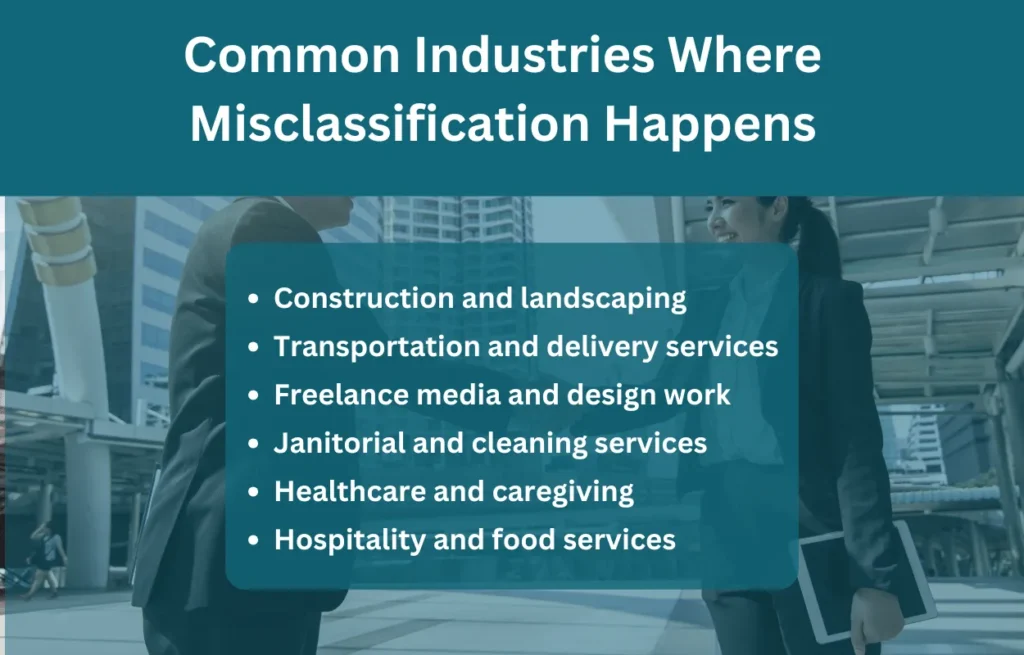
Common Industries Where Misclassification Happens
Some industries are more prone to misclassification, including:
-
- Construction and landscaping
-
- Transportation and delivery services
-
- Freelance media and design work
-
- Janitorial and cleaning services
-
- Healthcare and caregiving
-
- Hospitality and food services
In many cases, businesses retain significant control over the worker’s schedule, methods, or tools—signs that the worker should be classified as an employee under Oregon law.
Legal Protections for Misclassified Workers
If you believe you’ve been misclassified, you may be entitled to compensation. Oregon workers who should have been classified as employees can pursue claims for:
-
- Unpaid wages and overtime
-
- Reimbursement for business expenses
-
- Retroactive benefits (such as sick leave or health insurance)
-
- Penalties and interest
-
- Attorney’s fees and court costs
In many cases, multiple workers in the same company may be affected, potentially opening the door for class action lawsuits.

What to Do If You Suspect Misclassification
If you’re unsure whether you’ve been properly classified, take these steps:
-
- Review Your Work Arrangement
Look closely at your contract, job duties, and how much control the company has over your day-to-day work.
- Review Your Work Arrangement
-
- Document Everything
Keep records of communications, payments, work schedules, and who provides tools or equipment.
- Document Everything
-
- Seek Legal Advice
Misclassification cases can be complex. Consulting with an experienced employment attorney is the best way to understand your options,
- Seek Legal Advice
Frequently Asked Questions About Oregon Independent Contractor Laws
Does receiving a 1099 mean I am an independent contractor in Oregon?
No. Receiving a Form 1099 does not automatically make someone an independent contractor. Worker classification depends on the actual working relationship and the legal standard that applies.
A company may issue a 1099 and call someone an independent contractor, but those labels do not necessarily determine the worker’s legal status.
Does an independent contractor agreement make me an independent contractor?
Not necessarily. A written contract can describe the relationship between a worker and a business, but the language in the agreement is not the only consideration.
Oregon agencies may look at how the relationship works in practice, including the degree of control over the work and whether the worker is actually operating an independent business. The Oregon Bureau of Labor and Industries explains the factors it considers when distinguishing employees from independent contractors.
Can an independent contractor receive overtime pay in Oregon?
True independent contractors generally are not covered by the employee overtime protections of state and federal wage laws. However, a worker who has been incorrectly classified as an independent contractor may still qualify as an employee and may have a claim for unpaid overtime.
Whether overtime is owed depends on the worker’s proper classification, the hours worked, and whether an overtime exemption applies.
What are some signs that I may have been misclassified?
Misclassification may be worth investigating when a business calls a worker an independent contractor but exercises significant control over the working relationship.
For example, questions may arise when the business controls how the work is performed, requires a set schedule, closely supervises the worker, restricts the worker’s ability to serve other customers, or otherwise treats the worker much like an employee.
No single factor automatically proves misclassification. The applicable legal test and the overall working relationship must be considered.
What rights could I have if I was misclassified as an independent contractor?
The answer depends on the circumstances and the law involved. Misclassification can potentially affect rights involving minimum wage, overtime, unemployment insurance, workers’ compensation, taxes, and other workplace protections.
For wage and hour issues, workers can find additional information through the Oregon Bureau of Labor and Industries Wage and Hour Division.
Where can I report independent contractor misclassification in Oregon?
The appropriate agency depends on the type of problem involved.
For example, wage and hour complaints may fall within the jurisdiction of the Oregon Bureau of Labor and Industries. Unemployment insurance, workers’ compensation, and tax matters may involve other Oregon agencies.
The State of Oregon provides information about independent contractor laws, agency responsibilities, and worker classification.
A worker may also choose to speak with an employment attorney about the circumstances before deciding how to proceed.
Can my employer make me become an independent contractor?
Simply changing a worker’s title, issuing a 1099, or asking the worker to sign a new agreement does not necessarily change the worker’s legal classification.
If the working relationship continues to function like an employment relationship, the worker may still qualify as an employee under the legal test that applies.
Can I be an independent contractor if I only work for one company?
Working for only one company does not necessarily settle the classification question by itself. The analysis can involve several factors, and the applicable test depends on the law at issue.
For purposes of ORS 670.600, Oregon’s independently established business requirements address issues such as providing services to multiple customers or routinely advertising and promoting the business, along with several other statutory criteria. You can review the requirements in ORS 670.600.
How do I know whether I have been misclassified?
There is rarely one fact that answers the question. Determining worker status can require looking at how much control the company exercises, how the worker’s business operates, the financial relationship between the parties, and which Oregon or federal law applies.
If you believe you have been classified as an independent contractor but are being treated like an employee, an employment attorney can review the facts and explain which classification rules may apply.
At Meyer Employment Law, we’ve helped Oregon workers recover unpaid wages and fight back against employer abuse of the independent contractor label.
Protecting Worker Rights in Oregon
The line between employee and independent contractor isn’t always clear but Oregon law provides strong protections against misclassification. If you’ve been denied basic workplace rights because of your classification, you may have legal recourse.
Meyer Employment Law is committed to helping Oregon workers navigate the complexities of employment law. We offer experienced, compassionate legal support for those who’ve been misclassified and want to assert their rights. Contact us today to schedule a consultation and learn how we can help.