Whistleblowing in the workplace can protect the public and your coworkers, but it can also put your job at risk if your employer retaliates. Here is what Oregon employees should know before reporting misconduct, how to document concerns, and what to do if retaliation happens.
If you are considering whistleblowing in the workplace, you are probably weighing two things at once: doing the right thing and protecting your livelihood. Oregon law and federal law provide important protections for employees who report violations of law or workplace safety concerns in good faith, and those protections often apply even if the report is not ultimately substantiated.
This guide walks through the practical steps Oregon employees should take before reporting misconduct, the legal protections that may apply, and how to respond if your employer retaliates.
Read More from Meyer Employment Law:
- Retaliation for Reporting Harassment in Oregon
- Unsafe Work Environments in Oregon: Your Right to Refuse
- How to Report Workplace Discrimination in Oregon (Step by Step)
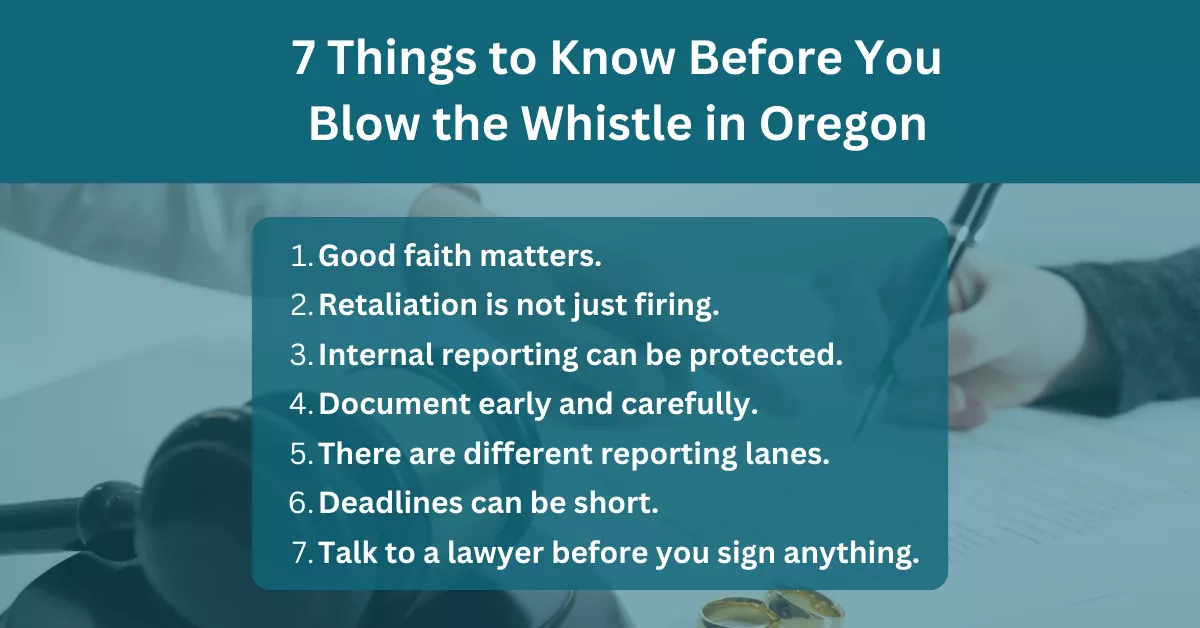 7 Things to Know Before You Blow the Whistle in Oregon
- Good faith matters. Oregon whistleblowing protections generally apply when you report information you reasonably believe is evidence of a violation of state or federal law, rule, or regulation.
- Retaliation is not just firing. Demotions, pay cuts, sudden discipline, isolation, and schedule changes can also count as retaliation.
- Internal reporting can be protected. Reporting concerns to a supervisor or HR can be protected activity under Oregon whistleblower rules when done in good faith.
- Document early and carefully. Your notes, emails, texts, and witness statements can become key evidence if retaliation occurs.
- There are different reporting lanes. Some issues go to internal compliance, some to BOLI, and some to federal agencies like OSHA.
- Deadlines can be short. Some retaliation complaints, especially federal ones, have strict filing windows. Do not wait to get advice.
- Talk to a lawyer before you sign anything. Severance agreements and releases after a retaliation event can waive claims if you are not careful.
What Counts as Whistleblowing in the Workplace
“Whistleblowing in the workplace” usually means reporting misconduct that implicates law, safety, fraud, or regulatory violations. In Oregon, whistleblower protections often focus on reports of violations of law and certain safety dangers, when made in good faith.
Examples that commonly trigger whistleblower concerns include:
- Reporting wage theft or recordkeeping fraud
- Reporting discrimination or harassment, or participating in an investigation
- Reporting safety hazards, unsafe staffing, or dangerous equipment
- Reporting billing fraud or improper charges involving public funds
- Reporting violations of licensing rules or regulated practices
Not every workplace complaint is whistleblowing. A disagreement about management style is different from reporting a violation of law. That said, many situations overlap. For example, “unfair treatment” can become legally protected activity if it involves discrimination, harassment, or retaliation.
Oregon Whistleblower Protections: The Core Rules
ORS 659A.199 and Oregon’s whistleblowing rules
Oregon’s whistleblowing protections are reflected in ORS 659A.199, and the related administrative rules explain that employers in Oregon generally may not discharge, demote, suspend, or otherwise retaliate against an employee because the employee, in good faith, reported information they believe is evidence of a violation of law.
BOLI also emphasizes a key point for employees: a report does not have to be substantiated for whistleblower protection to apply, as long as the employee had a good faith belief when reporting.
You may have options through BOLI or court
BOLI explains that employees may have civil rights protections if they experience retaliation due to protected whistleblowing activity, including filing with BOLI or suing in circuit court.
Because the right forum and deadlines can vary depending on the facts, it is often worth speaking with an employment lawyer before you file or immediately after the first signs of retaliation.
Federal Protections: OSHA and other whistleblower laws
Some workplace reports are protected by federal law as well. OSHA’s whistleblower program covers retaliation protections under many statutes, including safety-related protections. OSHA notes that Section 11(c) of the OSH Act prohibits retaliation against employees who complain about unsafe or unhealthful conditions or exercise rights under the Act.
If your report relates to workplace safety or health hazards, you may be able to file a complaint through OSHA’s whistleblower complaint process.
Before You Report: Practical Steps to Protect Yourself
Whistleblowing in the workplace is not only a moral decision. It is a strategic decision. The strongest cases are usually the ones that are documented, timely, and carefully reported.
1) Identify the issue clearly
Write down what you believe is happening and why you believe it violates a law, regulation, safety rule, or policy tied to legal compliance.
Helpful questions:
- What exactly happened?
- When did it happen?
- Who was involved?
- What rule, law, or safety standard is implicated?
2) Preserve evidence legally and safely
Evidence can include:
- Emails, Slack messages, texts (screenshots with dates if possible)
- Photos of safety hazards (only if allowed and safe)
- Schedules, time records, pay stubs
- Written policies or handbooks
- Names of witnesses and what they observed
Do not forward confidential client lists or protected health information to yourself. Evidence gathering should be careful and legal. If you are unsure, talk to an attorney first.
3) Choose the right reporting channel
You can often report:
- Internally (HR, compliance hotline, supervisor, board, ethics officer)
- Externally (BOLI, OSHA, or another agency depending on the misconduct)
Oregon’s administrative whistleblowing rule specifically addresses good faith reports “to anyone” of an apparent violation of law, which can include internal reporting in many circumstances.
4) Report in writing when possible
A written report creates a timestamped record. Keep a copy of what you submitted and any responses.
If you must report verbally, follow up with an email summarizing what you reported and when.
5) Expect the “retaliation zone” after reporting
Retaliation often appears within days or weeks of a report. Common patterns include:
- Suddenly “documenting” performance issues
- Moving you off projects
- Cutting hours
- “Restructuring” your role
- Increased scrutiny or discipline
The key is to document the timeline and compare treatment before and after the report.
 If Retaliation Happens: What to Do Next
Step 1: Document the retaliation
Keep a timeline of adverse actions and save evidence. This is often the difference between a strong retaliation claim and a weak one.
Step 2: Do not resign impulsively
Many employees feel pushed out. In some cases, quitting can be framed as voluntary unless you have clear evidence that working conditions became intolerable. Talk to counsel before you resign.
Step 3: Escalate internally (when safe)
If you reported to a manager, escalate to HR or a higher-level contact. If HR is involved in the retaliation, external reporting may be safer.
Step 4: Consider agency or legal action
Depending on the type of report and retaliation:
- You may be able to file through BOLI’s whistleblowing protections process.
- You may be able to file through OSHA’s whistleblower complaint process for safety-related reports.
Step 5: Talk to a lawyer early
Early legal guidance can help you:
- Preserve claims and meet deadlines
- Avoid common traps (including broad releases)
- Build a litigation-ready record
- Reduce the risk of further retaliation
How Meyer Employment Law Can Help
Meyer Employment Law represents Oregon employees in retaliation cases, including whistleblower retaliation. If you were punished at work for speaking up, reporting discrimination or harassment, raising safety concerns, or taking protected leave, you may have a workplace retaliation claim.
If you are considering whistleblowing in the workplace, we can help you:
- Evaluate whether your report is protected activity
- Plan a reporting strategy that preserves evidence
- Respond to retaliation and document damages
- Pursue relief through negotiation, agency action, or litigation
Conclusion
Whistleblowing in the workplace can be the right thing to do, and Oregon employees have meaningful legal protections when they report misconduct in good faith. The smartest approach is usually a careful one: document what you are seeing, report through the right channel, and get legal advice early if the stakes are high or retaliation begins.
If you believe you are facing retaliation after reporting misconduct, you do not have to navigate it alone. Contact us today to learn more about how we can support you through your protections as a whistleblower in the workplace.
FAQs
Is my report protected if the misconduct is not proven?
Often yes. BOLI explains that a report does not have to be substantiated for whistleblower protection to apply, as long as you had a good faith belief when reporting.
Do I have to report to the government, or is internal reporting protected?
Oregon’s whistleblowing rules can protect good faith reports to “anyone,” which may include internal reporting channels.
What actions count as retaliation?
Retaliation can include firing, demotion, discipline, reduced hours, hostile treatment, or other negative actions tied to your report.
What if my report is about unsafe working conditions?
Safety-related complaints may also be protected under federal OSHA whistleblower laws, and OSHA provides an online complaint form.
Should I quit if the workplace becomes hostile after I report?
Do not rush to resign. Quitting can create legal complications. Talk to a lawyer first to evaluate your options and preserve claims.